
Table of Contents
- What is a virtual receptionist?
- What is an AI receptionist?
- Virtual receptionist vs AI receptionist: the 2026 comparison
- How much does each one cost?
- Which handles call volume and after-hours better?
- When a virtual receptionist still makes sense
- When an AI receptionist is the better choice
- How to switch, in five low-risk steps
- Frequently asked questions
A virtual receptionist is a remote human who answers your calls; an AI receptionist is software that answers and books them automatically using conversational AI. In 2026, most businesses use AI for 24/7 coverage, instant answers, and flat pricing at scale, and keep humans for complex, high-empathy calls. Many run both.
See MIA answer, book, and route a real call — book a demo →
Key takeaways
- A virtual receptionist is a person; an AI receptionist is software — that one difference drives cost, speed, and scale.
- AI answers every call instantly, handles many at once, and never sleeps; human services bill per minute and can queue at peak.
- Cost flips with volume: per-minute human pricing overtakes a flat AI plan after roughly a few hours of calls a month.
- Humans still win on nuance — angry callers, judgment calls, and sensitive conversations.
- The lowest-risk move in 2026 is hybrid: AI for after-hours and overflow, humans for daytime complexity.
If you are comparing a virtual receptionist against an AI receptionist, you are really choosing between a remote person and a piece of software that answers your phone. Both keep callers from hitting voicemail. They differ sharply on cost, hours, and how many calls they can take at once. This guide breaks down the two side by side, shows where each one wins in 2026, and gives you a low-risk way to switch.
What is a virtual receptionist?
A virtual receptionist is a trained person who answers your calls remotely, usually through an answering service that charges by the minute or by the call.
They greet callers, take messages, book appointments, transfer urgent calls, and screen spam. You get real human warmth and judgment, which matters on sensitive or complicated calls.
The trade-offs are practical. One agent handles one caller at a time, so busy periods can queue. Coverage often stops at business hours unless you pay extra for nights and weekends. And because pricing is usually per minute, your bill climbs as call volume grows.
What is an AI receptionist?
An AI receptionist is software that answers calls with a natural voice, understands what the caller wants, and completes tasks like booking, routing, and answering FAQs — 24/7.
It runs on conversational AI and connects to your calendar, CRM, or practice-management system. SuperMIA's MIA voice agent answers instantly, takes unlimited calls at the same time, logs each one, and never calls in sick. If you want the deeper difference between a voice agent and a simple bot, see our voice agent vs bot breakdown.
Where does it struggle? Truly novel or emotional calls still need a person, so a good setup keeps a warm-transfer path to a human. Setup and clear instructions matter too — the AI is only as good as the workflow behind it.
Virtual receptionist vs AI receptionist: the 2026 comparison
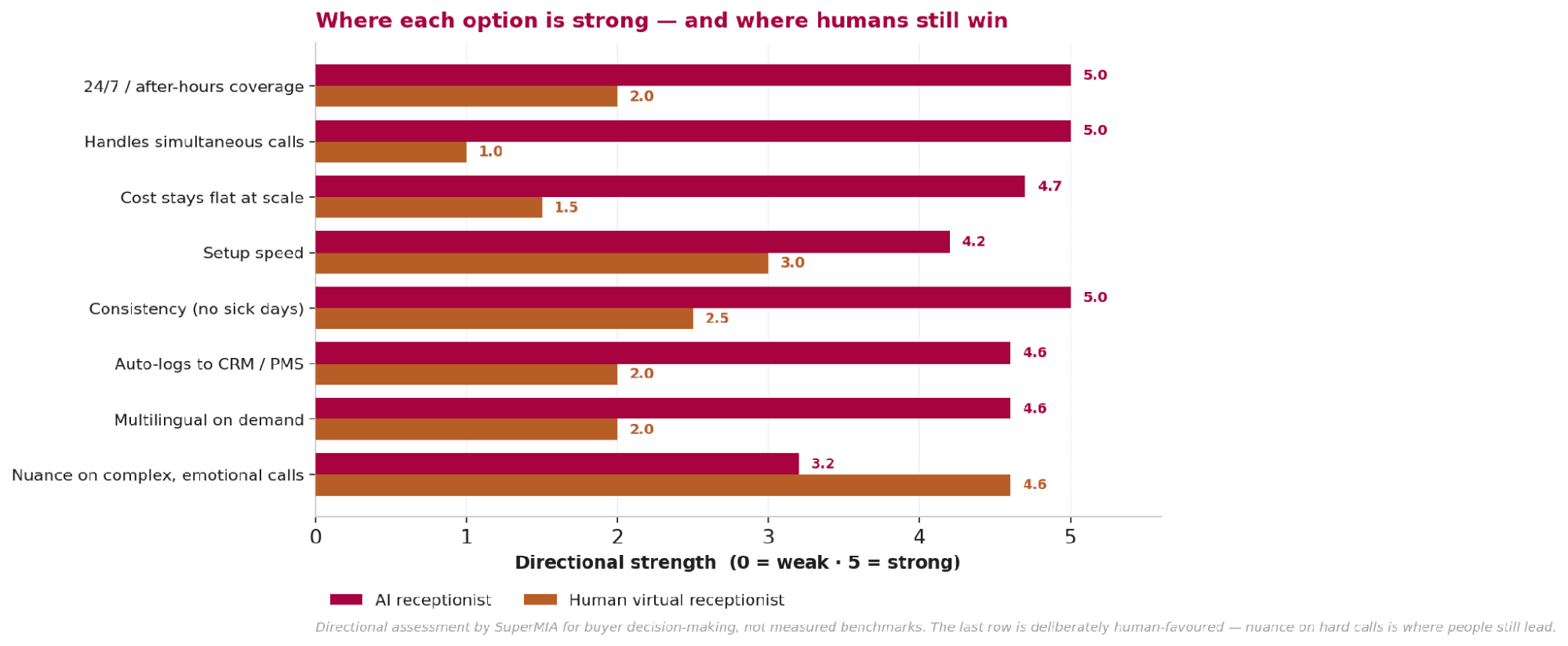
Here is the side-by-side. The last two rows show where a human still holds an edge.
| Factor | Virtual receptionist (human) | AI receptionist (SuperMIA) |
|---|---|---|
| Who answers | A remote person | Conversational AI software |
| Availability | Business hours; after-hours costs extra | 24/7, including nights and weekends |
| Simultaneous calls | One per agent — can queue | Unlimited at once |
| Pricing model | Per minute or per call | Flat monthly plan |
| Cost at scale | Rises with volume | Stays steady |
| Booking / scheduling | Manual, if trained | Automatic, via calendar + CRM/PMS |
| Call logging | Manual notes | Auto-logged to your system |
| Multilingual | Depends on staff | On demand |
| Setup time | Onboarding + scripts | Connect stack + instructions |
| Complex, emotional calls | Strong — human judgment | Good, with warm transfer |
| Consistency | Varies; sick days, turnover | Same every call |
How much does a virtual receptionist vs AI receptionist cost?
Human virtual receptionist services usually bill per minute or per call, so cost rises with volume; AI receptionists usually charge a flat monthly fee, so cost stays steady as calls grow.
That difference creates a break-even point. Below a few hours of calls a month, a light human plan can be cheap. Above it, the per-minute meter keeps running while a flat AI plan does not.
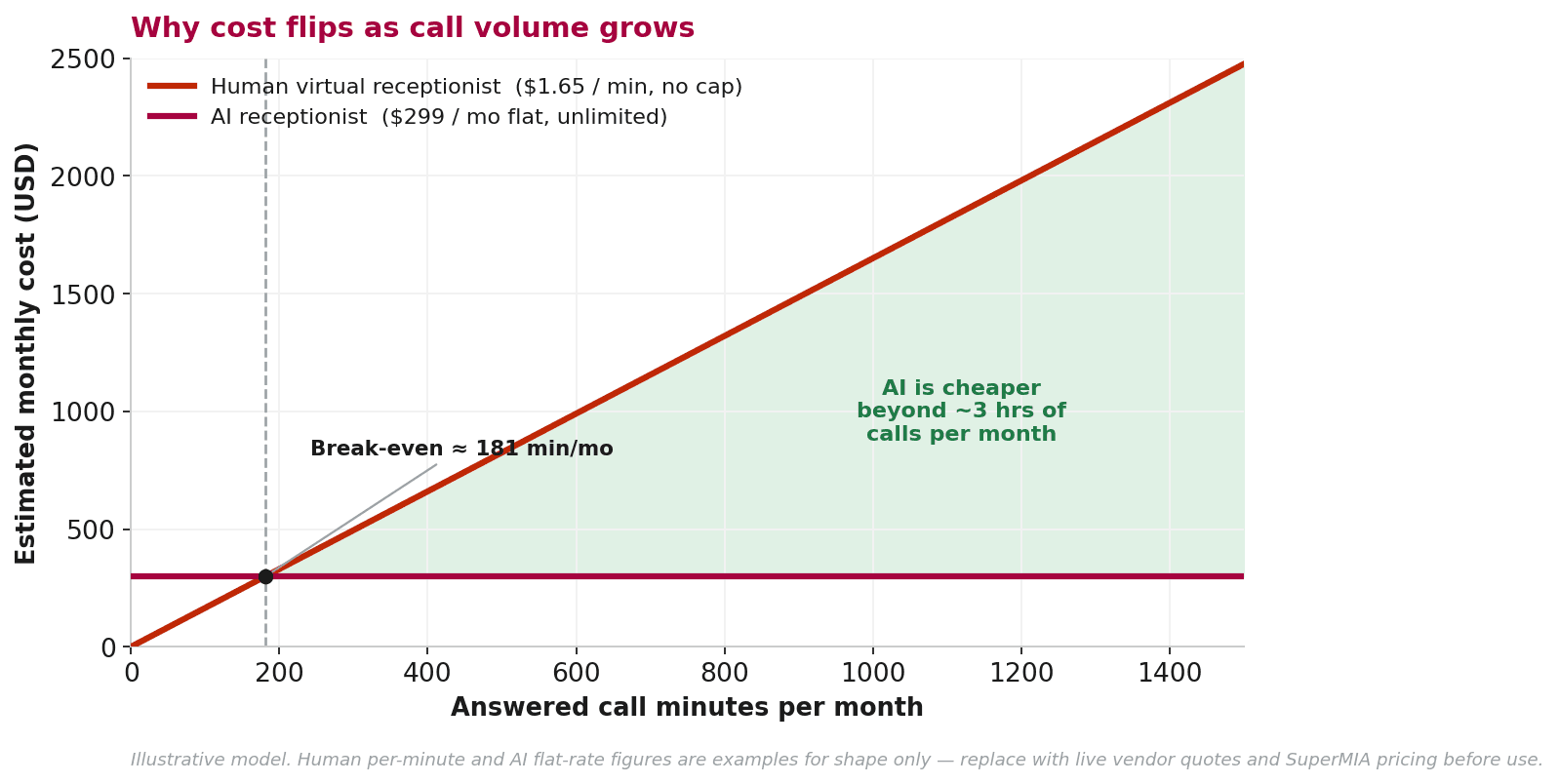
Read the model honestly. The figures above are illustrative, to show the shape of the curve — not vendor quotes. Pull your own call minutes and compare against real prices, including SuperMIA's. Check current plans on the SuperMIA pricing page and run your own numbers before deciding.
Which handles call volume and after-hours better?
An AI receptionist handles unlimited calls at once and answers 24/7, so it wins on volume and after-hours; a human service queues callers and often charges extra for nights and weekends.
This is where most missed revenue hides. Many callers who reach voicemail after hours simply don't call back — they call the next business instead. An always-on AI receptionist answers that call, books it, and logs it, so the lead never leaks.
For high-value front desks like medical and dental, see how this plays out on our AI receptionist for medical & dental front desks page, or watch MIA handle live calls in this property-management use case.
When a virtual receptionist still makes sense
A human virtual receptionist is the better fit when most of your calls are complex, sensitive, or need real human judgment.
- Emotional or high-stakes intake — legal, crisis, or grief-adjacent calls where tone matters more than speed.
- Very low call volume — if you take only a handful of calls a week, a light human plan may be simplest.
- Highly bespoke conversations that change every time and resist any script or workflow.
If that sounds like your front desk, a human service — or a hybrid — is the honest recommendation.
When an AI receptionist is the better choice
An AI receptionist is the better choice when you miss calls after hours, get the same questions repeatedly, book a lot of appointments, or want costs that don't climb with call volume.
- You lose calls at night, on weekends, or during lunch rushes.
- A big share of calls are FAQs, bookings, or routing — repeatable work.
- Call volume is growing and per-minute human pricing is starting to hurt.
- You want every call logged to your CRM or PMS automatically.
If two or more of those fit, SuperMIA's AI chat agent and voice agent can cover the repeatable calls while your team handles the rest.
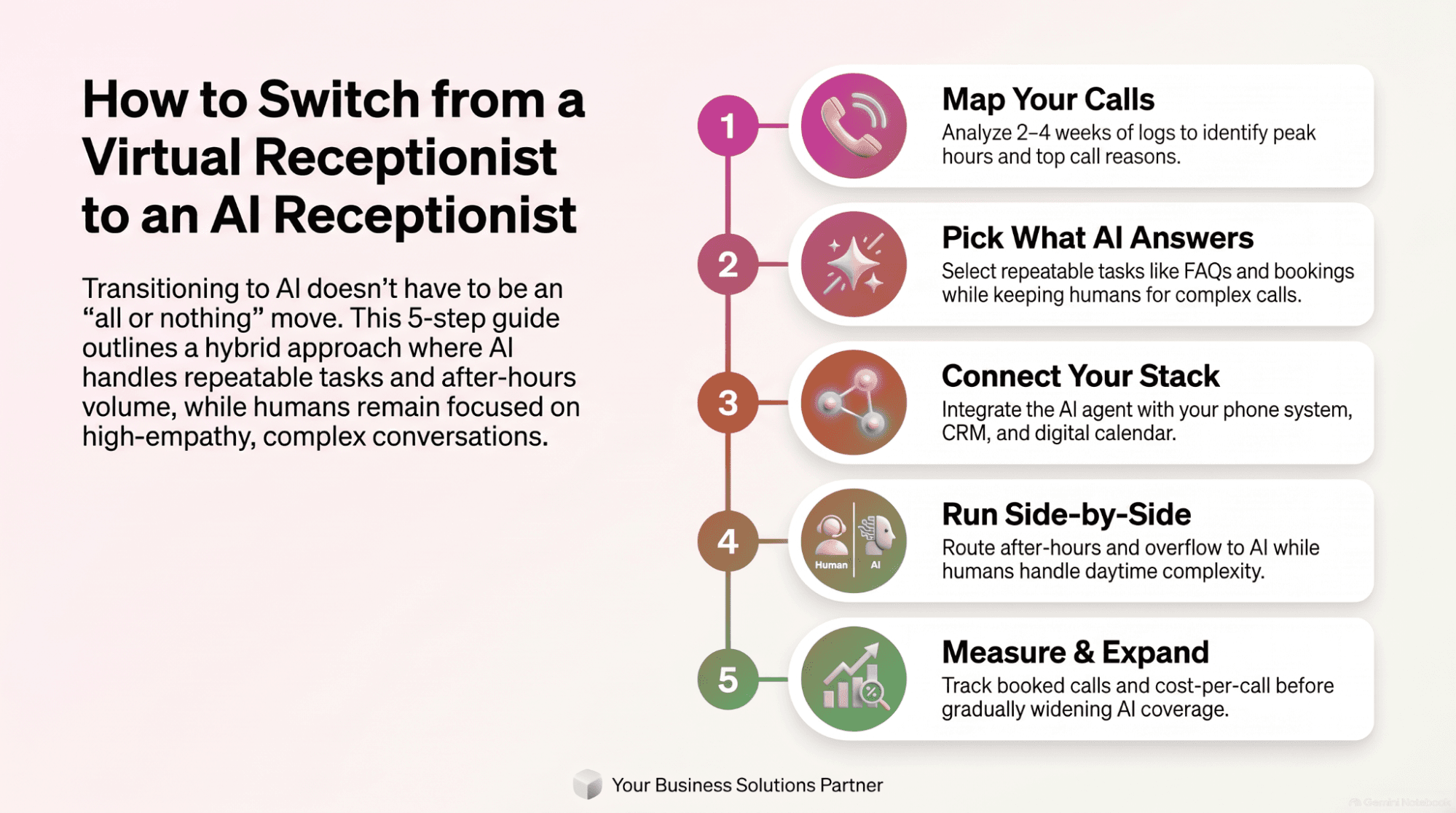
How to switch from a virtual receptionist to an AI receptionist
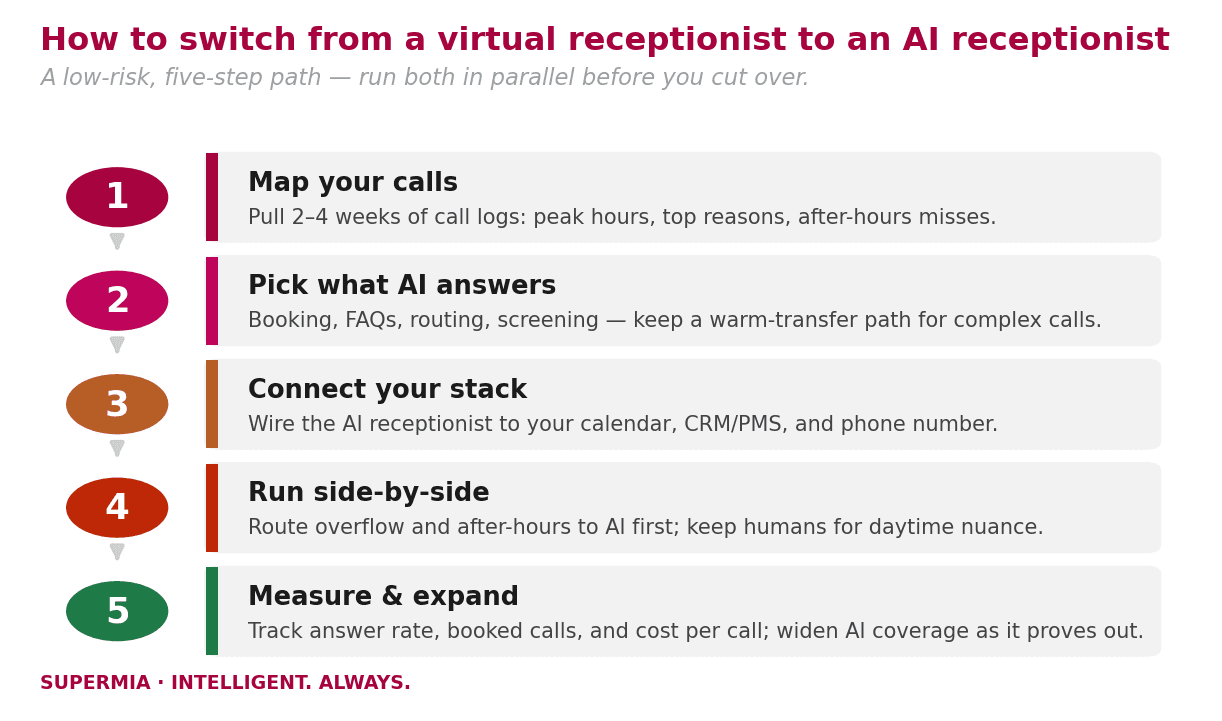
Switch in five low-risk steps — run both in parallel before you cut over.
- Map your calls. Pull 2–4 weeks of call logs: peak hours, top reasons, and after-hours misses.
- Pick what AI answers. Choose booking, FAQs, routing, and screening, and keep a warm-transfer path for complex calls.
- Connect your stack. Wire the AI receptionist to your calendar, CRM or practice-management system, and phone number.
- Run side-by-side. Route overflow and after-hours calls to AI first, and keep humans for daytime nuance.
- Measure and expand. Track answer rate, booked calls, and cost per call, then widen AI coverage as it proves out.
Frequently asked questions
What is the difference between a virtual receptionist and an AI receptionist?
A virtual receptionist is a remote human who answers your calls; an AI receptionist is software that answers and completes calls automatically. The human offers judgment and warmth; the AI offers 24/7 coverage, instant answers, and flat pricing at scale.
Is an AI receptionist cheaper than a virtual receptionist?
Usually at higher call volumes. Human services bill per minute or per call, so cost rises with volume. AI receptionists typically charge a flat monthly fee, so they become cheaper once you pass roughly a few hours of calls a month. Compare against your own call minutes.
Can an AI receptionist book appointments?
Yes. A modern AI receptionist connects to your calendar and CRM or practice-management system, checks availability, books or reschedules, and logs the call automatically.
Will callers know they are talking to an AI?
Often not at first, because modern voice AI sounds natural. Being upfront that it is an assistant, and offering a fast path to a human, builds trust and keeps hard calls covered.
Can I use both a virtual receptionist and an AI receptionist?
Yes, and many businesses do. A common setup sends after-hours and overflow calls to AI and keeps humans for daytime and complex calls. This is the lowest-risk way to cut over.
Is an AI receptionist HIPAA compliant for medical or dental offices?
It depends on the vendor and plan. SuperMIA is designed to support HIPAA-aligned workflows, with a BAA available on eligible plans. Confirm safeguards and sign a BAA before handling protected health information.
Bottom line: in 2026, the receptionist is becoming software for most repeatable calls, while people stay on the hard ones. The safest way to find out where your front desk lands is to hear an AI receptionist handle your real calls.
Hear MIA answer, book, and route a real call — book a demo →

Urvil Dhanani
Urvil Dhanani is the AI/ML Lead at SuperMIA, focused on the architecture behind reliable conversational AI - agent design patterns, voice and chat orchestration, and platform evaluation. He writes practical, vendor-neutral guides that help technical teams build and choose AI systems that hold up in production.