
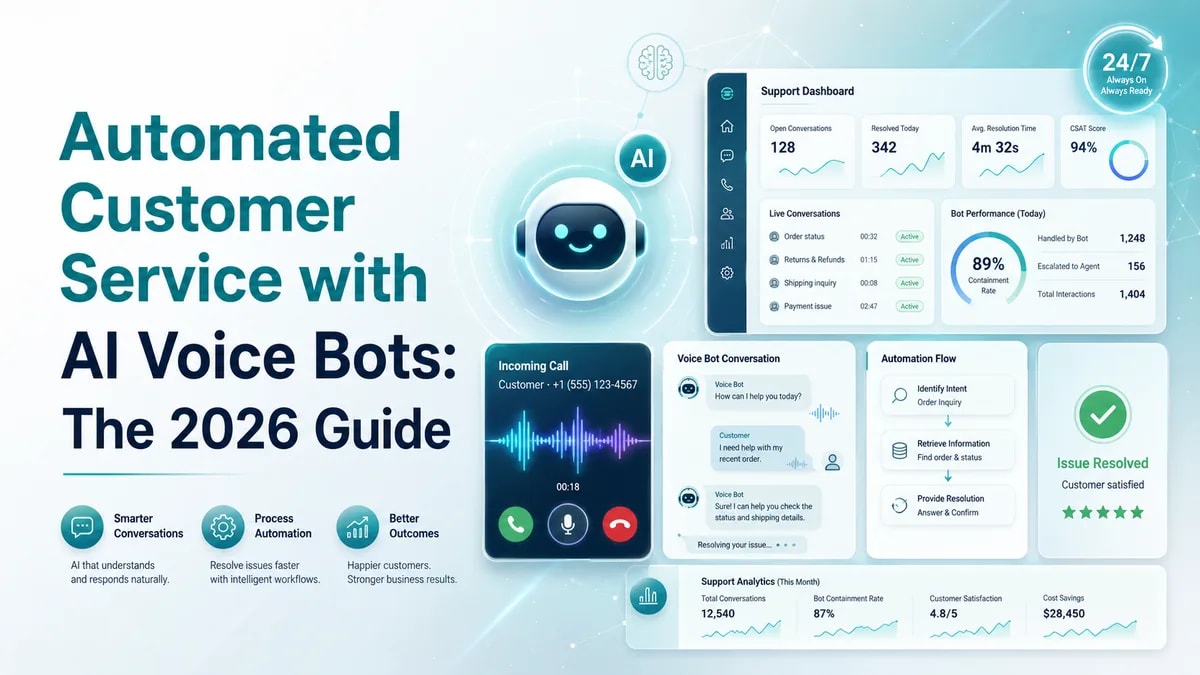
Quick answer. Automated customer service uses AI to handle routine support contacts — like order status, rescheduling, or billing questions — without a human agent. An AI voice bot answers the call, understands the request in natural speech, resolves it or routes to a person, and updates your systems. It runs 24/7, cuts wait times, and frees agents for complex issues.
Key takeaways
- Automated customer service handles routine contacts end to end; humans take the complex, emotional ones.
- A modern AI voice bot replaces rigid IVR menus with natural conversation — callers just say what they need.
- The economics are real: Gartner projects ~$80B in call-center labor savings, with multi-hundred-percent ROI reported.
- The win is the execution layer — updating the CRM, booking, confirming — not just answering.
- Measure containment, first-call resolution, and CSAT; keep a clean path to a human for everything else.
An AI voice assistant for customer service is no longer experimental — it's the fastest way to give callers clear answers without long holds, repeated transfers, or menu mazes. This guide covers how it works, where it helps, what it costs, what to measure, and where a human still wins. For the full landscape of the technology, see our complete guide to AI voice agents.
What is automated customer service?
Automated customer service is the use of AI to resolve routine support contacts without a human agent. The customer asks in plain language — by voice or chat — and the system understands the request, completes it or escalates it, and records what happened.
Done well, it doesn't feel like a robot wall. It feels like getting a fast, correct answer at 2 a.m. SuperMIA's MIA Voice Agent answers inbound calls 24/7, hands off to a live agent when needed, and resolves the bulk of routine inquiries on its own.
How does an AI voice bot work? (the call flow)
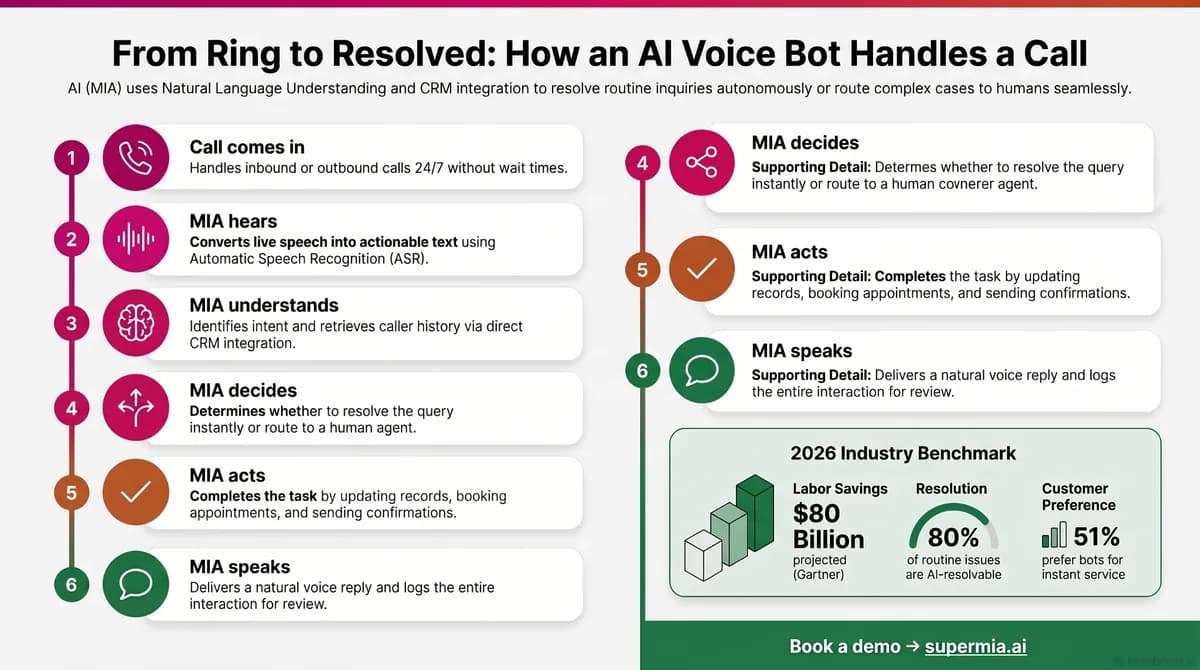
Every call runs through the same loop, in real time. Here's what happens between "hello" and "resolved."
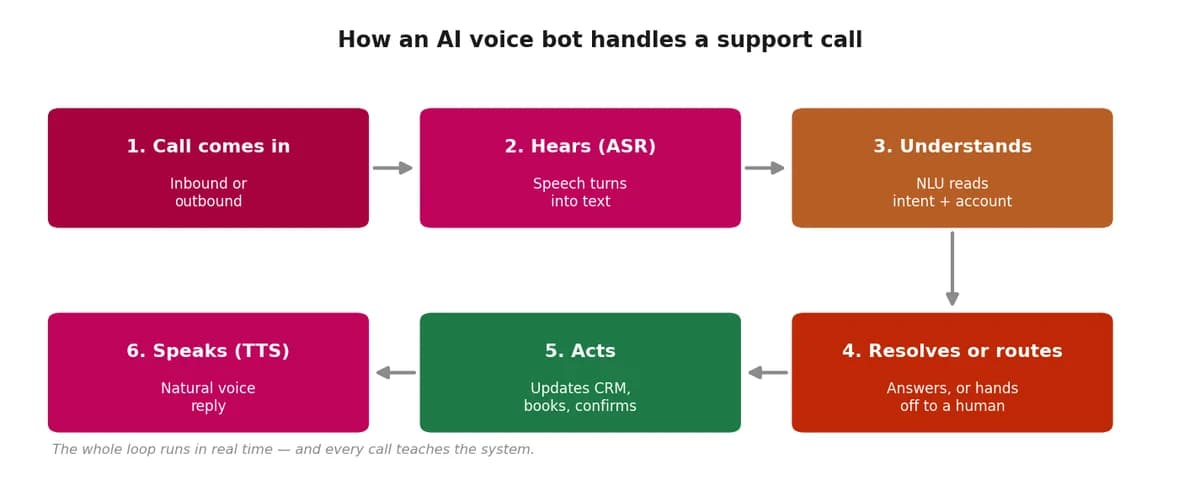
How an AI voice bot handles a support call.
Hearing the caller: speech recognition (ASR)
Automatic speech recognition turns the caller's words into text the system can work with — handling accents, background noise, and interruptions far better than older phone systems.
Understanding intent: NLU + your data
Natural language understanding works out what the caller actually wants — "I need to move my Tuesday appointment" is read as a reschedule, not a new booking. Connected to your CRM, MIA also knows who's calling and skips the "what's your account number" dance. For known customers, Personalized MIA tailors the reply.
Resolving or routing to a human
If the request is routine, MIA handles it. If it's complex, sensitive, or the caller is upset, MIA routes to a live agent — with the full context, so the customer doesn't repeat themselves. Knowing when to hand off is a feature, not a failure.
Acting: the execution layer
This is the part that separates a real solution from a talking FAQ. MIA updates the CRM, books or moves the appointment, processes the simple transaction, and sends the confirmation — then logs the call. It connects to your stack through the same agent logic that runs MIA Chat Agent across channels.
AI voice bot vs traditional IVR
Most people have rage-pressed 0 to escape an IVR menu. Here's why a conversational voice bot is a different experience.
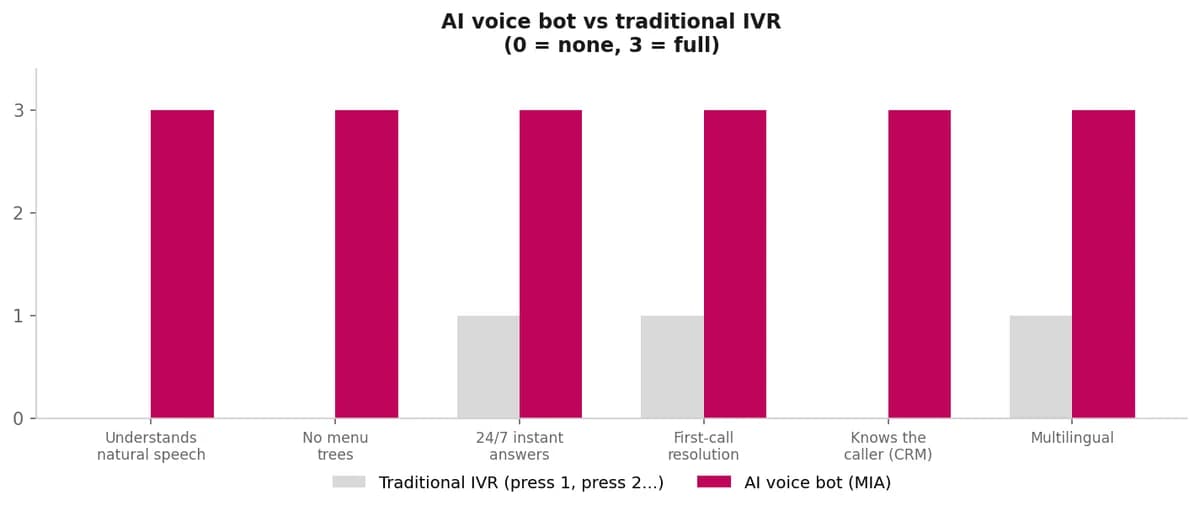
Where an AI voice bot beats a traditional IVR menu.
IVR forces callers down fixed menu trees. An AI voice bot lets them say what they need and resolves it on the first call. For a deeper breakdown, see voice agent vs IVR vs chatbot.
The benefits (and the 2026 numbers)
The case for automating routine support is now backed by hard data, not hype.
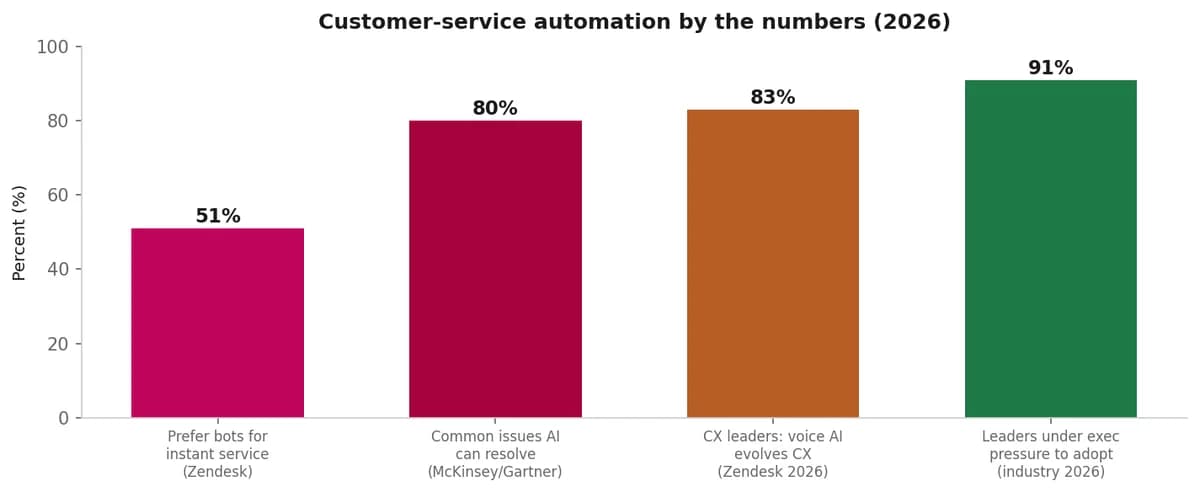
What the 2026 research shows about customer-service automation.
- Lower cost and wait times. Gartner's customer-service AI forecast projects AI will cut call-center labor costs by roughly $80 billion, and independent studies report multi-hundred-percent multi-year ROI.
- 24/7 instant answers. Routine questions get resolved immediately — no queue, no hold music.
- Consistency + multilingual. The same accurate answer every time, in many languages, without staffing a specialized team.
- Happier agents. People stop resetting passwords all day and focus on work that needs judgment. Customer expectations keep rising, too — see the Zendesk CX Trends 2026 research.
Industry use cases
- Healthcare. Appointment scheduling, reminders, and after-hours triage — see AI for healthcare support.
- Retail & eCommerce. Order status, returns, and product questions — especially during peak-season call surges. See AI for retail customer service.
- Insurance & finance. Policy and billing questions, claim intake, and balance checks.
- Hospitality & services. Bookings, confirmations, and FAQs across time zones.
What an AI voice bot can't do (and when to use a human)
Honesty builds trust, so here's the straight version. AI is the wrong tool for some calls:
- Emotional or high-stakes situations. Complaints, grief, cancellations, or anything where a person needs to feel heard.
- Genuinely complex problems. Multi-step disputes or edge cases the system hasn't seen.
- Anything requiring judgment or empathy. Keep a person in the loop — and a fast, frustration-free path to reach them.
Two failure modes to avoid: a bot that sounds robotic, and one that doesn't capture the caller's details into the CRM so the booking breaks. Both come from weak setup, not from the idea itself — which is why the execution layer and a clean handoff matter more than a clever script.
What to measure: the metrics that matter
If you can't measure it, you can't prove it works. Track these from day one:
| Metric | What it tells you |
|---|---|
| Containment rate | Share of calls fully resolved without a human — the core automation metric. |
| First-call resolution | Whether callers get a complete answer the first time. |
| Average handle time | How quickly contacts are resolved. |
| CSAT / sentiment | Whether customers are actually satisfied with automated calls. |
| Escalation rate | How often (and why) calls route to a human — your tuning guide. |
Getting started with MIA
Start with your biggest backlog. If calls are being missed, start with voice; add chat later using the same intents. Pick a use case, say appointment booking, connect your tools, and go live — MIA is no-code, so it's days, not months. See MIA pricing to choose a plan.
Frequently asked questions
Conclusion
Automated customer service isn't about removing people — it's about freeing them from the repetitive calls that burn out teams and frustrate customers. A well-built AI voice bot answers instantly, resolves the routine, completes the task, and hands the hard stuff to a human. That's how support moves from a cost center to a growth lever. See how MIA powers customer engagement.
See MIA's voice assistant handle a live call for your business →

Harikrishna Patel
Harikrishna Patel is the founder of MIA – My Intelligent Assistant, the AI automation platform built under Botfinity Inc. in Dallas, Texas. With 15+ years in software engineering, AI/ML, and enterprise solution design, he focuses on creating practical, scalable AI tools that help businesses automate support, workflows, and operations through voice and chat.