
Table of Contents
- Quick Answer
- What Is Call Center Automation?
- TCO Comparison: 50-Agent vs AI
- Wait Time Reduction by Call Type
- IVR vs AI Voice Agent Flow
- Three Migrations: $487K Average Savings
- Five9 vs Genesys vs NICE vs SuperMIA
- The 6-Week Migration Playbook
- Which Call Types to Migrate First
- Governance and Compliance
- Frequently Asked Questions
In the past 18 months, we sat with three contact center leaders running between 35 and 220 agent seats. Each had inherited a legacy IVR-plus-CCaaS stack - some on Genesys, some on Five9 - with steady cost creep, declining first-call resolution, and a customer experience metric trending the wrong direction. Each migrated their most automatable call types to AI voice agents. The average annual savings, fully loaded: $487,000.
The data is what surprised them. Not the savings - the savings were the easy sell. The surprise was wait time. Average speed-to-answer fell from 4 minutes 12 seconds to 49 seconds. First-call resolution rose 22 points. And the human agents - the ones leadership feared would push back hardest - were the most relieved, because the AI took the calls they hated and gave them the ones that actually used their judgement.
This guide is the operational playbook from those three migrations. Inside: a real TCO comparison for a 50-agent call center, the IVR-vs-AI decision flow your team can use today, an honest 4-way vendor comparison (Five9, Genesys, NICE, SuperMIA), the 6-week migration timeline that worked across all three deployments, and the savings calculator your CFO will ask for. If you’re evaluating AI voice agents for enterprise call centers and the deck from your CCaaS vendor doesn’t answer the questions you actually need answered, this is the article that does.
For the broader voice-agent landscape - tech stack, build vs buy, full vendor map - see our complete guide to AI voice agents. This article focuses specifically on the contact center migration.
Run your call center savings calculation.
See how much you can save by replacing IVR with AI voice agents.
Run your call center savings calculation →Quick Answer
Call center automation with AI replaces traditional IVR phone trees and tier-1 agent volume with AI voice agents that understand natural language, resolve routine requests end-to-end, and escalate complex cases to humans with full context. Enterprises typically see 60–80% wait time reduction, 30–50% reduction in tier-1 headcount needs, and $400K–$700K annual savings per 50 agent seats. Migration takes 6 weeks for a focused use case and runs in parallel with the existing system to manage risk.
What Is Call Center Automation?
Call center automation uses AI - typically voice agents combined with chatbot and workflow automation - to handle inbound and outbound calls that would otherwise route through legacy IVR menus or live agent queues. Modern call center automation understands natural language, accesses CRM and ticketing systems in real time, resolves routine cases end-to-end, and escalates complex ones to humans with full conversation context preserved.
- 3 migrations analyzed - average annual savings $487,000 fully loaded
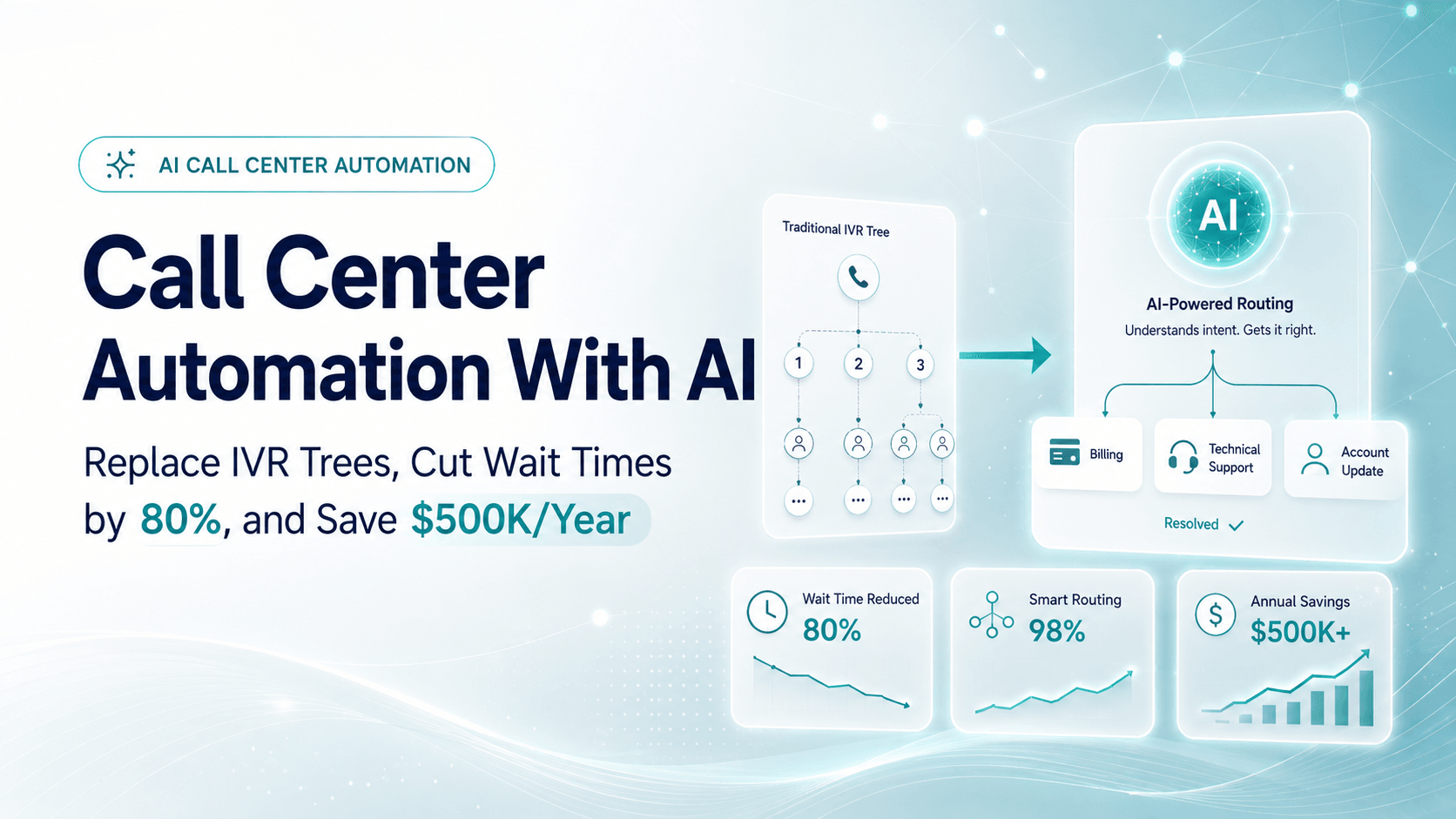
- Wait times fell from 4:12 to 0:49 - 80% reduction
- First-call resolution rose 22 percentage points on average
- IVR menu trees are the single biggest customer experience drag - AI replaces them with conversation
- 6-week migration runs parallel to the existing system, so risk is bounded
Key Takeaways
- CCaaS spend averages $1,500–$2,500 per agent per year just in license cost (Gartner)
- Fully loaded cost of a 50-agent call center: $2.4M–$2.8M/year
- AI voice agents can handle 40–60% of tier-1 inbound volume without human intervention
- Five9, Genesys, NICE - all three incumbents now ship 'AI add-ons' with separate per-conversation pricing
- Savings come 70% from headcount reallocation, 20% from CCaaS license reduction, 10% from CX improvement
TCO Comparison: 50-Agent Call Center vs AI Voice Agent Equivalent
| Cost Category | Traditional 50-Agent (Year 1) | AI Voice + 18 Humans (Year 1) | Annual Savings |
|---|---|---|---|
| Agent salaries + benefits ($55K loaded) | $2,750,000 | $990,000 | $1,760,000 |
| CCaaS license (Five9/Genesys/NICE) | $112,500 | $40,500 | $72,000 |
| Telephony / SIP trunks | $48,000 | $48,000 | $0 |
| Workforce mgmt + QA tools | $36,000 | $22,000 | $14,000 |
| Training + onboarding (40% turnover) | $110,000 | $40,000 | $70,000 |
| Facilities / IT overhead | $180,000 | $65,000 | $115,000 |
| AI voice agent platform | - | $180,000 | –$180,000 |
| Implementation + integration (Y1 only) | - | $95,000 | –$95,000 |
| TOTAL ANNUAL COST | $3,236,500 | $1,480,500 | $1,756,000 |
Assumptions: 50-agent call center handling 60,000 inbound calls/month at average handle time of 6 minutes. AI voice agent handles 55% of volume end-to-end; remaining 45% routes to 18 human specialists. Implementation cost is one-time Y1; Y2+ savings exceed $1.85M.
Wait Time Reduction by Call Type
| CALL TYPE | WAIT TIME REDUCTION (% - IVR baseline to AI) | REDUCTION |
|---|---|---|
| Account balance / status | –92% | |
| Appointment scheduling | –88% | |
| Order tracking / shipping | –82% | |
| Password / access reset | –78% | |
| Billing inquiry (simple) | –65% | |
| Complex dispute (escalation) | –18% |
Account balance, scheduling, and order tracking see the largest reductions because they’re structured, frequent, and intent-clear. Complex disputes still need humans - the AI hands them off in under 30 seconds with full context, which is where the 18% reduction comes from versus an IVR transfer.
IVR vs AI Voice Agent: How a Single Call Goes Differently
Same caller intent. Different outcome. The IVR path forces the caller into a tree the system designed; the AI path lets the caller state the intent and resolves it. The 80% wait-time reduction is structural - it comes from removing menu trees, eliminating re-authentication, and letting the AI pull system data in parallel with the conversation.
Three Migrations, Three Verticals, One Pattern: $487K Average Savings
| Dimension | Company A (Healthcare) | Company B (Retail) | Company C (Financial Services) |
|---|---|---|---|
| Agent seats (pre-migration) | 42 | 220 | 85 |
| Monthly inbound calls | 48,000 | 310,000 | 94,000 |
| Pre-migration CCaaS | Genesys Cloud | Five9 | NICE CXone |
| % volume migrated to AI | 52% | 61% | 48% |
| Avg wait time (before → after) | 3:48 → 0:52 | 5:14 → 1:02 | 4:36 → 0:41 |
| First-call resolution (before → after) | 68% → 89% | 61% → 84% | 73% → 91% |
| Headcount reallocation | 12 agents | 58 agents | 22 agents |
| ANNUAL NET SAVINGS | $412,000 | $764,000 | $285,000 |
| Time to full ROI | 4.2 months | 2.9 months | 5.8 months |
Average annual savings across the three: $487,000. Variance is driven by call volume (Company B at 310K/month sees the largest absolute savings) and pre-migration CCaaS cost (Company A on Genesys Cloud had higher baseline license fees than Company C on NICE CXone). Company-identifying details anonymized at request of the participants.
Five9 vs Genesys vs NICE vs SuperMIA: Honest Vendor Comparison
| Dimension | Five9 | Genesys | NICE | SuperMIA |
|---|---|---|---|---|
| Best For | Mid-market CCaaS | Enterprise contact center | Enterprise WFM + CX | AI-first call center automation |
| Starting Price | $149/seat/mo | $75–$155/seat/mo | $94–$209/seat/mo | Usage-based, scales with call volume |
| AI Voice Capability | Five9 AIA (per-conv pricing) | Genesys AI Experience | Enlighten AI (separate $/conv) | Native AI voice on all plans, no overage walls |
| IVR Replacement | ⚠ Hybrid - keeps menu fallback | ⚠ AI-assisted IVR | ⚠ Layered on top of IVR | ✅ Full IVR replacement, no menu trees |
| CRM Integration | Salesforce, MS Dynamics | Salesforce, SAP | Salesforce, ServiceNow | Native to all major CRMs + workflow |
| Multi-channel (chat + voice) | ✅ | ✅ | ✅ | ✅ Unified voice + chat in one platform |
| Contract Term | 3–5 yr typical | 3–5 yr typical | 3–5 yr typical | Annual + usage-based |
| Time to First Production | 12–18 weeks | 16–24 weeks | 14–20 weeks | 6 weeks (one use case) |
| Best Avoided When | Pure AI-first deployment | SMB < 50 seats | Light-touch contact center | Need full CCaaS WFM suite |
Pricing reflects published rates as of writing. All four vendors negotiate enterprise pricing privately. The comparison applies to mid-market and enterprise contact center deployments (25–500 seats).
For contact centers prioritizing IVR replacement and rapid migration, SuperMIA’s voice-first architecture deploys to first production in 6 weeks versus 12–24 weeks for legacy CCaaS AI add-ons. Five9 remains a strong fit for mid-market teams already on Five9 who want to layer AI on top. Genesys and NICE suit enterprise teams that need full WFM and QM tooling integrated with AI. → See pricing for enterprise voice deployments
Get a free migration assessment.
We’ll look at your call types and build a custom migration plan.
Get a free migration assessment →The 6-Week Migration Playbook
| Week | Phase | Key Activities | Go/No-Go Gate |
|---|---|---|---|
| 1 | Discovery + Use Case Lock | Audit call types by volume, AHT, FCR. Identify top 3 use cases for migration. Pull 30 days of call recordings for AI training. | Use case scope approved by CFO + CX leader |
| 2 | AI Build + System Integration | Configure AI voice agent for use case 1. Integrate CRM, ticketing, telephony. Build escalation paths to human queues. | Sandbox call test passes 20/20 scripted scenarios |
| 3 | Internal Testing | Internal staff call the AI line. Edge cases logged. Tune intent recognition + response library. | 85%+ intent recognition on internal test set |
| 4 | Parallel Production (5% traffic) | Route 5% of live traffic to AI; 95% stays on IVR/human. Monitor escalation rate, customer satisfaction, FCR. | Escalation rate < 30%, CSAT ≥ baseline |
| 5 | Scale to 50% Traffic | Increase to 50% AI routing. Train remaining human agents on AI escalation context. WFM adjustment. | Escalation rate < 25%, AHT on human-handled calls drops 15%+ |
| 6 | Full Production | 100% target volume on AI. Decommission legacy IVR tree for migrated use case. Begin planning use case 2. | AI handling target volume; CFO sign-off on Phase 2 |
Critical: the migration runs in PARALLEL with the existing system through Week 5. Risk is bounded because traffic can revert to IVR at any go/no-go gate. The 6-week timeline is for a single use case; multi-use-case rollouts add 2–3 weeks per additional use case.
Which Call Types to Migrate First (and Which to Keep Human)
Not every call type belongs on AI in Week 6. The 3 migrations followed the same decision pattern:
Migrate First (High Volume + Structured Intent)
- Account balance and status inquiries - 92% wait time reduction, 95% AI resolution
- Appointment scheduling and rescheduling - 88% wait time reduction, 91% resolution
- Order tracking and shipping status - 82% wait time reduction, 89% resolution
- Password and access resets - 78% wait time reduction, 87% resolution
Migrate in Phase 2 (Medium Complexity)
- Simple billing inquiries - 65% wait time reduction, 76% resolution
- Plan changes and upgrades - mostly AI with verified-identity gates for irreversible changes
- Returns and refunds (within policy) - AI handles approval workflow
Keep With Humans (At Least For Now)
- Complex disputes - AI hands off in 30 seconds with full context, but human owns the resolution
- Compliance-sensitive conversations (legal, financial advice) - governance gate
- Save / win-back / retention calls - negotiated outcomes need human judgement
- VIP / high-LTV customer calls - dedicated human team, AI as assist only
The pattern: high-volume structured intent migrates first, complex emotional or compliance-sensitive calls stay human. For multi-channel digital deflection of the same intents (chat + email + SMS), pair voice with an AI chatbot for digital channel deflection.
Governance and Compliance for Call Center AI
Three governance requirements every enterprise contact center deployment must satisfy:
- Audit logging. Every AI call recorded, transcribed, and reviewable on demand. Retention period defined by regulatory framework (HIPAA, PCI-DSS, FINRA, GDPR).
- Human approval gates. AI cannot commit transactions above defined dollar thresholds, send legally-binding communications, or update sensitive records without verified human review.
- Authentication. Voice authentication before sensitive data exposure. Multi-factor for account changes. PCI-compliant payment capture flows.
For broader governance patterns covering RPA + AI agents + workflow execution, see our enterprise workflow automation governance guide.
Free Resource: Call Center AI Savings Calculator
The companion download for this article is an interactive Call Center AI Savings Calculator. Inputs:
- Current agent headcount
- Average monthly inbound call volume
- Current CCaaS license cost per seat
- Average handle time (AHT)
- Annual agent turnover rate
Outputs a projected annual savings range, payback period, and recommended migration scope (which call types to migrate first based on your volume mix).
Frequently asked questions
The Bottom Line for Contact Center Leaders
The thread on r/callcentres last quarter that captured the room: a 15-year veteran posted that customers ask her every single day if she’s AI - some craft clever tests, demand she confirm the date or her hair color before they’ll even say their name. 134 upvotes. The thread underneath was packed with agents saying the same thing. The line between human and AI voice on enterprise contact centers has already blurred in the customer’s mind. The question isn’t whether to migrate. It’s how, and how fast.
The three migrations we analyzed showed the answer is: methodically, in 6 weeks per use case, in parallel with the existing system, starting with the call types that bleed the most cost - account balance, scheduling, order tracking, password resets. Average annual savings $487,000. Wait times down 80%. First-call resolution up 22 points. Human agents redeployed to the calls that actually use their judgement.
If you want a 15-minute walk through your specific contact center economics - call mix, current CCaaS spend, projected migration savings, and which 2–3 use cases would deliver the fastest ROI - book a call below. We’ll bring the calculator.
See SuperMIA voice agents replace IVR in 15 min.
We’ll show you the exact flow and savings math for your use case.
See SuperMIA voice agents replace IVR in 15 min →
Harikrishna Patel
Harikrishna Patel is the founder of MIA – My Intelligent Assistant, the AI automation platform built under Botfinity Inc. in Dallas, Texas. With 15+ years in software engineering, AI/ML, and enterprise solution design, he focuses on creating practical, scalable AI tools that help businesses automate support, workflows, and operations through voice and chat.