
Table of Contents
- Do customer service chatbots actually save money?
- The core driver: cost per ticket
- How much can you save? (a simple model)
- A worked example
- What this looks like across industries
- When does a chatbot pay for itself?
- Beyond cost: the ROI you don't see on the invoice
- Why most ROI projections miss (and how not to)
- Resolution rate, not deflection rate
- How to calculate your own ROI
- Frequently asked questions
Quick Answer
A customer service chatbot pays off by reducing routine ticket cost from human-level ranges (often $6 to $12) to AI-assisted ranges (roughly $0.50 to $2.00), creating major unit-economics leverage. Many teams report first-year returns around 3.5x and payback in 3 to 6 months. The key condition is resolution quality: savings come from tickets solved end-to-end, not just deflected away from agents.
Key takeaways
- ROI starts with cost per resolved ticket, not software subscription price.
- At scale, even small per-ticket savings produce six-figure annual impact.
- Payback is often fast for SMB and mid-market support operations.
- Full ROI includes faster response, 24/7 coverage, and better retention.
- Strong deployments optimize for resolution rate, not deflection rate.
Do customer service chatbots actually save money?
For repetitive, high-volume support queries, yes. The economics are structural: AI handles predictable intents at a much lower unit cost than human-only workflows. Public analyst coverage from Gartner and enterprise benchmarks from IBM consistently point to meaningful support-cost compression when implementation quality is high. If you are still evaluating automation types, this comparison of chatbots, voice agents, and AI agents helps frame what each system should own.
The core driver: cost per ticket
Most chatbot ROI outcomes can be explained by one metric: cost per resolved ticket. If your AI can resolve routine tickets at lower cost while preserving customer experience, margin expands quickly.
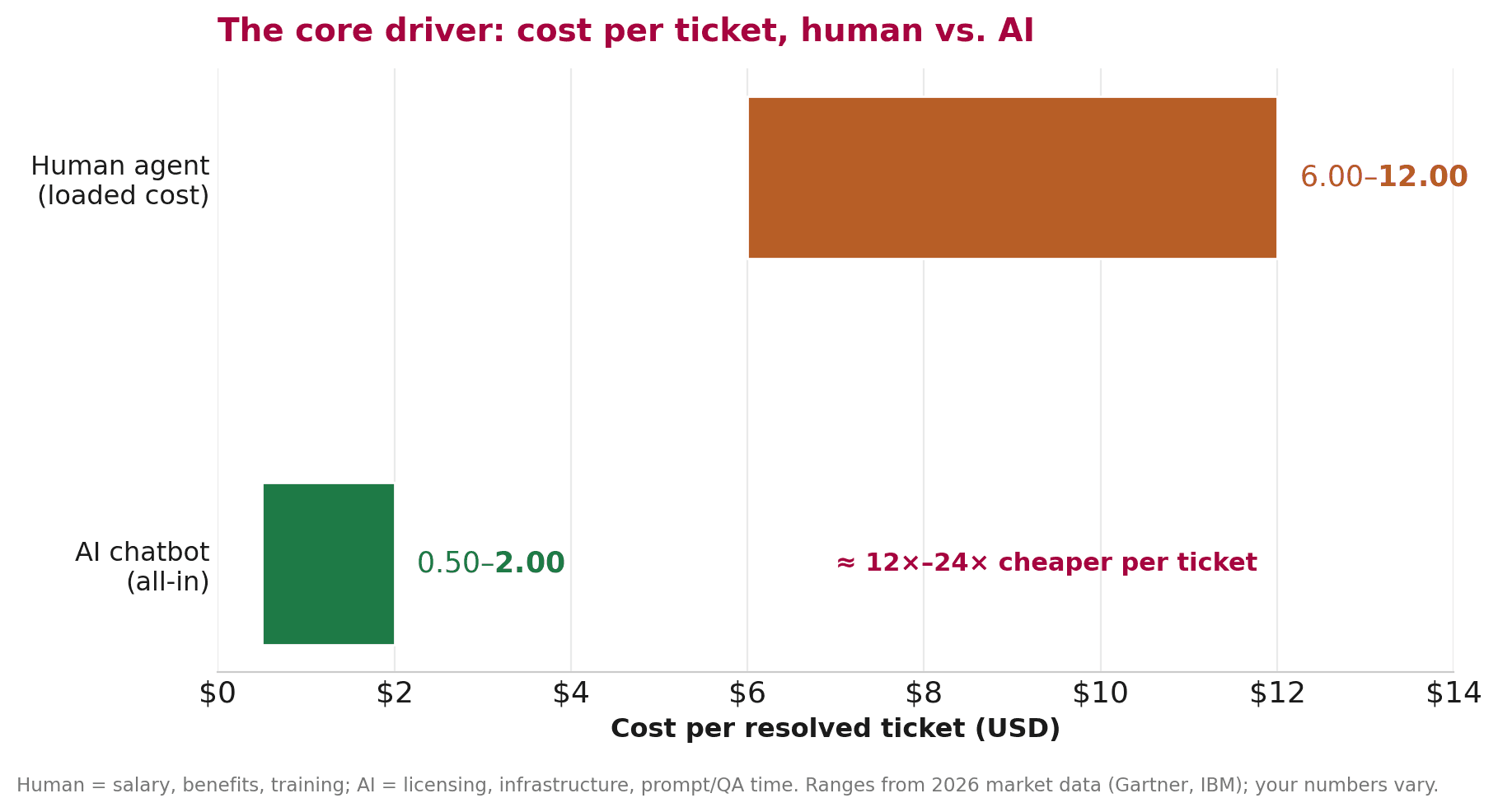
Figure 1. The cost-per-ticket gap is the primary ROI engine.
| Channel | Cost per resolved ticket | Typical components |
|---|---|---|
| Human agent | $6 to $12 | Salary, benefits, training, supervision, turnover |
| AI chatbot | $0.50 to $2.00 | Platform, infrastructure, tuning, QA oversight |
How much can you save? (a simple model)
Savings scale with three inputs: total ticket volume, automation/resolution rate, and per-ticket cost delta. Model conservatively first, then iterate with real production data.
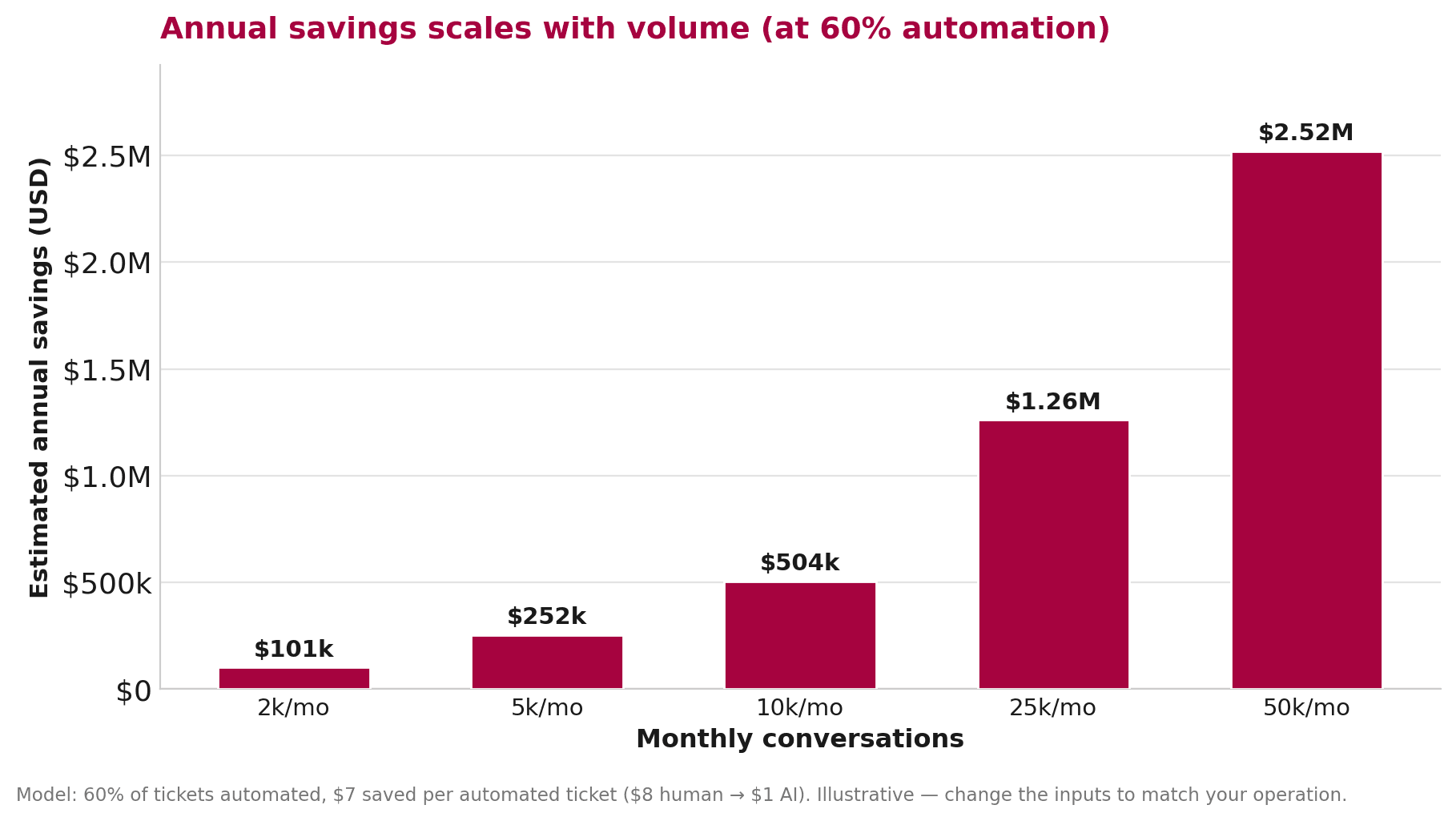
Figure 2. Annual savings rises with conversation volume at constant automation assumptions.
A worked example
Assume 50,000 monthly support conversations, human ticket cost of $8, AI ticket cost of $1, and 60% AI resolution rate. Annualized savings is approximately: 50,000 × 60% × ($8 - $1) × 12 = $2.52M. Even at lower volume, the same math often yields meaningful five-figure or six-figure annual impact.
It helps to see the math line by line so you can swap in your own numbers:
- Monthly conversations: 50,000
- AI resolution rate: 60% → 30,000 tickets resolved by AI each month
- Cost delta per ticket: $8 human − $1 AI = $7 saved per resolved ticket
- Monthly savings: 30,000 × $7 = $210,000
- Annual savings: $210,000 × 12 = $2.52M
- Less annual platform cost (example): $360,000 → net annual benefit ≈ $2.16M
Now scale it down to a mid-market team to keep it realistic. At 6,000 monthly conversations, a 50% resolution rate, and the same $7 delta, you save 3,000 × $7 × 12 = $252,000 a year before platform cost. Subtract a $36,000 annual customer service chatbot investment and you still net roughly $216,000 - an ROI of about 6x. The point is that the model holds across volumes: as long as the per-ticket delta and resolution rate are real, the savings scale almost linearly with volume.
What this looks like across industries
The same framework produces different shapes of return depending on ticket mix and seasonality. A few representative patterns:
- E-commerce retailer. High volume of "where is my order," returns, and sizing questions - typically 65-75% of tickets are automatable. These teams often see the fastest payback (under four months) because resolution rates are high and human cost per ticket is moderate.
- SaaS support desk. A mix of how-to questions (highly automatable) and technical bugs (escalate to humans). Resolution rates land around 45-55%, but each deflected ticket is expensive, so absolute savings are strong even at lower automation rates.
- Financial services. Heavy compliance and identity-verification requirements cap resolution rates and lengthen payback to 12-18 months, but 24/7 coverage and audit-friendly logging add value beyond pure cost savings.
The lesson across all three: model your own ticket mix rather than borrowing someone else's headline ROI number. A 50% resolution rate in a high-cost vertical can beat a 70% rate in a low-cost one.
When does a chatbot pay for itself?
Many small and mid-market deployments recover investment in 3 to 6 months. Larger enterprise implementations with heavier integration and governance requirements may take 12 to 18 months.
Payback period is simply total implementation cost divided by monthly savings. Two things move it the most: how quickly you reach a stable resolution rate, and how much of your ticket volume is genuinely automatable. A focused launch - pick your three highest-volume, lowest-risk intents first - reaches break-even far faster than a "boil the ocean" rollout that tries to automate everything on day one. Each additional intent you add after launch compounds the savings against a fixed platform cost, which is why the payback curve steepens over the first two quarters rather than staying linear.
Factor in ramp time honestly. Most deployments take four to eight weeks to tune knowledge, escalation paths, and tone before resolution rates stabilize. Model that ramp as reduced savings in months one and two rather than assuming full performance from launch - it keeps your payback estimate credible and avoids the disappointment of a model that looked great on paper but slipped in practice.
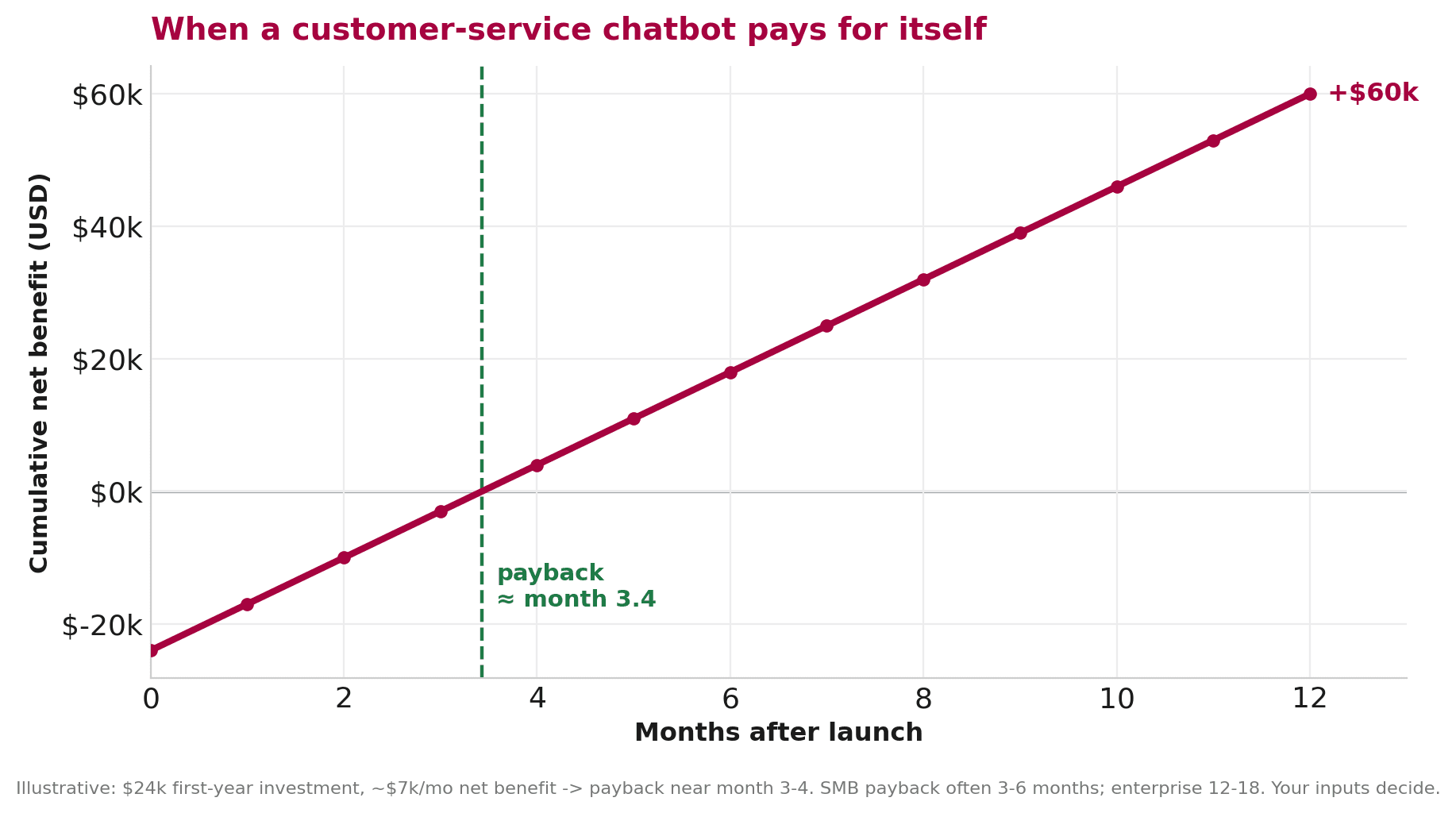
Figure 3. Typical payback trajectory for customer-service chatbot deployments.
Beyond cost: the ROI you don't see on the invoice
Labor savings is only part of value. Organizations often capture additional returns through 24/7 availability, faster first response, better queue handling during spikes, and stronger human-agent utilization for high-complexity issues. Broader strategy analysis from McKinsey supports this view: operating-model gains can multiply direct unit-cost savings.
These second-order effects are harder to put on a spreadsheet but often larger than the direct labor line over a full year:
- Revenue protection. Instant answers at the moment of purchase intent reduce cart abandonment and recover sales that would otherwise leak away while a customer waits in a queue.
- Churn reduction. Consistent, fast resolutions lift satisfaction, and even a one-point improvement in retention compounds meaningfully on recurring-revenue businesses.
- Agent retention. When a well-tuned support chatbot absorbs repetitive tickets, human agents handle more interesting work, which lowers burnout and the very real cost of attrition and re-training.
- Data and insight. Every conversation is structured data - top intents, failure points, and emerging issues surface automatically, informing product and process fixes that prevent tickets in the first place.
When you build the business case, present the direct cost-per-ticket savings as the conservative floor and treat these effects as upside. Stakeholders trust a model that under-promises on the hard number and lists the soft gains separately.
Why most ROI projections miss (and how not to)
- Inflated ticket baselines and underestimated fully loaded human cost.
- Weak knowledge architecture that reduces true resolution ability.
- Poor escalation design that creates repeat contacts and frustration.
- Optimization for deflection volume instead of solved outcomes.
Resolution rate, not deflection rate
Deflection can hide unresolved demand. Resolution rate is the stronger operational KPI because it aligns with both cost outcomes and customer experience. Teams that prioritize resolution quality usually outperform headline-deflection deployments over a full-year window.
The distinction matters financially. A deflected ticket that the customer re-opens an hour later because the bot didn't actually solve their problem costs you twice: once for the failed AI interaction and again for the human who now handles a frustrated customer. Worse, repeat contacts inflate your ticket volume, making the baseline look bigger than it should and corrupting the very numbers you're using to measure ROI. Optimizing for deflection can therefore produce a model that shows savings while quietly destroying customer experience.
Measure resolution as: tickets fully closed by the AI with no human follow-up within a defined window (say, 72 hours), divided by total tickets the AI attempted. Track it alongside customer satisfaction on AI-handled conversations. If both numbers are healthy, your savings are real. If resolution looks high but satisfaction is sliding, you're deflecting, not resolving - and your ROI projection is built on sand.
How to calculate your own ROI
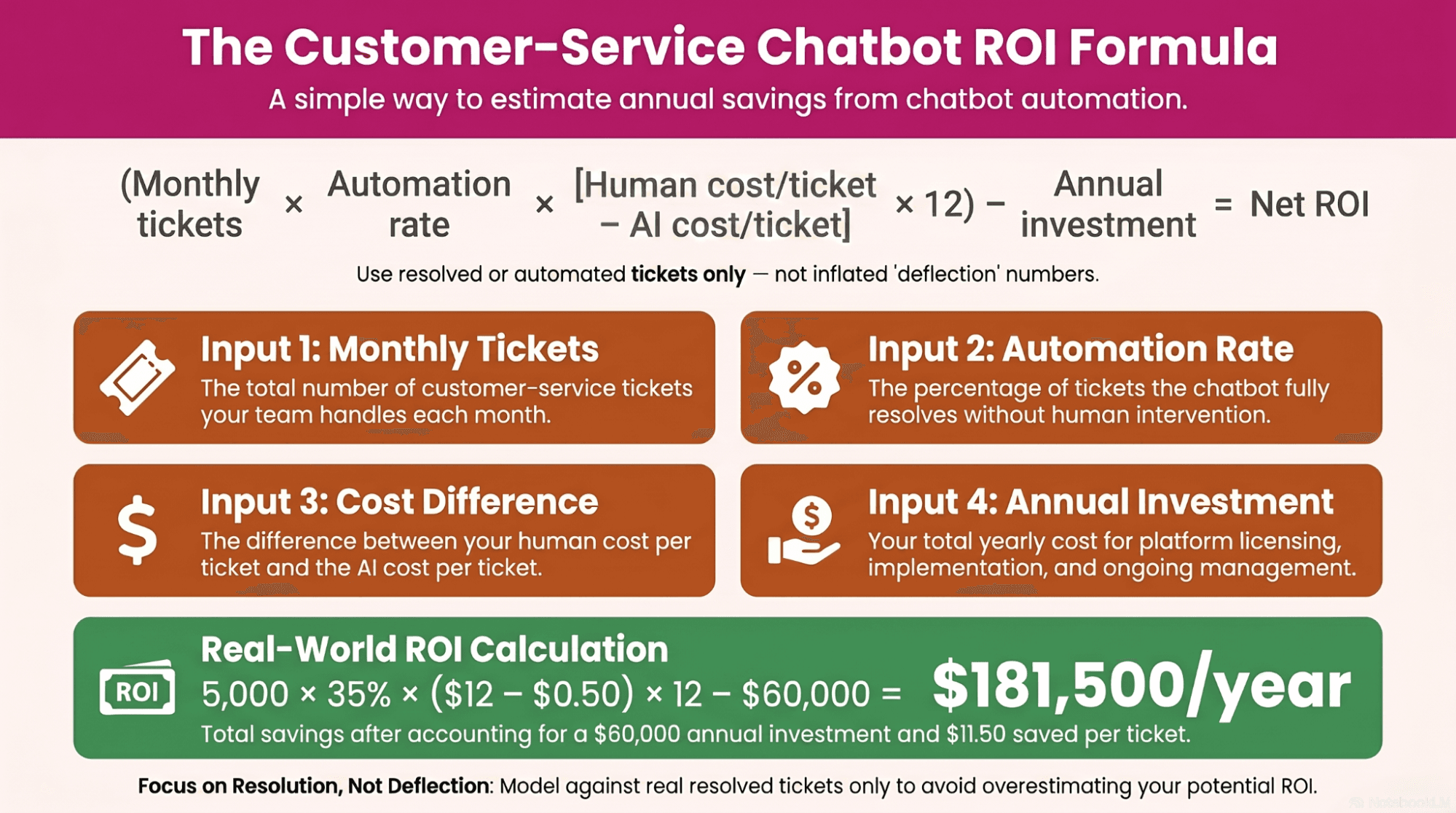
Use a conservative formula first: (monthly tickets × AI resolution rate × per-ticket savings × 12) - annual chatbot investment. Then sensitivity-test with 40%, 50%, and 60% resolution assumptions. If your model works at the low case, implementation risk is much lower. For budget anchoring, compare platform cost against this build-vs-buy breakdown and current pricing options.
Where SuperMIA fits
SuperMIA customer service chatbot is built for measurable resolution outcomes: it connects with CRM/helpdesk workflows so actions are completed, not just acknowledged, and escalates cleanly when human intervention is needed. The target is not vanity deflection, but lower cost per resolved ticket at reliable service quality on the SuperMIA platform.
Get an ROI estimate for your support volume.
Share your monthly tickets and current support cost, and we will map realistic savings and payback scenarios.
Get my ROI estimate →Frequently asked questions

Harikrishna Patel
Harikrishna Patel is the founder of MIA – My Intelligent Assistant, the AI automation platform built under Botfinity Inc. in Dallas, Texas. With 15+ years in software engineering, AI/ML, and enterprise solution design, he focuses on creating practical, scalable AI tools that help businesses automate support, workflows, and operations through voice and chat.