
Table of Contents
- What is a dental virtual assistant?
- What does a dental virtual assistant do?
- Human vs. AI virtual assistant: which does what?
- What does a dental virtual assistant cost?
- Virtual assistant vs. in-house: the savings
- What a dental virtual assistant can’t do
- Is a dental virtual assistant worth it?
- How to choose (and where SuperMIA fits)
- Frequently asked questions
Quick Answer
A dental virtual assistant handles non-clinical admin work — scheduling, insurance verification, billing, recall, and patient calls — either as a remote person or an AI system. A human dental VA costs $7 to $15 per hour ($1,200 to $2,500 a month full-time); an AI dental VA runs about $199 to $870 a month. Both cost far less than an in-house hire, and many practices use them together.
Key takeaways
- A dental virtual assistant covers front- and back-office admin — far more than just answering phones.
- Two models: a human VA (broad back-office work) and an AI VA (always-on phones and booking).
- Human VA: $7–$15/hr ($1,200–$2,500/mo). AI VA: ~$199–$870/mo. In-house: $3,840+/mo loaded.
- Neither replaces in-office check-in or clinical support — that still needs your team.
- The best ROI usually comes from combining AI for phones with a human VA for complex tasks.
| If you need… | Start with… |
|---|---|
| Phones answered 24/7, booking into your PMS | An AI virtual assistant |
| Insurance, billing, and complex back-office work | A human virtual assistant |
| Both, with the lowest total cost | AI + a human VA together |
| In-person check-in and clinical support | In-office staff (neither VA replaces this) |
What is a dental virtual assistant?
A dental virtual assistant is a remote professional — or an AI system — that handles a practice’s non-clinical administrative work without being physically in the office. The human version is usually a trained, HIPAA-aware admin who works inside your practice management software during your business hours, often based offshore. The AI version is software that answers calls and completes tasks automatically, around the clock. Per the ADA Health Policy Institute, administrative load is one of the biggest cost pressures on modern practices — which is why both models are growing fast. For a fuller view of how AI fits the front office, see our dental practice solutions.
Because a dental VA touches scheduling, insurance, and patient records, it works with protected health information. Any model you choose — human or AI — must be HIPAA-compliant, sign a Business Associate Agreement where required, and follow the HHS HIPAA Privacy Rule. Staffing benchmarks from the MGMA show why so many practices look to virtual coverage: front-desk turnover and wage pressure keep climbing.
What does a dental virtual assistant do?
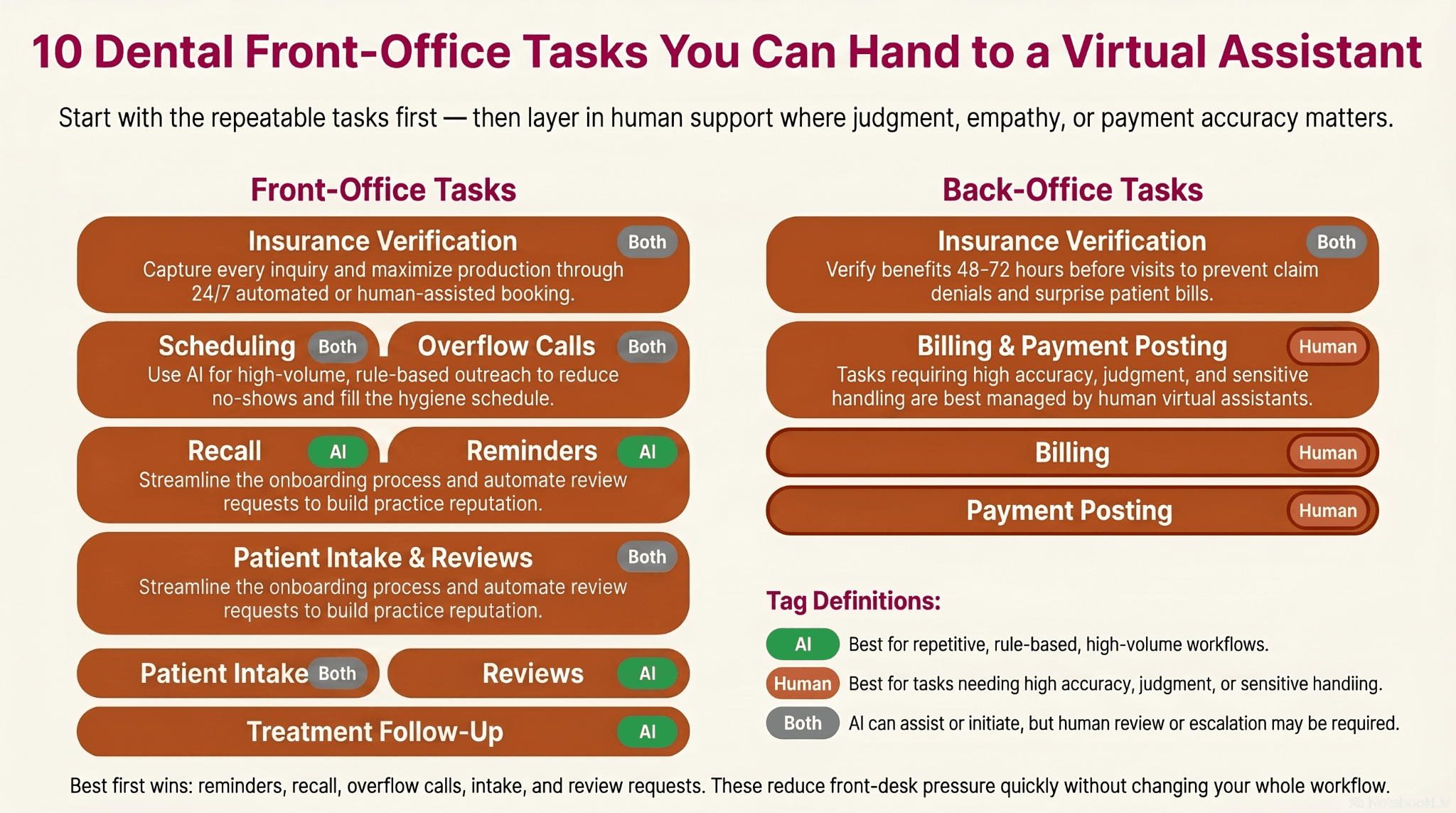
The role spans the whole front- and back-office workload that doesn’t need a dentist’s license.
Front-office tasks
- Answering and overflow calls — capturing every inquiry so patients aren’t sent to voicemail. See how the AI handles calls and booking.
- Scheduling & block scheduling — booking, confirming, and rescheduling to maximize production.
- Reminders & recall — proactive outreach to overdue hygiene patients and no-show prevention.
- Patient communication — answering FAQs, intake, and follow-ups, often bilingually.
Back-office tasks
- Insurance verification — checking benefits 48–72 hours before the visit so there are no surprises.
- Billing & collections — sending statements and following up on aging or denied claims.
- Treatment-plan follow-up — re-engaging patients who left without booking recommended care.
From the field: insurance verification is the task with the most downstream cost. When the same overwhelmed front-desk person is answering phones AND verifying benefits, verification is what slips — and that’s where claim denials and surprise patient bills come from.
Human vs. AI virtual assistant: which does what?
“Dental virtual assistant” covers two different things, and they’re good at different jobs. The honest way to choose is to match each to the work it does best.
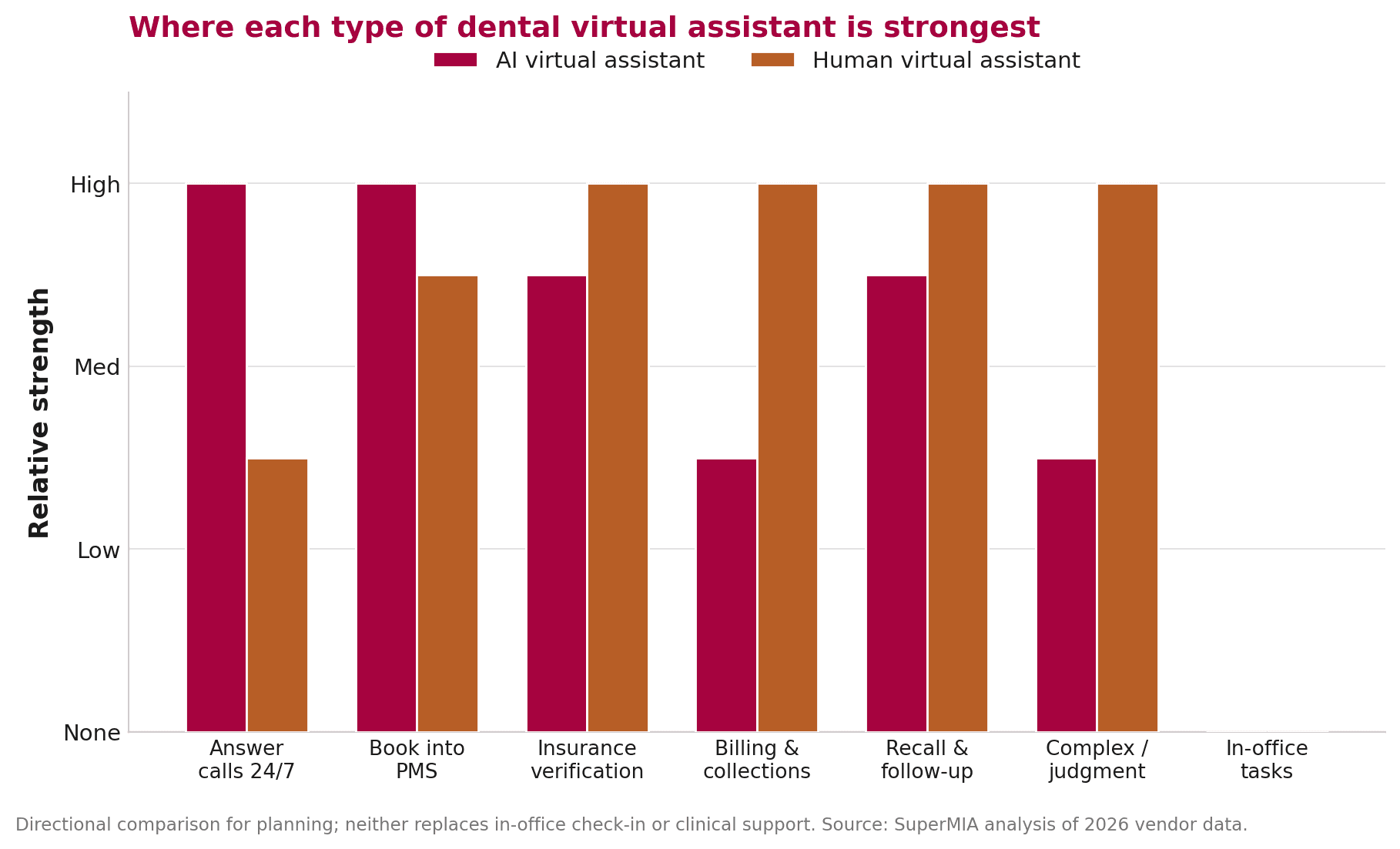
Figure 2. Where each type of dental virtual assistant is strongest.
An AI virtual assistant wins on always-on phones, instant booking, and never missing a call. A human virtual assistant wins on complex insurance work, billing nuance, and judgment calls with anxious patients. Neither is strictly better — they cover different ground.
The AI side is essentially a dental voice assistant: it picks up every call on the first ring, day or night, understands natural speech, and books straight into your schedule without putting the patient on hold. That matters because the most expensive moment in a dental front office is a ringing phone no one can answer — that caller often books with the next practice on their list. An AI assistant closes that gap at a fixed monthly cost, with no overtime, no sick days, and no drop in quality during a busy Monday morning rush.
A human VA, by contrast, shines on the work that needs judgment: untangling a denied claim, walking an anxious patient through treatment financing, or handling an edge case the software wasn't trained for. The two are complementary, not competing. Many practices route every inbound call to the voice AI for instant capture and booking, then hand the messy back-office threads to a human VA — getting 24/7 coverage and human judgment without paying for a full in-house team.
What does a dental virtual assistant cost?
Cost depends on the model. Here’s the full picture across human VA, AI VA, and the in-house hire they’re usually compared against.

Figure 1. Monthly cost by dental virtual assistant model, 2026.
| Model | Typical cost | Coverage | Best for |
|---|---|---|---|
| AI virtual assistant | $199–$870/mo | 24/7 | Phones, booking, recall at scale |
| Human virtual assistant | $7–$15/hr ($1,200–$2,500/mo) | Your business hours | Insurance, billing, complex back-office |
| In-house front desk | $3,840–$5,800/mo (loaded) | Office hours only | In-person check-in + clinical support |
Human VA pricing
Human dental VAs are typically offshore (LATAM or the Philippines), advertised from about $8/hr, with full-time-equivalent packages around $1,200–$2,500 a month. Some agencies charge a one-time placement fee; others bill monthly. Confirm whether you’re hiring or renting the relationship — and check the Bureau of Labor Statistics wage data for your in-house benchmark.
AI VA pricing
AI dental VAs are software, usually $199–$870 a month depending on volume and features, with no salary or benefits. For the full breakdown of what phone coverage specifically costs once setup and add-ons are counted, see the full breakdown of phone-coverage cost. We publish transparent pricing on a pay-per-task model.
Virtual assistant vs. in-house: the savings
Most practices compare a VA to a subscription. The more revealing comparison is against what it actually replaces: a loaded in-house front-desk salary.
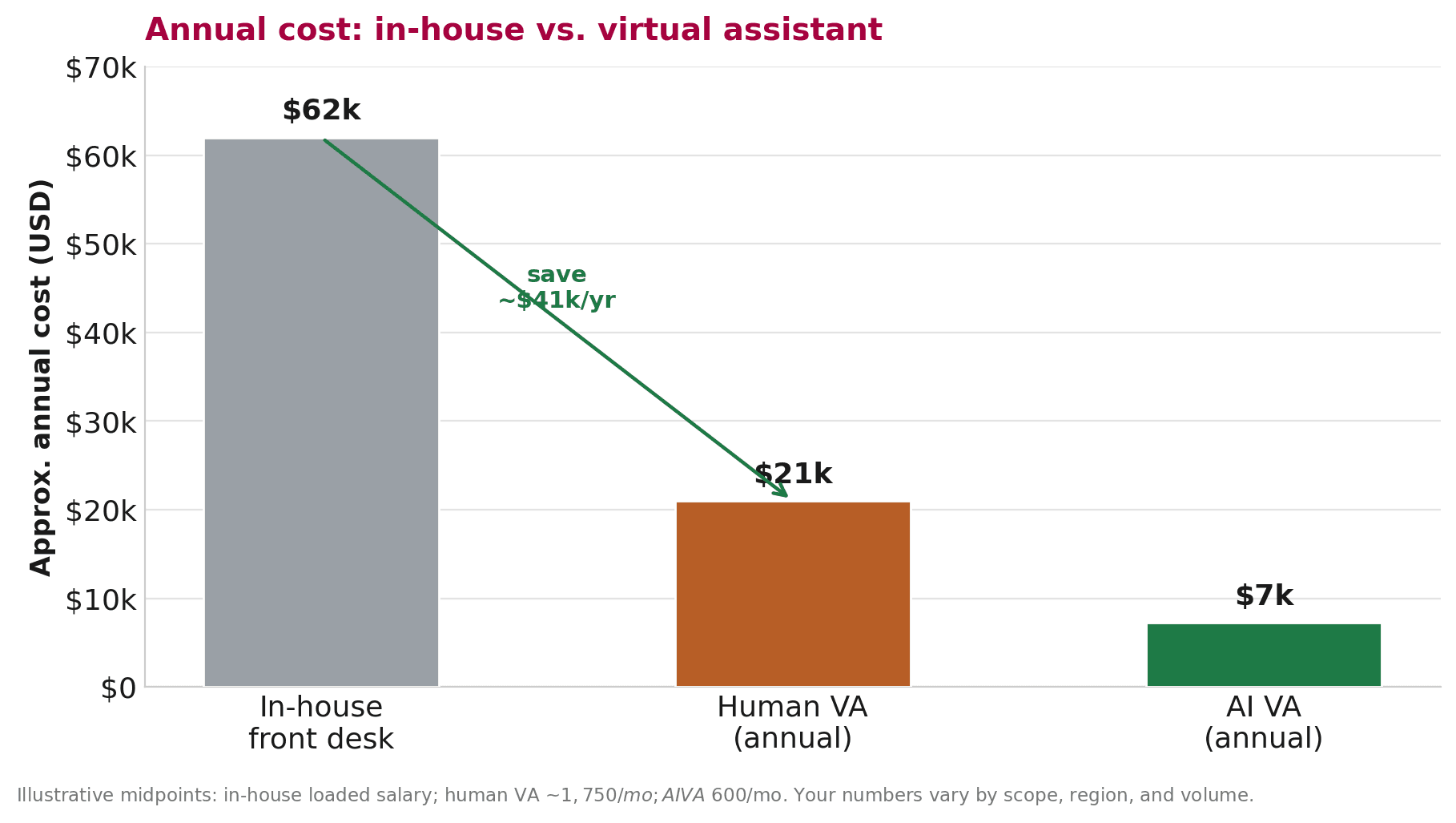
Figure 3. Approximate annual cost: in-house vs. virtual assistant.
An in-house front-desk coordinator runs roughly $53,000–$78,000 a year once benefits, payroll taxes, and turnover are included. A human VA or AI assistant can cut that by tens of thousands annually. For the AI-vs-human decision specifically, the AI-vs-human ROI math breaks it down with a calculator.
What a dental virtual assistant can’t do
An honest guide has to say where the model stops. A virtual assistant — human or AI — does not replace:
- In-person check-in and checkout, or managing the waiting room.
- Walk-ins and hands-on help at the front desk.
- Any clinical or chairside support.
- Complex, empathy-heavy conversations (AI escalates; a human VA helps but isn’t on-site).
Is a dental virtual assistant worth it?
For most practices, yes — but not just because it’s cheaper than staff. It’s worth it because it recovers revenue you’re quietly losing: missed calls that book elsewhere, lapsed recall patients, and denied claims from rushed verification. Match the model to the work, and the cost usually pays for itself in recovered production.
Put rough numbers on it. A practice that misses ten calls a week and converts even half of those into booked new-patient visits at an average first-year value of a few hundred dollars each is leaving tens of thousands of dollars on the table every year — far more than the $199–$870 monthly cost of an AI assistant. Add the recall patients who never get a reminder and the claims denied because verification slipped, and the "is it worth it?" question usually answers itself within the first month of data.
The practices that get the least value are the ones that bolt on a virtual assistant without fixing the underlying workflow — no clear escalation path, no PMS integration, no defined hand-off between the AI and human staff. The model is a force multiplier, not a magic fix: it pays off fastest when it slots into a clear process and is measured against concrete numbers like missed-call recovery, no-show rate, and verification accuracy.
Proof — Media Brite Smile Dental
After deploying SuperMIA’s AI assistant, the practice cut no-shows from 14.2% to 5.8%, hit a 94% appointment-slot fill rate, and grew revenue 57% while answering 43% faster.
How to choose (and where SuperMIA fits)
Start with the work that’s costing you most. If it’s missed calls and after-hours booking, lead with AI. If it’s insurance and billing backlogs, lead with a human VA. If it’s both, run them together. SuperMIA’s AI dental assistant covers the always-on phone and booking side — 24/7, into your PMS, with real-time eligibility checks — and pairs cleanly with a human VA for back-office work. It runs on the SuperMIA platform, so the same system handles voice, scheduling, and PMS workflows under one HIPAA-aware setup. Comparing specific AI tools? Compare specific AI vendors side by side.
See the AI side handle your calls — book a demo.
24/7 phone coverage, real-time booking, pay-per-task. See it work on your actual call flow.
Book a demo →Frequently asked questions

Harikrishna Patel
Harikrishna Patel is the founder of MIA – My Intelligent Assistant, the AI automation platform built under Botfinity Inc. in Dallas, Texas. With 15+ years in software engineering, AI/ML, and enterprise solution design, he focuses on creating practical, scalable AI tools that help businesses automate support, workflows, and operations through voice and chat.