
Table of Contents
- The Quick Answer: 2026 Pricing
- What It Actually Costs by Model
- The Four Pricing Models (And Which Matters Most)
- AI vs. Human vs. In-House: The Real Comparison
- Hidden Fees to Watch
- How Fast Does It Pay for Itself?
- Where SuperMIA Fits on Price
- What to Ask Before You Sign
- Is It Worth It?
- Frequently Asked Questions
Quick Answer
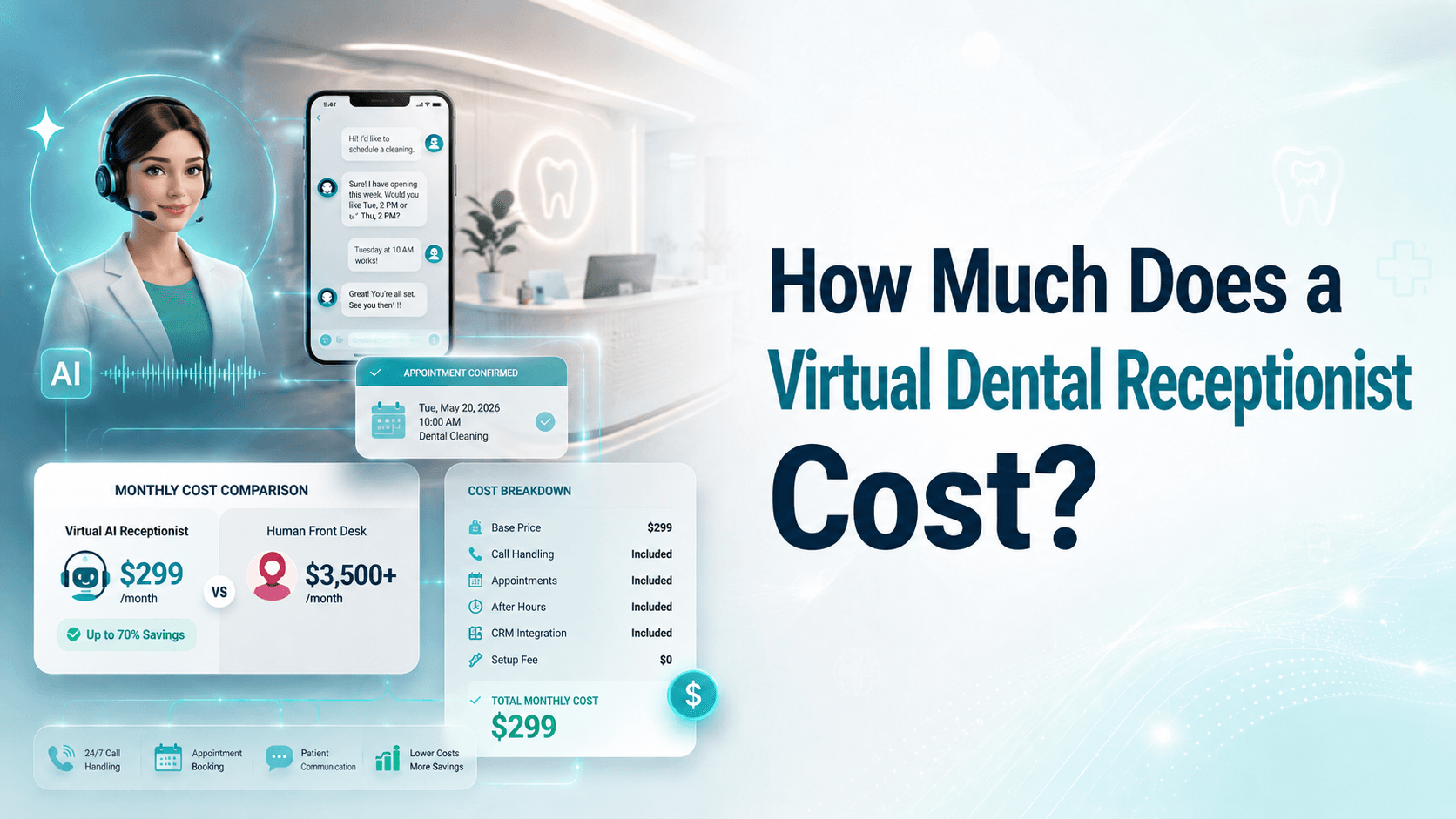
A virtual dental receptionist costs $199 to $2,500 per month in 2026, depending on whether you choose AI software or a human agent. AI platforms run $199–$870/month, though the real all-in cost is usually $400–$1,400 once setup, PMS integration, and add-ons are counted. A full-time in-house receptionist costs $42,000–$70,000 a year.
Key takeaways
- AI dental receptionists are the cheapest 24/7 option - $199–$870/month, but read the all-in number, not the homepage price.
- Human answering services cost $500–$2,000+/month and mostly take messages; in-house staff cost $42K–$70K/year loaded.
- Hidden fees (setup, PMS integration, overages, add-ons) can lift the real AI cost 20–40% above the sticker.
- Flat-rate pricing wins as call volume grows; per-minute plans punish busy practices.
- Break-even usually arrives at one to three recovered new-patient calls per month.
The Quick Answer: 2026 Pricing
A virtual dental receptionist costs $199 to $2,500 per month. The range is wide because "virtual receptionist" covers two very different things: AI software - like a dental AI voice bot - that answers and books calls automatically, and a human agent who works remotely.
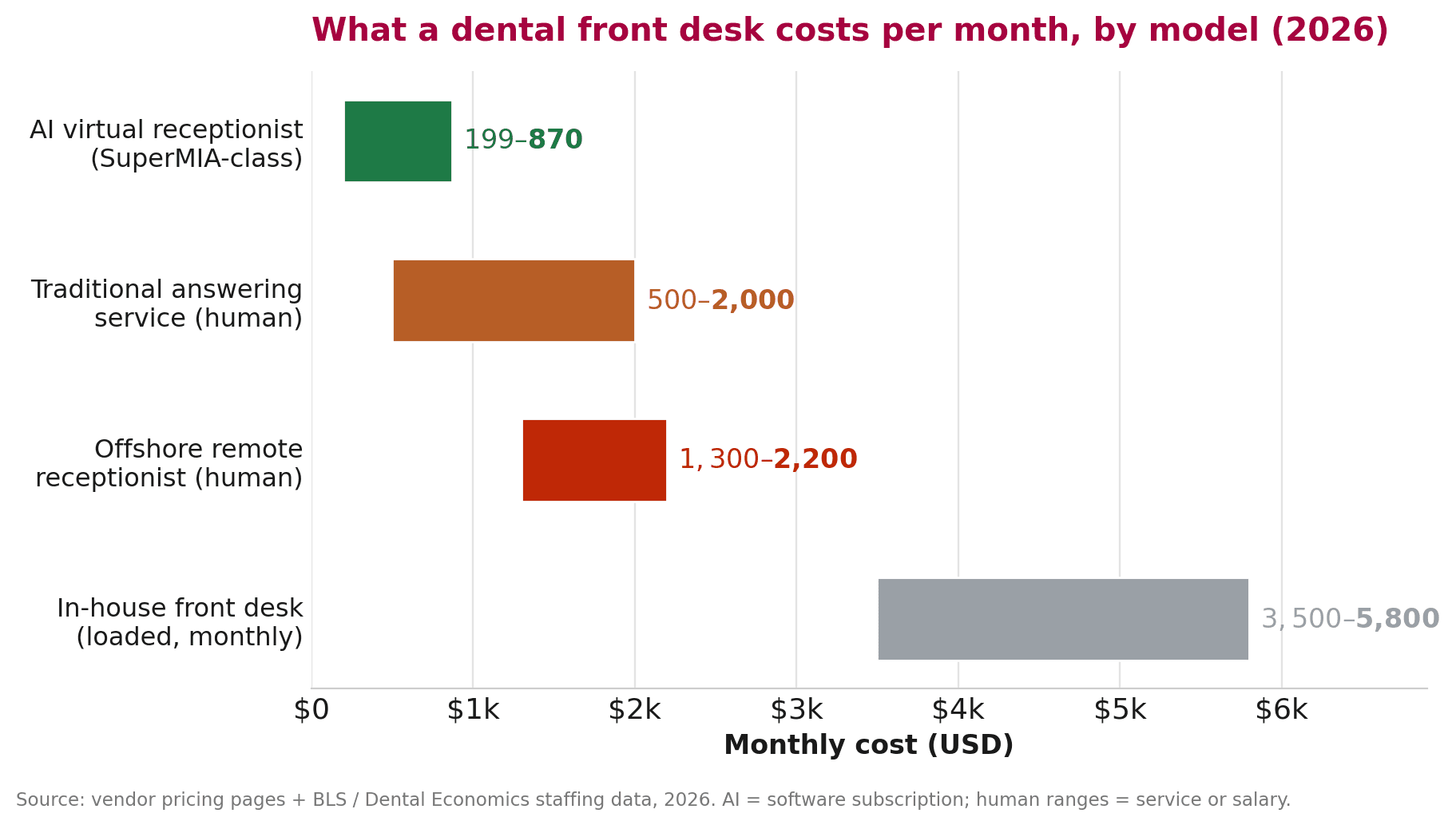
Here's the picture across every model, including what it costs to keep a receptionist on payroll.
| Model | Typical Monthly Cost | 24/7? | Books Into PMS? |
|---|---|---|---|
| AI virtual receptionist | $199–$870 | Yes, real time | Yes |
| Traditional answering service | $500–$2,000+ | Varies | No - messages only |
| Offshore remote receptionist | $1,300–$2,200 | Limited hours | Yes, manually |
| In-house front desk (loaded) | $3,500–$5,800 | Office hours only | Yes |
From the field: Across our dental deployments, after-hours calls are where the cheapest model quietly loses money. A practice that sends 25–30% of calls to voicemail at night is paying staff salaries during the day and losing new patients at night.
If you want a full breakdown of how dental AI receptionists work before comparing costs, see our dental AI receptionist guide - covering platform evaluation, deployment criteria, and 2026 pricing across all vendors.
What It Actually Costs by Model
Vendors price four ways. The model matters as much as the headline number, because the wrong model can double your bill in a busy month.
Flat Monthly Subscription
You pay one fixed fee for a set of features and usage. It's predictable and easy to budget. Best for practices with steady call volume.
Per-Call or Per-Minute
You pay for what the system handles. It looks cheap upfront but climbs fast during seasonal spikes or marketing pushes. Best for low-volume offices testing AI.
Tiered Usage with Overages
A bundle of usage at a monthly fee, plus charges once you cross the cap. Fine for moderate volume - risky if your call flow is uneven.
Hybrid (AI + Human Escalation)
A base AI fee plus charges for human backup or extra services. It fits complex practices - orthodontics, implants - where some calls truly need a person. You can compare the trade-offs in detail in our breakdown of AI vs. a human front desk.
| Pricing Model | Typical Range | Best For |
|---|---|---|
| Flat subscription | $199–$870/mo | Steady volume, predictable budgeting |
| Per-call / per-minute | $0.50–$2.00 per call | Low-volume or early testing |
| Tiered usage | $400–$900/mo + overages | Moderate volume with some fluctuation |
| Hybrid (AI + human) | Base fee + variable | Complex scheduling, human backup |
The pattern is simple: per-minute billing punishes growth. When your marketing works and calls climb, per-minute costs climb too. Flat-rate does the opposite - cost per call drops as volume rises. Above ~200 calls a month, flat-rate almost always wins.
See what's included at each tier
Compare AI dental receptionist plans and find the right fit for your practice.
See what's included at each tier →The Four Pricing Models
Understanding how you'll be billed is as important as the headline price. Here's what separates cheap from "looks cheap but isn't."
AI vs. Human vs. In-House: The Real Comparison
This is the decision most owners are actually weighing. The honest answer: it's rarely AI versus staff. It's AI plus staff versus staff alone handling every call, every interruption, and every after-hours inquiry.
| Factor | AI Receptionist | Human Answering Service | In-House Hire |
|---|---|---|---|
| Monthly cost | $199–$870 | $500–$2,000+ | $3,500–$5,800 (loaded) |
| Availability | 24/7 | Varies | Office hours only |
| Concurrent calls | Unlimited | Limited by staff | One at a time |
| Books appointments | Yes, real time | No - messages | Yes |
| Complex / empathy calls | Escalates | Good | Best |
| In-office tasks | No | No | Yes |
Where humans still win - and we'll say it plainly. A person is better at complex insurance questions, upset patients, and in-office coordination. AI is better at never missing a call, handling ten at once, and working at 9 PM. The cheapest practice runs both - AI on the phones, people on the floor.
A full-time U.S. front desk role costs $42,000–$70,000 a year once you add benefits and payroll taxes (see Bureau of Labor Statistics wage data). That's the benchmark every other model is measured against.
Hidden Fees to Watch
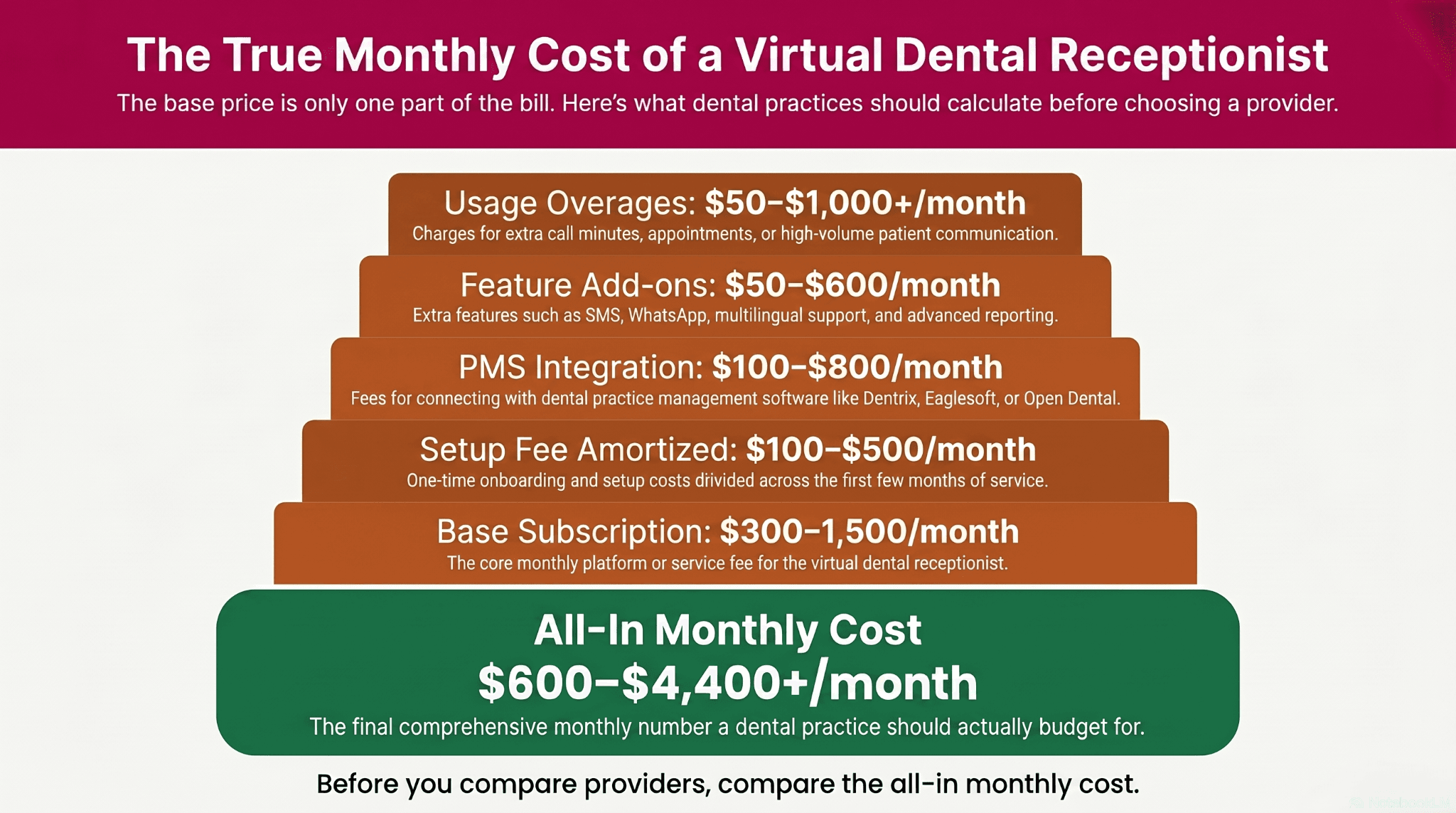
The advertised monthly price is rarely the full cost. This is the single biggest mistake practices make when comparing vendors.
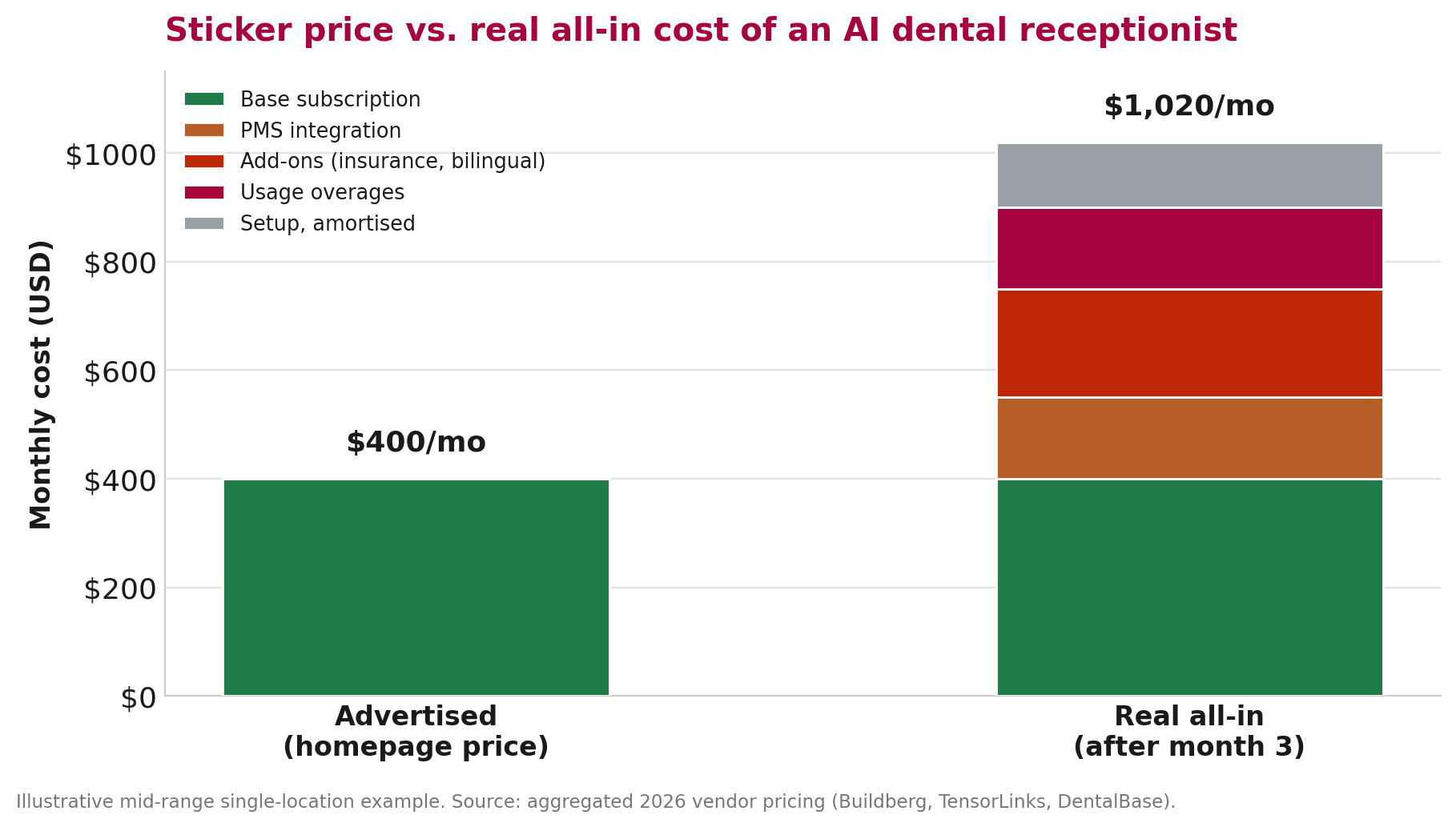
Common extras include:
- Setup / onboarding: $500–$3,500 one-time. Ask exactly what’s covered.
- PMS integration: $50–$299/month, or extra for “real booking” vs. message-only.
- Usage overages: per-minute charges that spike in busy or seasonal months.
- Add-ons: insurance verification ($99–$299), bilingual agent ($50–$150), SMS, recall campaigns.
- Contract terms: annual lock-ins and 20–40% renewal hikes after promo pricing ends.
Compliance and data: Any dental tool touching patient data needs the right safeguards. SuperMIA is designed to support HIPAA-aligned workflows, with a BAA available on eligible plans (see HHS HIPAA requirements). We publish transparent SuperMIA pricing so there's no month-three surprise.
How Fast Does It Pay for Itself?
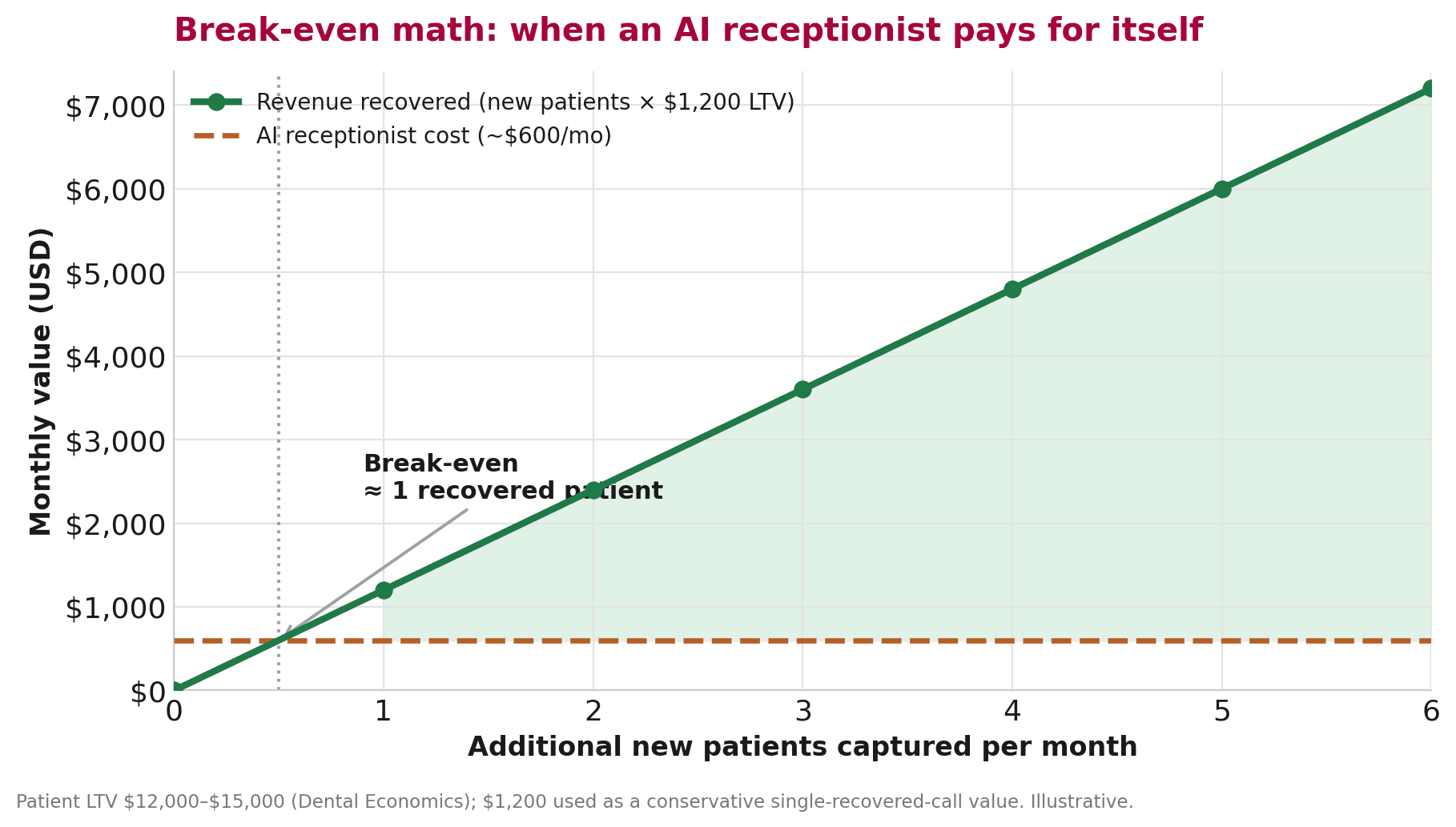
Most practices break even within 60 to 90 days. The reason is simple: a single recovered new patient is worth far more than a month of service.
According to industry reporting, around 80% of callers who reach voicemail never leave a message and don't call back. Those aren't hypothetical losses - they're patients who already wanted to book.
The Break-Even Formula (Copy This)
1. Count your missed calls per month (pull from your voicemail system or PMS logs, especially after-hours).
2. Estimate new-patient value - industry estimates run $1,200 per recovered call up to $12,000–$15,000 lifetime value.
3. Multiply: Recovered calls × Patient LTV = Recovered revenue
4. Compare to your all-in subscription: If recovered revenue > subscription cost, you're past break-even.
Worked example: Recover 2 new patients/month × $1,200 = $2,400 recovered. Subtract a $600 all-in plan = $1,800/month net profit. Even one recovered patient clears the cost.
Where SuperMIA Fits on Price
SuperMIA’s AI dental receptionist sits in the flat-rate AI band: predictable monthly pricing, 24/7 answering, real-time booking into your PMS, and no per-minute surprise. It handles the repetitive phone work so your team stays with patients in the chair. See all SuperMIA dental practice deployments for industry-specific results. The underlying voice capability is built on the SuperMIA AI voice bot - purpose-built for inbound call handling - and the full SuperMIA platform covers chat, workflow, and scheduling alongside voice.
What that looks like in practice - with attribution:
Case study - Media Brite Smile Dental
After deploying SuperMIA, the practice cut no-shows from 14.2% to 5.8%, reached a 94% appointment-slot fill rate, and grew revenue 57% - while answering 43% faster. The gain came from calls that used to hit voicemail now turning into booked, confirmed appointments.
See your numbers
Book a working session and map the cost savings for your practice.
Book a working session and see your numbers →What to Ask Before You Sign
These questions separate real capability from a polished demo:
- Can it book directly into our PMS, or only collect a lead?
- What’s included in the monthly price, and what costs extra?
- How are overages calculated?
- Is there a BAA, and what are the HIPAA controls?
- Month-to-month, or am I locked into a contract?
- Can I call it right now and test a real booking?
So, Is It Worth It?
For most practices, yes - but not because it's blindly "cheaper than staff." It's worth it because it answers every call, books while you sleep, and recovers patients you were quietly losing to voicemail. Match the model to your call volume, read the all-in number, and run the break-even on your own figures.
If you want a practical evaluation path, skip the sales deck and run the break-even formula on your own missed-call data.
Frequently Asked Questions

Harikrishna Patel
Harikrishna Patel is the founder of MIA – My Intelligent Assistant, the AI automation platform built under Botfinity Inc. in Dallas, Texas. With 15+ years in software engineering, AI/ML, and enterprise solution design, he focuses on creating practical, scalable AI tools that help businesses automate support, workflows, and operations through voice and chat.