
Table of Contents
- The quick verdict: which fits which DSO?
- How we compared them
- Side-by-side comparison table
- SuperMIA - the cross-channel platform
- IntelePeer - the enterprise option
- Viva - the dental-only all-in-one
- Pricing: what each vendor actually publishes
- Which should your DSO choose?
- Frequently asked questions
A quick note on fairness: this comparison is published by SuperMIA. We've represented IntelePeer and Viva from their own public materials as of 2026, and we link to their pages so you can check. Vendor features and pricing change - confirm the current details before you decide.
Quick Answer
There's no single "best" dental AI receptionist - the right pick depends on your size and goals. Viva fits single and small multi-location practices that want transparent tiers and an all-in-one front office. IntelePeer fits large enterprise DSOs needing carrier-grade scale. SuperMIA fits groups that want voice, chat, and workflow automation on one platform, deployed fast.
Key takeaways
- All three handle inbound dental calls, book into leading PMS systems, and support HIPAA-aligned workflows.
- Viva is dental-only with public pricing ($349–$1,199/mo) - strongest for single and small multi-location practices.
- IntelePeer is enterprise-grade with custom pricing - strongest at large-DSO scale (100K+ calls/month, per its site).
- SuperMIA is a cross-channel platform (voice + chat + workflow), 40+ languages, ~48-hour deploy, pay-per-task.
- Match the tool to your PMS, call volume, and number of locations - then test a live booking before signing.
The quick verdict: which fits which DSO?
If you remember one thing: these three target different ends of the market. Picking well is less about which is "best" and more about which matches your size and how many tools you want to run.
Before comparing platforms, see our dental AI receptionist guide for a full breakdown of how these systems work, what features matter, and how to evaluate deployment fit for your practice.
Still deciding whether to automate the phones at all? Start with whether AI or a human front desk fits first, then come back to choose a vendor.
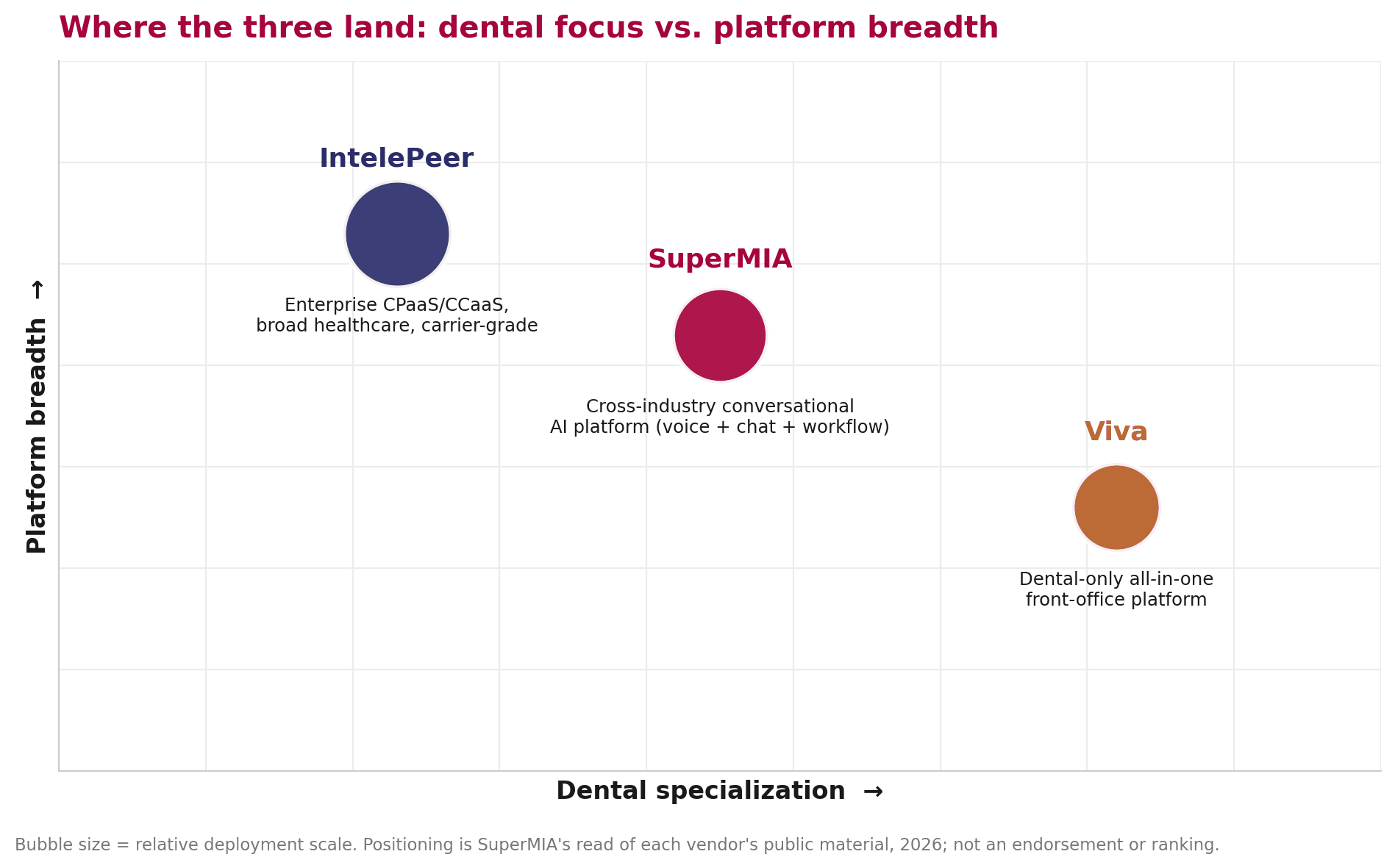
Figure 1. Dental specialization vs. platform breadth.
How we compared them
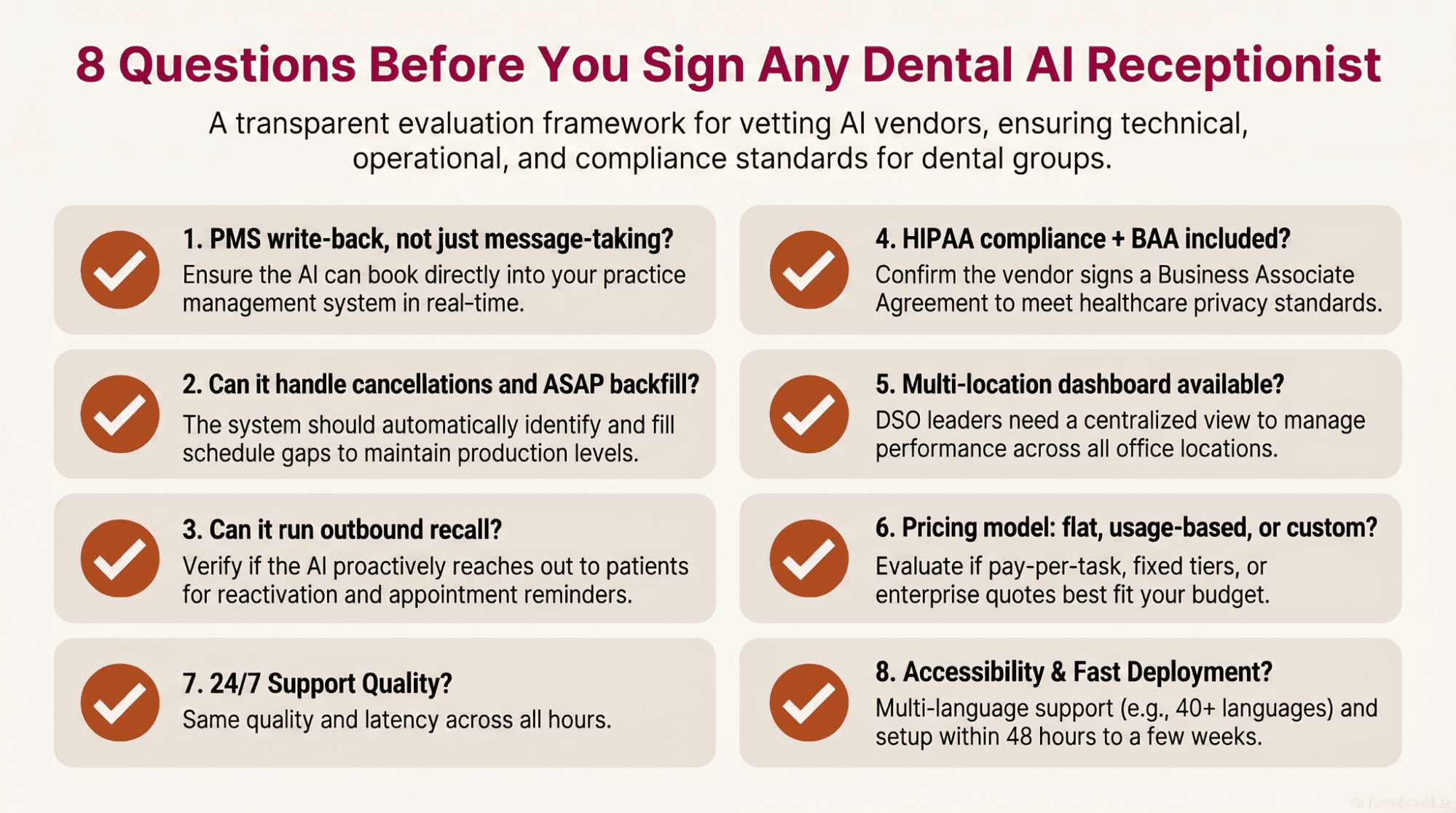
We looked at the criteria that actually decide a dental deployment, drawing on each vendor's public materials and neutral industry context from the ADA Health Policy Institute:
- PMS integration depth - real write-back, not message-taking
- Channels - voice, SMS/chat, email
- Languages and after-hours coverage
- Compliance - HIPAA, SOC 2, BAA availability
- Multi-location/DSO management
- Pricing model and transparency
- Deployment speed
Side-by-side comparison table
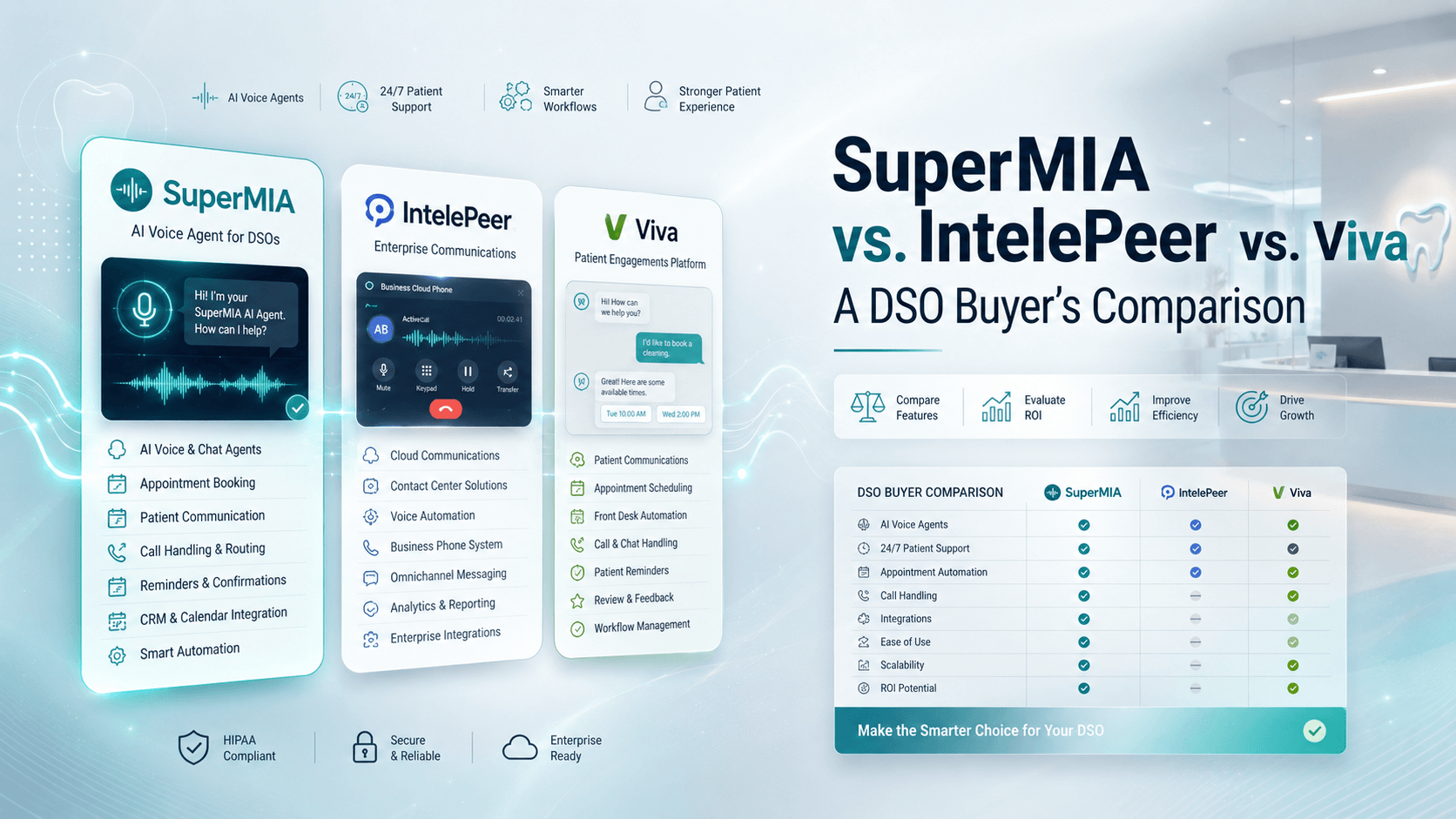
Here's the at-a-glance view. For SuperMIA's full capabilities, see the full feature set.
| Criterion | SuperMIA | IntelePeer | Viva |
|---|---|---|---|
| Built for | Cross-industry platform | Enterprise healthcare | Dental only |
| Channels | Voice + chat + workflow | Voice + SMS + email | Voice + text + more |
| Languages | 40+ | Multiple | 100+ (per Viva) |
| PMS integration | Yes (confirm yours) | Dentrix, Dentrix Ascend (per site) | Dentrix Ascend, CareStack, Cloud9 (per site) |
| Compliance | HIPAA-aligned; BAA* | Healthcare-grade (per site) | SOC 2 Type II + HIPAA (per Viva) |
| Multi-location/DSO | Yes | Enterprise scale | Per-site branded agents |
| Pricing model | Pay-per-task | Custom quote | Public tiers $349–$1,199 |
| Deployment | ~48 hours | Weeks (per site) | Fast (per Viva) |
| Named proof | Media Brite (dental) | Jefferson Dental, 42 North (per site) | Soothing Dental (per Viva) |
* SuperMIA is designed to support HIPAA-aligned workflows with a BAA on eligible plans. Competitor cells reflect each vendor's published claims - verify current details directly.
SuperMIA - the cross-channel platform
SuperMIA is a conversational AI platform that runs voice, chat, and workflow automation together. The core call-handling engine is the SuperMIA AI voice bot - purpose-built for inbound and outbound phone conversations. For dental, SuperMIA's AI dental receptionist answers calls 24/7, books into your PMS, and handles routine front-desk work across phone, web, and messaging - in 40+ languages, typically live in about 48 hours on a pay-per-task model. See all dental practice results on SuperMIA's dental deployments page.
| Strengths | Trade-offs |
|---|---|
| Voice + chat + workflow on one platform | Not dental-exclusive - broad platform, not a single-vertical suite |
| Fast (~48-hour) deployment, pay-per-task | Newer brand at the largest enterprise scale vs. carrier incumbents |
| Named dental outcome (Media Brite) with attribution | Some advanced add-ons may need scoping per practice |
Proof - Media Brite Smile Dental
After deploying SuperMIA, the practice cut no-shows from 14.2% to 5.8%, reached a 94% appointment-slot fill rate, and grew revenue 57% while answering 43% faster.
IntelePeer - the enterprise option
Per IntelePeer's healthcare AI receptionist page, its SmartAgent product delivers conversational and agentic AI on a carrier-grade communications platform, marketed to Dental Service Organizations. It handles voice, SMS, and email, with scheduling, insurance questions, billing routing, and revenue-cycle workflows, and integrates with EHR/PMS systems including Dentrix and Dentrix Ascend.
| Strengths | Trade-offs |
|---|---|
| Enterprise/carrier-grade scale | Broad healthcare focus - not purpose-built for dentistry alone |
| Proven at very high call volumes (100K+/mo, per its site) | Pricing is custom - no public floor to compare quickly |
| Strong analytics + revenue-cycle workflows | Enterprise sales + onboarding can run longer (weeks, per site) |
Best fit: large, multi-state DSOs that need enterprise governance, deep telephony, and are comfortable with a custom enterprise procurement.
Viva - the dental-only all-in-one
Per Viva's published pricing and product pages, Viva is a dental-only platform built to replace several front-office tools at once. It covers inbound and outbound (recall/reactivation), 100+ languages with auto-detection, payments, forms, and analytics; lists SOC 2 Type II and HIPAA; and integrates with Dentrix Ascend, CareStack, and Cloud9. Pricing is public: Gold $349, Platinum $899, Diamond $1,199 per month on a usage-based credit model, no contract.
| Strengths | Trade-offs |
|---|---|
| Dental-only depth + transparent tiers | Single-vertical - no use beyond dental practices |
| 100+ languages; all-in-one front office | Replacing 3–4 tools may be more than a lean practice needs |
| Per-location branded agents + central dashboard | Newer at the very top of the enterprise-DSO range |
Best fit: single-location and small multi-location practices that want one dental-specific vendor with predictable, published pricing.
Pricing: what each vendor actually publishes
Pricing transparency varies widely - and that itself is a decision factor. For the full picture of what a virtual receptionist really costs once add-ons are counted, see the real all-in cost of a virtual receptionist.
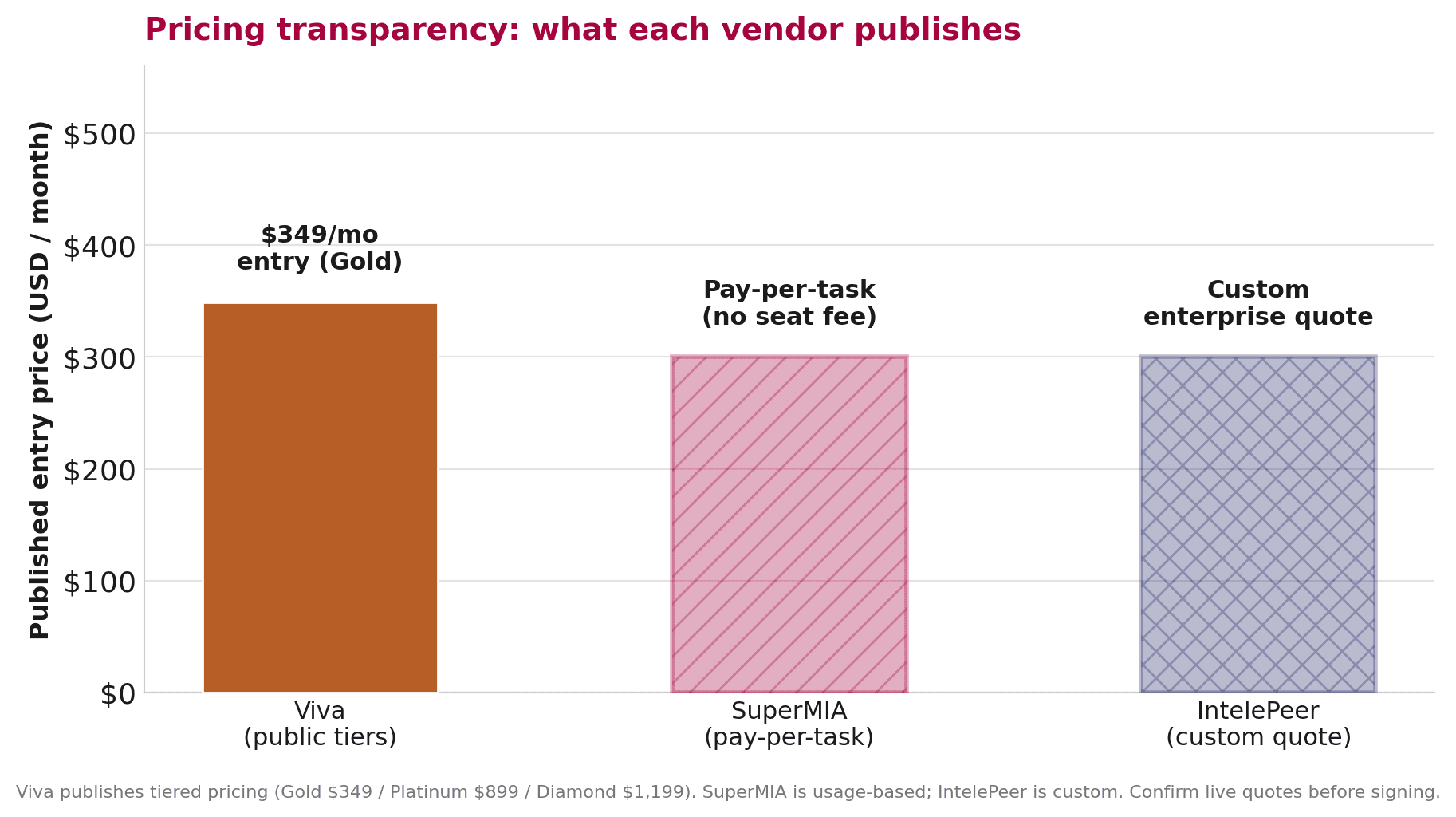
Figure 2. What each vendor publishes.
SuperMIA publishes transparent SuperMIA pricing on a pay-per-task model (no seat fees). Viva publishes fixed tiers. IntelePeer quotes custom enterprise pricing. Whichever you choose, get the quote in writing for your call volume and PMS.
Which should your DSO choose?
Start with the outcome and your size, not the brand. The decision usually comes down to how many locations you run, how many tools you want to consolidate, and how much pricing transparency you need up front.
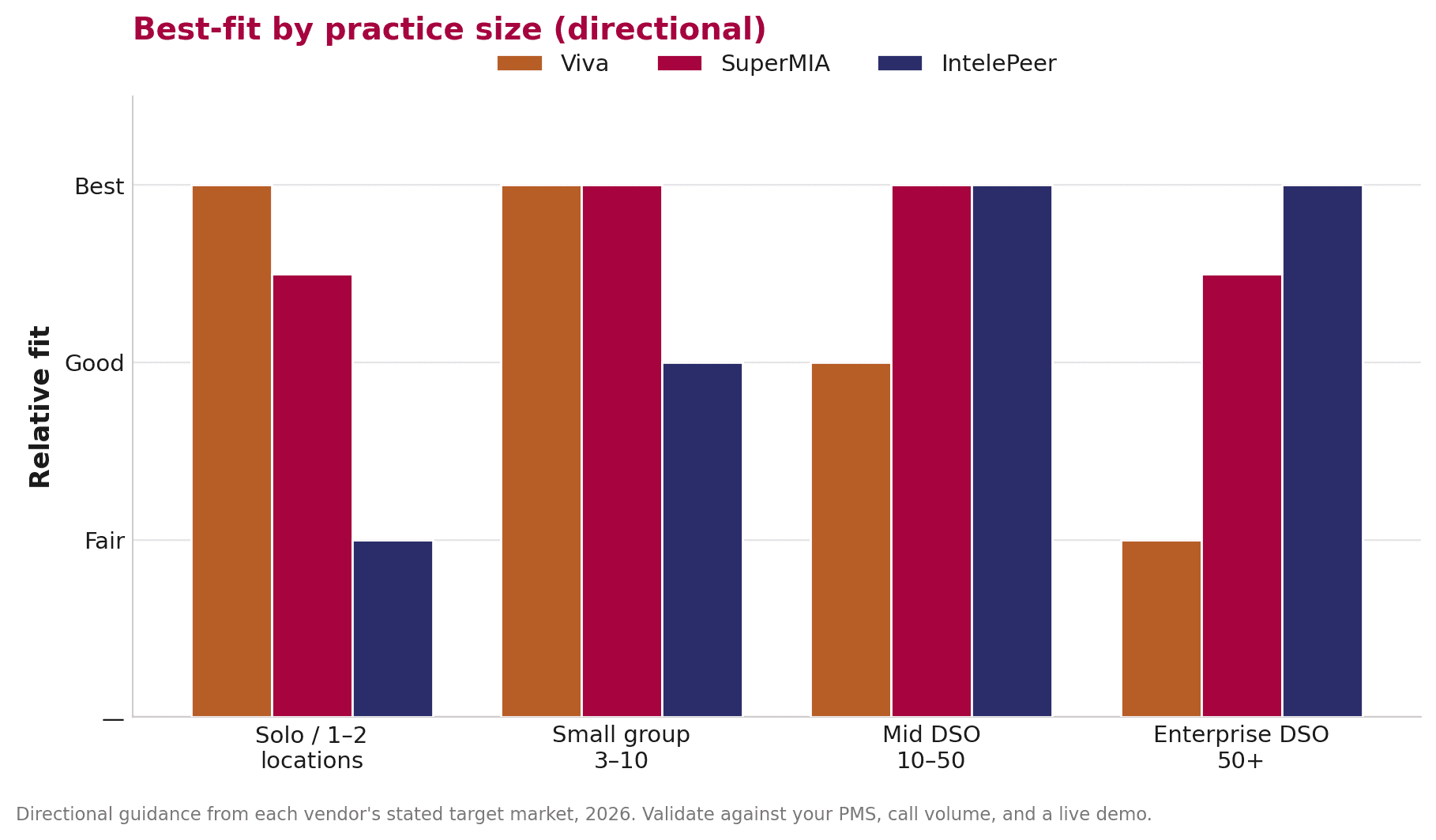
Figure 3. Directional best-fit by practice size.
A decision framework by practice size
- Solo / 1–2 locations: a dental-only tool with transparent entry pricing (e.g., Viva's Gold) is the simplest start.
- Small-to-mid group wanting voice + chat + workflow on one platform: SuperMIA fits - especially the AI voice bot for inbound call handling alongside chat and workflow.
- Mid-to-large DSO consolidating the whole front office in dental: weigh Viva (dental depth) against SuperMIA (platform breadth).
- Enterprise DSO (50+ sites) needing carrier-grade governance: IntelePeer's enterprise model is built for that scale.
- In every case: confirm PMS write-back, ask for a BAA, and test a real booking before signing.
The honest takeaway: all three can answer your phones well. The right choice is the one that matches your PMS, your number of locations, and how much you want to run from a single platform. The fastest way to know is to see it handle your actual call flow.
If you want a curated shortlist instead of the full matrix, see our best dental AI receptionist guide with verified outcome data across 2026 deployments.
Book a side-by-side demo on your own numbers.
48-hour deploy. Voice + chat + workflow from one credit pool. See it handle your actual dental call flow.
Book a side-by-side demo →Frequently Asked Questions

Harikrishna Patel
Harikrishna Patel is the founder of MIA – My Intelligent Assistant, the AI automation platform built under Botfinity Inc. in Dallas, Texas. With 15+ years in software engineering, AI/ML, and enterprise solution design, he focuses on creating practical, scalable AI tools that help businesses automate support, workflows, and operations through voice and chat.