

Table of Contents
Agentic AI design patterns are reusable architectural blueprints for building autonomous AI agents that reason, act, and self-correct reliably. The seven core patterns are ReAct (reason + act), Reflection (self-critique), Tool Use (call external systems), Planning (decompose tasks), Multi-Agent Collaboration (specialized agents working together), Sequential Workflows (fixed step order), and Human-in-the-Loop (human approval gates). Most production agents layer four or five of these. Start simple and add patterns only when a failure mode demands it.
Key takeaways
- Most agent failures are architectural, not model. The LLM usually works; the design around it doesn't.
- There are 7 core patterns. ReAct, Reflection, Tool Use, Planning, Multi-Agent, Sequential, Human-in-the-Loop.
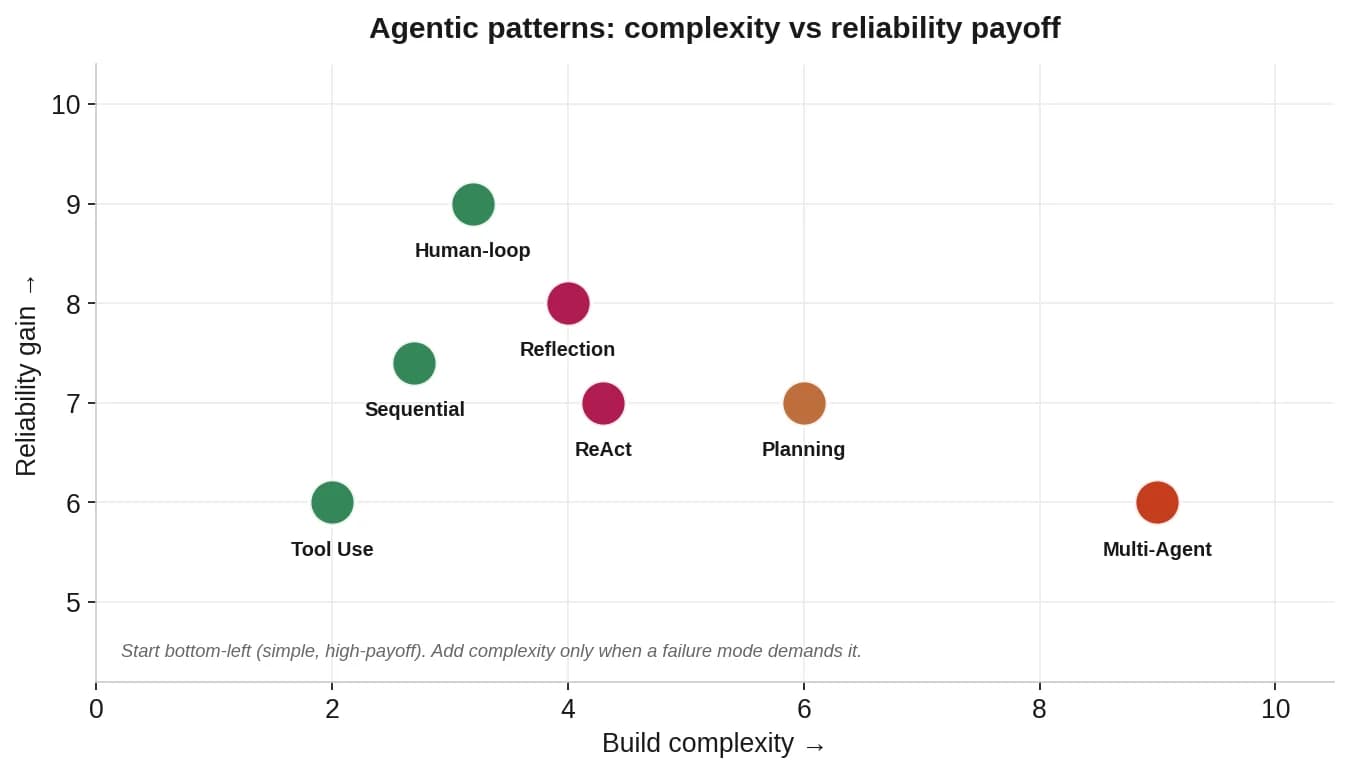
- Start simple. Tool Use + ReAct handle most real tasks; add complexity only at a clear limit.
- Patterns layer. Production systems combine four or five - there's no single-pattern app.
- Reflection and Human-in-the-Loop buy reliability. The cheapest insurance against hallucinated or harmful actions.
What are agentic AI design patterns?
Agentic AI design patterns are reusable architectural blueprints for building autonomous agents that reason, act, and self-correct. They define how an agent structures its thinking and its actions - the same way classic software design patterns define how code is organized. Get them right and your agent is reliable; get them wrong and it loops, hallucinates, or takes bad actions.
An "agent" here means an LLM-driven system that pursues a goal with some autonomy - not a one-shot chatbot reply. (For how agents differ from simpler systems, see how agents differ from chatbots and voice agents.) If you're new to building them, start with building effective AI agents and come back here for the architecture.
Why AI agents fail in production
Most production AI agent failures are architectural, not model-quality problems. The LLM works fine. The design around it doesn't. You tune prompts for weeks, then ship - and the agent loops infinitely, burns API credits, or confidently does the wrong thing.
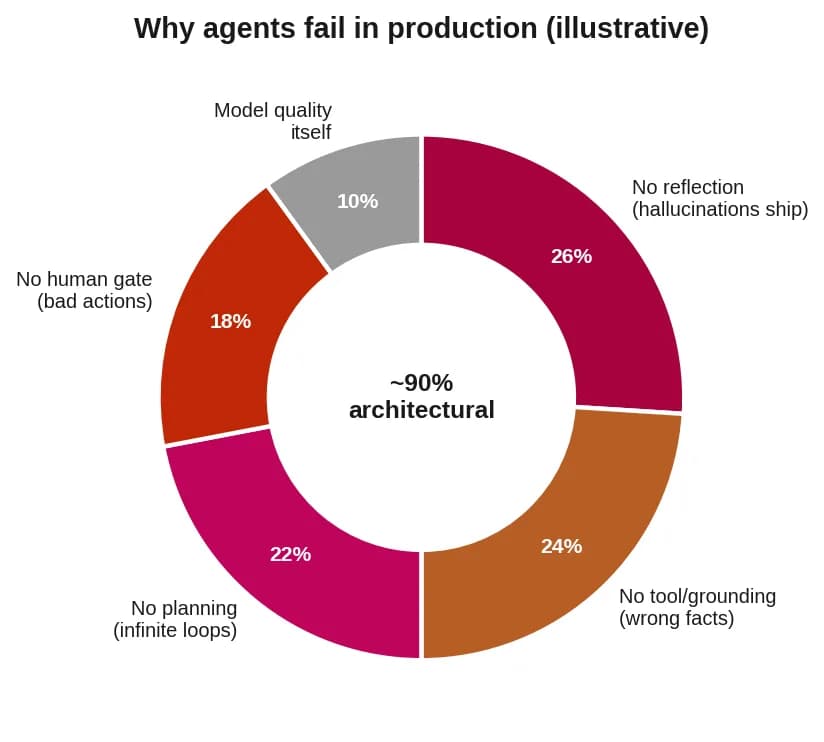
Each failure maps to a missing pattern: hallucinations ship because there's no Reflection; wrong facts because there's no Tool Use grounding; infinite loops because there's no Planning; bad actions because there's no Human-in-the-Loop. It's the same lesson in major-vendor agent guidance: reliability comes from architecture, not just a better model. The patterns below are the fixes.
The 7 agentic AI design patterns
The seven agentic AI design patterns are Tool Use, ReAct, Reflection, Planning, Multi-Agent Collaboration, Sequential Workflows, and Human-in-the-Loop. Here's what each solves.
| Pattern | What it solves | When to use |
|---|---|---|
| Tool Use | Grounds the agent in real data/actions | Almost always - the baseline |
| ReAct | Adapts step-by-step to new info | Multi-step, unpredictable tasks |
| Reflection | Catches errors before delivery | When output quality is critical |
| Planning | Decomposes complex goals | Long, multi-step objectives |
| Multi-Agent | Splits work across specialists | Genuinely distinct roles |
| Sequential Workflow | Enforces a fixed step order | Known, repeatable processes |
| Human-in-the-Loop | Gates high-stakes actions | Irreversible or risky decisions |
1. Tool Use
The baseline pattern: the agent calls external tools - search, APIs, databases, code execution - instead of relying on the model's memory. Without it, an agent can only talk; with it, it can act. Connecting tools to real systems is where most of the engineering lives; see integration challenges in agentic workflows.
2. ReAct (Reason + Act)
ReAct interleaves reasoning and action: the agent thinks, takes a tool action, observes the result, then thinks again. This loop lets it adapt mid-task instead of committing to one plan up front. It's the workhorse pattern for customer support, research, and diagnosis - formalized in the original ReAct paper.
3. Reflection
After generating output, the agent critiques its own work against quality criteria and revises before delivering - an automated editorial gate. It's a second LLM pass that slashes hallucination rates. Cheap insurance for any high-stakes output, and grounded in the Reflexion research.
4. Planning
The agent decomposes a complex goal into ordered sub-tasks before executing, rather than improvising. Planning prevents the wandering and infinite loops that plague open-ended tasks. Use it for long, multi-step objectives like a full research report.
5. Multi-Agent Collaboration
Multiple specialized agents collaborate - e.g., a researcher, a writer, and a reviewer - each owning part of the task. It adds capability but also cost, latency, and coordination overhead. Reach for it only when roles are genuinely distinct; a single good agent handles most work.
6. Sequential Workflows
A fixed, deterministic step order - research → draft → review → format - where each stage feeds the next. It trades flexibility for reliability and is ideal for known, repeatable processes. This overlaps heavily with classic workflow automation.
7. Human-in-the-Loop
A human approves or corrects the agent at defined checkpoints - before a refund, a send, or any irreversible action. It's the simplest, highest-value safety pattern: it keeps autonomy without handing over accountability.
How to choose a pattern
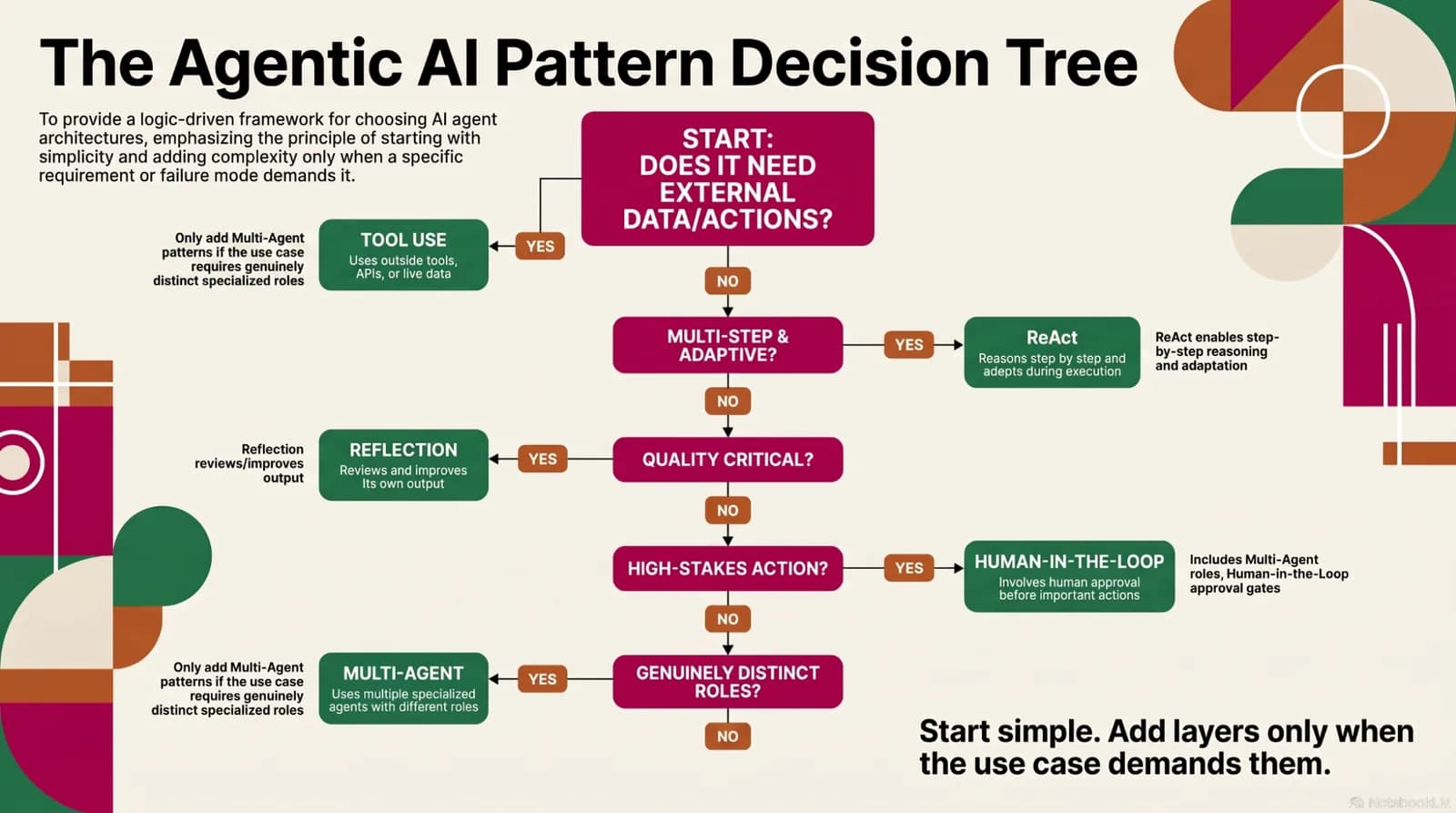
Start with the simplest pattern that fixes your main failure mode, then add complexity only when needed. The expensive mistake is jumping to multi-agent systems prematurely.
- Does it need external data or actions? Add Tool Use (almost always).
- Is the task multi-step and unpredictable? Add ReAct.
- Does output quality matter? Add Reflection.
- Is any action high-stakes or irreversible? Add Human-in-the-Loop.
- Are the roles genuinely distinct? Only then consider Multi-Agent.
How patterns layer in real systems
No production system uses just one pattern - real agents combine four or five. The pattern set is a toolkit, not a menu where you pick one.
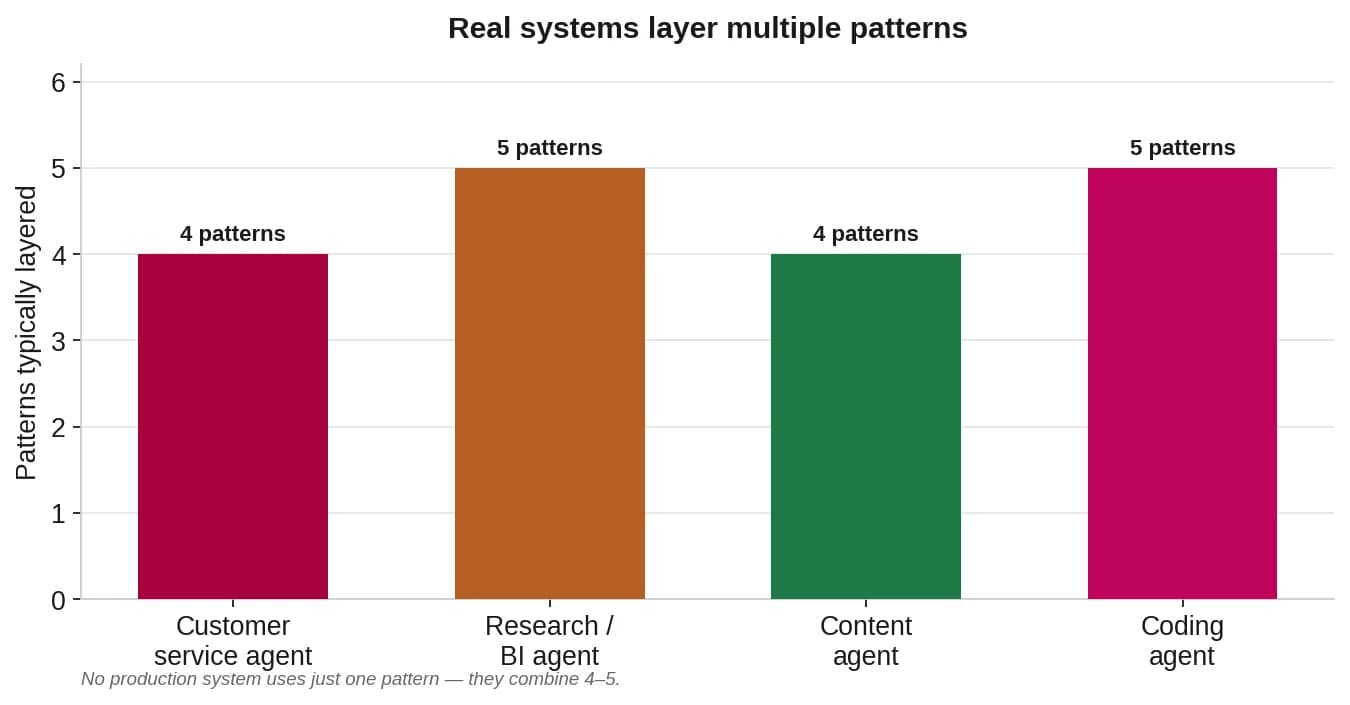
- Customer-service agent: Tool Use (CRM lookup) + ReAct (diagnose) + Human-in-the-Loop (refund approval) + Sequential (standard resolution).
- Research / BI agent: Planning (decompose) + Tool Use (pull data) + Multi-Agent (analyst + writer) + Reflection (fact-check) + Human-in-the-Loop (sign-off).
- Content agent: Tool Use (research APIs) + ReAct (adaptive research) + Reflection (draft critique) + Sequential (research → draft → format).
Apply these patterns without code
You don't need a framework and a research team to use these patterns. Tool Use, Sequential Workflows, and Human-in-the-Loop are native to visual builders; ReAct and Reflection map to LLM nodes with loop logic. You can build these patterns on a no-code agent platform - MIA's no-code agent platform lets you wire tools, reasoning loops, approval gates, and multi-agent handoffs without writing the orchestration yourself. Complex multi-agent planning may still warrant a code framework, but most business agents don't need one.
Frequently asked questions
What are agentic AI design patterns?
Agentic AI design patterns are reusable architectural blueprints for building autonomous AI agents that reason, act, and self-correct reliably. The seven core patterns are ReAct, Reflection, Tool Use, Planning, Multi-Agent Collaboration, Sequential Workflows, and Human-in-the-Loop. They define how an agent structures its reasoning and actions, and most production systems combine several of them.
What is the ReAct pattern?
ReAct (Reason + Act) is an agentic pattern where the agent alternates between reasoning about a problem and taking actions with tools, then observing the result and reasoning again. This loop lets the agent adapt step by step instead of committing to a single plan, which makes it well suited to multi-step tasks like customer support and research.
How do I choose the right agentic AI pattern?
Start with the simplest pattern that addresses your main failure mode. Use Tool Use and ReAct for most tasks; add Reflection when output quality matters, Planning for complex multi-step goals, Human-in-the-Loop for high-stakes actions, and Multi-Agent only when distinct specialized roles are genuinely needed. Avoid jumping to complex patterns prematurely.
Why do AI agents fail in production?
Most production AI agent failures are architectural, not model-quality problems. The language model often works fine, but the design around it fails - agents loop infinitely, take ungrounded actions, or ship hallucinations because the system lacks reflection, tool grounding, planning, or a human approval gate. Choosing the right design patterns prevents these failures.
What is the difference between single-agent and multi-agent systems?
A single-agent system uses one agent that reasons and acts, often with Tool Use and ReAct. A multi-agent system splits work across specialized agents that collaborate, such as a researcher, a writer, and a reviewer. Multi-agent adds power but also cost and complexity, so most tasks are better served by a single well-designed agent.

Urvil Dhanani
Urvil Dhanani is the AI/ML Lead at SuperMIA, focused on the architecture behind reliable conversational AI - agent design patterns, voice and chat orchestration, and platform evaluation. He writes practical, vendor-neutral guides that help technical teams build and choose AI systems that hold up in production.