
Table of Contents
Is Drift shutting down? According to multiple industry reports, Clari and Salesloft announced a gradual sunset of Drift in March 2026, naming a successor product and giving existing customers a limited window — reported as roughly 60 to 90 days — to migrate. Active development has wound down. Confirm your own contract dates directly with your account team rather than planning around any published timeline.
Book a demo — and see it running on your own site →
Key takeaways
- Export your data now. Conversation history, contacts and playbook logic get much harder to retrieve once a contract lapses.
- It's a Clari + Salesloft decision, not a Salesforce one. The wrong version of this is circulating and it misdirects evaluations.
- Drift did two different jobs. Pipeline routing and question-answering — the right replacement depends entirely on which you bought it for.
- Matching Drift's full feature list is the trap. That's how you end up back on an enterprise contract you never needed.
- Categories, not a leaderboard. Products change monthly; shortlist two categories, then compare inside them.
If you are reading this, you are probably not casually comparing chat tools. You are working out what to do before a contract lapses. That is a different problem, and most 'best alternatives' articles are not much help with it — they open with a product list and end, predictably, by recommending whoever wrote them.
So this guide goes in a different order. First, what actually happened to Drift and what the timeline means. Second, the three things worth doing this week, before you shortlist anything. Third, a way of choosing that starts with the job you used Drift for rather than its feature list. Then the options themselves, compared by category with honest limitations — including a clear statement of who should not choose us. We sell a conversational AI platform, so read us with that in mind; the test of a guide like this is whether it is useful even if you buy nothing from the people who wrote it.
What actually happened to Drift
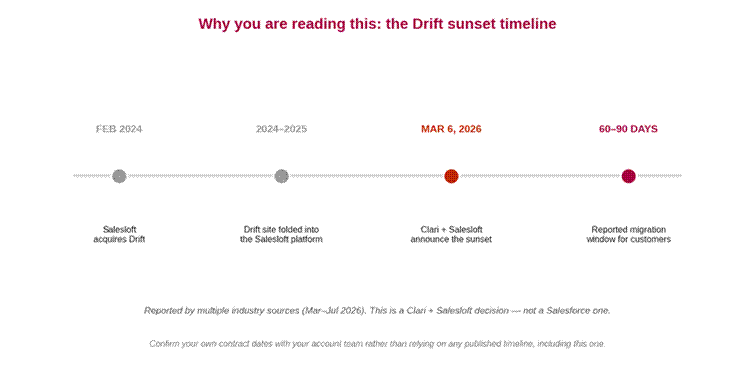
The short version: Drift is being wound down. Salesloft acquired it in February 2024 and folded its website into the Salesloft platform. Then, according to industry reporting on the sunset, Clari and Salesloft announced a gradual sunset of Drift in March 2026, naming a successor product and giving existing customers a limited window — reported as roughly 60 to 90 days — to migrate before contracts lapse. Active development has wound down, which means anyone signing a fresh Drift contract today is buying a product on its way out. The chart above lays out the sequence.
One correction worth carrying, because the wrong version is circulating: this is a Clari and Salesloft decision, not a Salesforce one. Some of the alternatives integrate deeply with Salesforce, which may be how the confusion started, but if you have been told 'Drift is moving to Salesforce,' that is wrong and it may be steering your evaluation in the wrong direction.
A caveat on the timeline itself: the dates and the migration window above come from industry reporting, and reporting on wind-downs is often approximate. Your own contract terms are what actually govern your situation, and they vary by customer. Confirm your renewal date and your options directly with your account team rather than planning around any published timeline — including this one.
Before you shortlist anything: three things to do this week
The instinct under time pressure is to start demoing products. That is the wrong first move, and it is how teams end up on a contract that costs more than it should. Do these three things first — they take a couple of hours and they make every later decision easier.
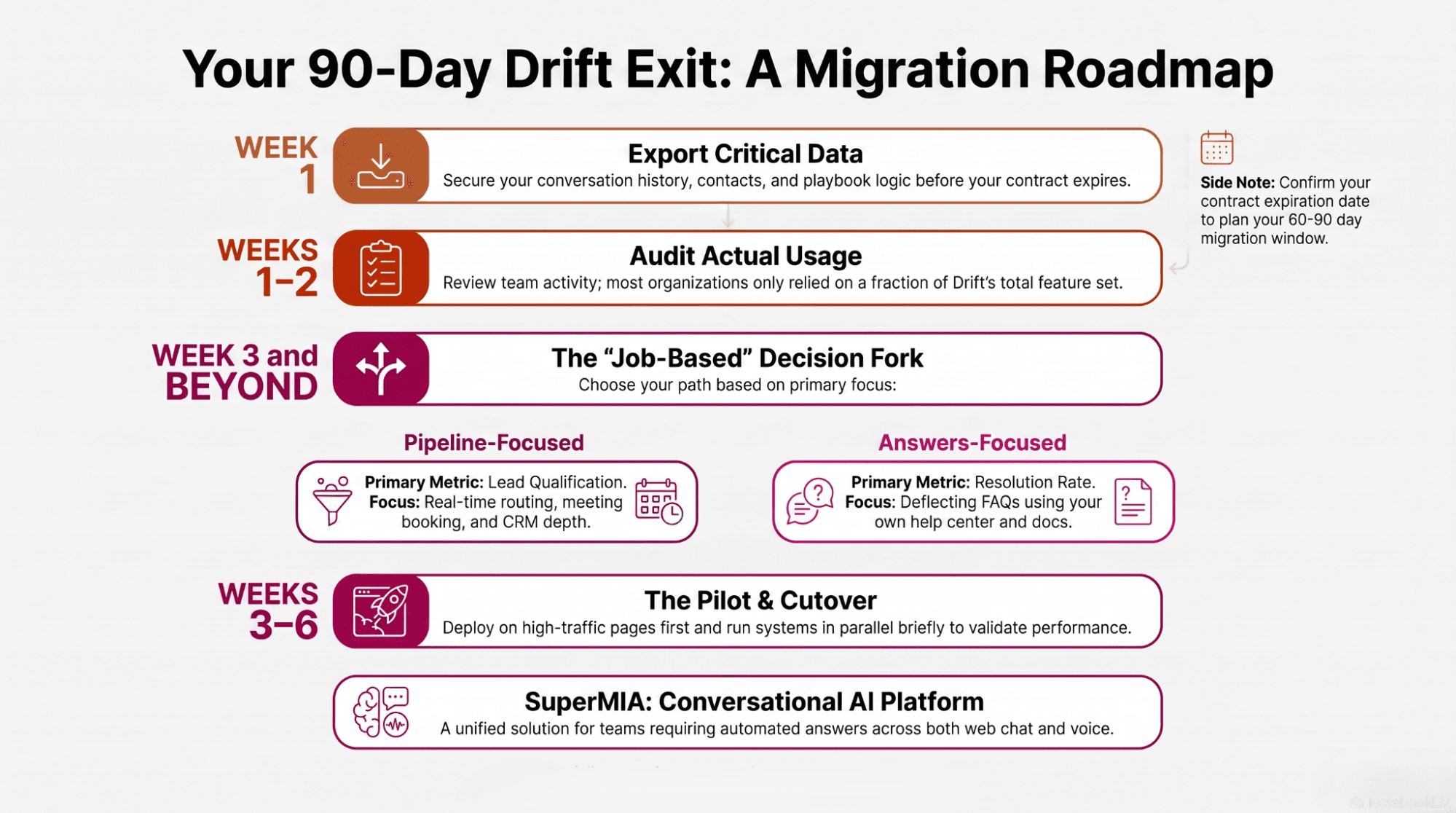
- Export your data now. Conversation history, captured contacts and leads, and your playbook or routing logic. This is the single most time-sensitive item on the list, because data becomes considerably harder to retrieve once an account winds down or a contract lapses. Do it before you evaluate anything.
- Audit what you actually used. Pull up your Drift usage and be honest about it: which playbooks genuinely fired, how many conversations the bot handled versus your team, whether the ABM routing was ever really switched on. Most teams use a fraction of an enterprise platform's feature set. Matching Drift's full feature list is precisely how you end up back on an enterprise contract you did not need.
- Write down the one job you cannot lose. If your Drift widget disappeared tomorrow, what breaks first — sales meetings stop getting booked, or support questions start hitting your inbox? That answer determines your category, and it is the subject of the next section.
Replace the job, not the logo
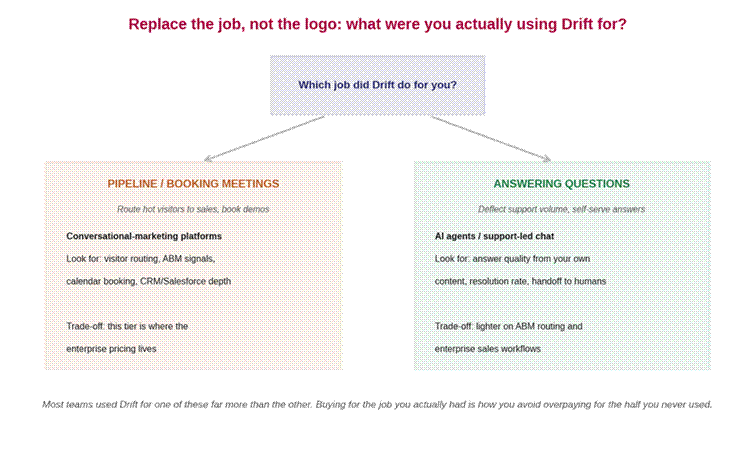
This is the most useful idea in this whole category, and credit where it is due — My AskAI framed it well: Drift did two quite different jobs, and the right replacement depends entirely on which one you were buying. The chart above sets out the split.
If you used Drift for pipeline
You had Drift on your marketing site to catch high-intent visitors, qualify them, route them to the right rep, and get meetings booked. Your success metric was pipeline. What you need is a conversational-marketing platform: real-time routing, calendar booking, account-based signals, and deep CRM integration — particularly if you run Salesforce. Be warned that this is the tier where the enterprise pricing lives; one honest assessment in this space notes that the strongest Salesforce-native option can cost as much as Drift did, sometimes more. If you are leaving Drift because of the price, this category may not solve that problem.
If you used Drift to answer questions
You had it answering the same twenty questions about pricing, features, integrations, and availability, and deflecting work from your team. Your success metric was resolution. What you need is an AI agent that answers accurately from your own content — your docs, help centre, and site — with a clean handoff to a human when it cannot. This category has improved dramatically, pricing is generally far more transparent, and you will likely spend a fraction of what Drift cost. The trade-off is that these tools are usually lighter on ABM routing and enterprise sales workflows.
Most teams lean heavily toward one of these. If you genuinely need both, be realistic about which is primary — and note that a few platforms now span chat and voice, which is worth considering if your customers also phone you. Our guide to how chat and voice compare covers that distinction if it is relevant to you. For a broader evaluation framework, our guide to how to pick an AI chatbot for your business walks through the criteria in more depth than we can repeat here.
The 7 alternatives, compared
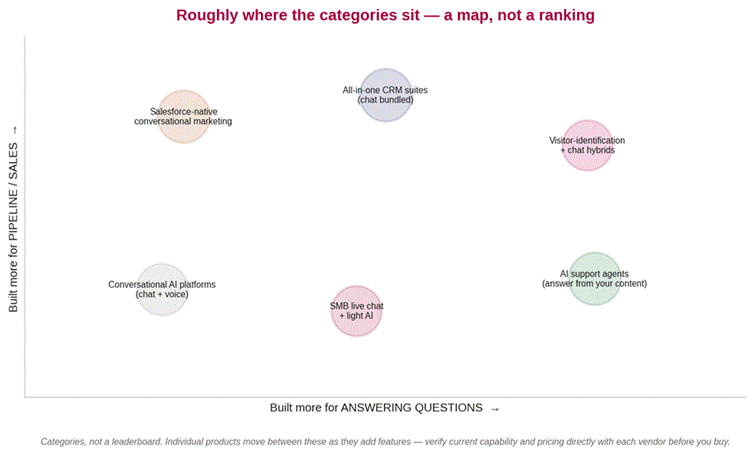
A note on how to read this. We have grouped the options by category rather than ranking individual products one to seven, and that is deliberate. Products in this space add features and change pricing monthly, so a ranked list goes stale fast and tends to reflect whoever the author sells. The chart above maps roughly where each category sits. Shortlist two categories, then compare the specific products inside them against your own requirements — and verify current pricing directly, because every figure below moves.
| Category | Best for | Honest limitation |
|---|---|---|
| Salesforce-native conversational marketing | Enterprise B2B running Salesforce; ABM routing, real-time meeting booking | Premium pricing — reported to match or exceed Drift. Not a budget escape. |
| All-in-one CRM suites with bundled chat | Teams already on a major CRM wanting conversations inside it, no new vendor | Bundled chatbots are often less capable than dedicated tools; more manual flow setup |
| AI support agents (answer from your content) | Deflecting repetitive questions; resolution-focused teams; transparent flat pricing | Lighter on ABM routing and enterprise sales workflows |
| SMB live chat with light AI | Small teams wanting capable chat and lead capture at low cost | Will not match enterprise routing or account-based targeting |
| Visitor-identification + chat hybrids | Revenue teams wanting to know WHO is on the site, then engage them | Chat and AI qualification typically less mature than dedicated chat tools |
| Conversational AI platforms (chat + voice) | Teams whose customers also phone them; unified chat and voice handling | Not built for B2B ABM pipeline routing — this is where SuperMIA sits, and it is the wrong fit for a pure ABM use case |
| Staying on the Salesloft path | Teams deeply embedded in Salesloft who want the named successor product | You are migrating anyway; worth evaluating against outside options rather than defaulting |
On pricing, since it is the reason many teams were already looking: published figures for Drift vary by source — as of mid-2026, industry write-ups have cited a minimum in the region of $2,500 per month and annual contracts around $30,000. The broader point holds regardless of which figure is closest: Drift moved upmarket after the acquisition, and several alternatives publish their pricing openly, which makes budgeting and renewals far less fraught.
How to actually run the migration
Assuming you have exported your data and picked a category, here is a sequence that avoids the two classic failure modes — losing conversations during cutover, and discovering in week three that the new tool cannot do the one thing you needed.
- Shortlist two or three products within your chosen category, not across categories. Comparing an ABM platform against a support agent wastes time; they are answering different questions.
- Run a pilot on a few pages rather than your whole site. Your highest-traffic pages will show you real conversation volume and quality within days.
- Rebuild only the playbooks that actually fired. Your audit told you which ones those were. Do not port logic nobody used.
- Check the integrations before you commit — CRM sync, calendar booking, and your help centre or docs if you are going the AI-agent route. Integration gaps are the most common post-purchase regret.
- Run both systems in parallel briefly during cutover, then switch fully. Keep your exported history somewhere permanent regardless of which tool you land on.
Where SuperMIA fits — and where it doesn't
We will be straight about this, since the rest of this SERP will not be. SuperMIA is an AI chatbot platform that handles conversations across chat and voice — answering questions from your own content, booking appointments, and routing to your team when a human is needed. If your customers reach you by phone as well as by web chat, that combination is genuinely useful, and it is something Drift never did; our AI voice agent handles the calls that a chat widget cannot.
Here is where we are the wrong choice. If you used Drift primarily as a B2B account-based marketing engine — de-anonymising enterprise website visitors, scoring them against target account lists, and routing hot prospects to named reps in real time — that is not what we are built for, and you should shortlist a dedicated conversational-marketing platform instead. Equally, if your entire need is a low-cost live chat widget for a small site, a dedicated SMB chat tool will serve you better than a platform. We would rather tell you that now than three weeks into a migration.
If, on the other hand, you were mostly using Drift to answer the same questions repeatedly and to capture enquiries — and especially if you also field phone calls — then we are worth twenty minutes of your evaluation. The most useful next step is watching it run against your own content rather than reading more comparisons.
Book a demo — and see it running on your own site →
Frequently asked questions
Is Drift shutting down?
According to multiple industry reports, Clari and Salesloft announced a gradual sunset of Drift in March 2026 and named a successor product, with existing customers given a limited window to migrate. Drift still operates for current customers as of mid-2026, but active development has wound down. Confirm your own contract dates and options directly with your account team rather than relying on published timelines.
What is the best Drift alternative?
There isn't a single best one, and any guide that names a winner is usually selling it. The right choice depends on which job you used Drift for. If you used it to route website visitors and book sales meetings, look at conversational-marketing platforms. If you mainly used it to answer visitor questions, look at AI agents that can resolve queries from your own content. Shortlist by job first, then compare pricing and integrations.
How much did Drift cost?
Published figures vary: as of mid-2026, industry sources have cited a minimum in the region of $2,500 per month, and annual contracts around $30,000. Drift moved upmarket after the Salesloft acquisition, and its enterprise pricing was already prompting teams to look elsewhere before the sunset was announced. Pricing in this category changes frequently, so verify current terms directly with any vendor you shortlist.
Is Drift moving to Salesforce?
No. This is a common misconception. The decision to sunset Drift came from Clari and Salesloft, not Salesforce. Some alternatives do integrate deeply with Salesforce, which may be why the two get confused, but the ownership and the wind-down decision sit with Clari and Salesloft.
How do I migrate off Drift?
Start by exporting your data — conversation history, captured contacts, and your playbook or routing logic — because that becomes much harder to retrieve once a contract lapses. Then audit what you actually used, since most teams use a fraction of the feature set. Shortlist by the job you need replaced, run a short pilot on a few pages before switching everything, and keep both systems running briefly during cutover.

Vicky Lalwani
Vicky Lalwani is Marketing Manager at SuperMIA, focused on practical AI education, buyer's guides, and solution explainers that help business teams evaluate and adopt conversational AI across support, sales, and operations.