
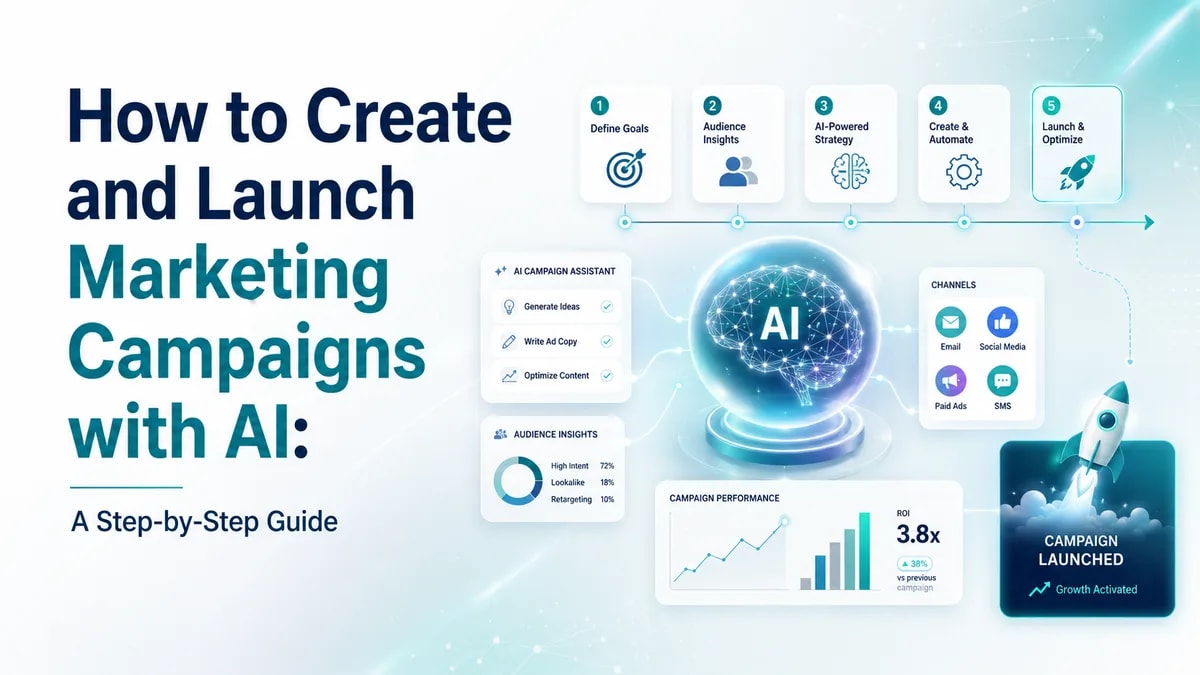
Quick answer. To create a marketing campaign with AI: define a clear goal, pick your audience and channels, generate concepts and copy, produce channel-ready content, review and approve, launch across channels, then track and optimize. AI handles the repetitive production so you focus on strategy. An integrated platform like MIA runs all seven steps in one place, instead of stitching together separate tools.
Key takeaways
- AI removes the repetitive 80% of campaign work — production, formatting, scheduling — not the strategy.
- The workflow is seven steps: goal, audience, concepts, content, review, launch, optimize.
- Generic AI output is the #1 reason campaigns flop; brand voice and human review keep yours distinct.
- An integrated platform beats stitched-together tools because it also launches and measures.
- AI isn't replacing marketers — it lets small teams perform like agencies.
What is an AI marketing campaign?
An AI marketing campaign uses artificial intelligence to plan, produce, launch, and optimize marketing across channels. Instead of hand-building every email, ad, and post, you brief the AI and it generates channel-ready assets, then helps you launch and measure them.
The point isn't to remove people. It's to remove repetition, so your team spends time on strategy and creativity. That's the core of MIA's AI Marketing Campaign Manager.
How do you create a marketing campaign with AI? (7 steps)
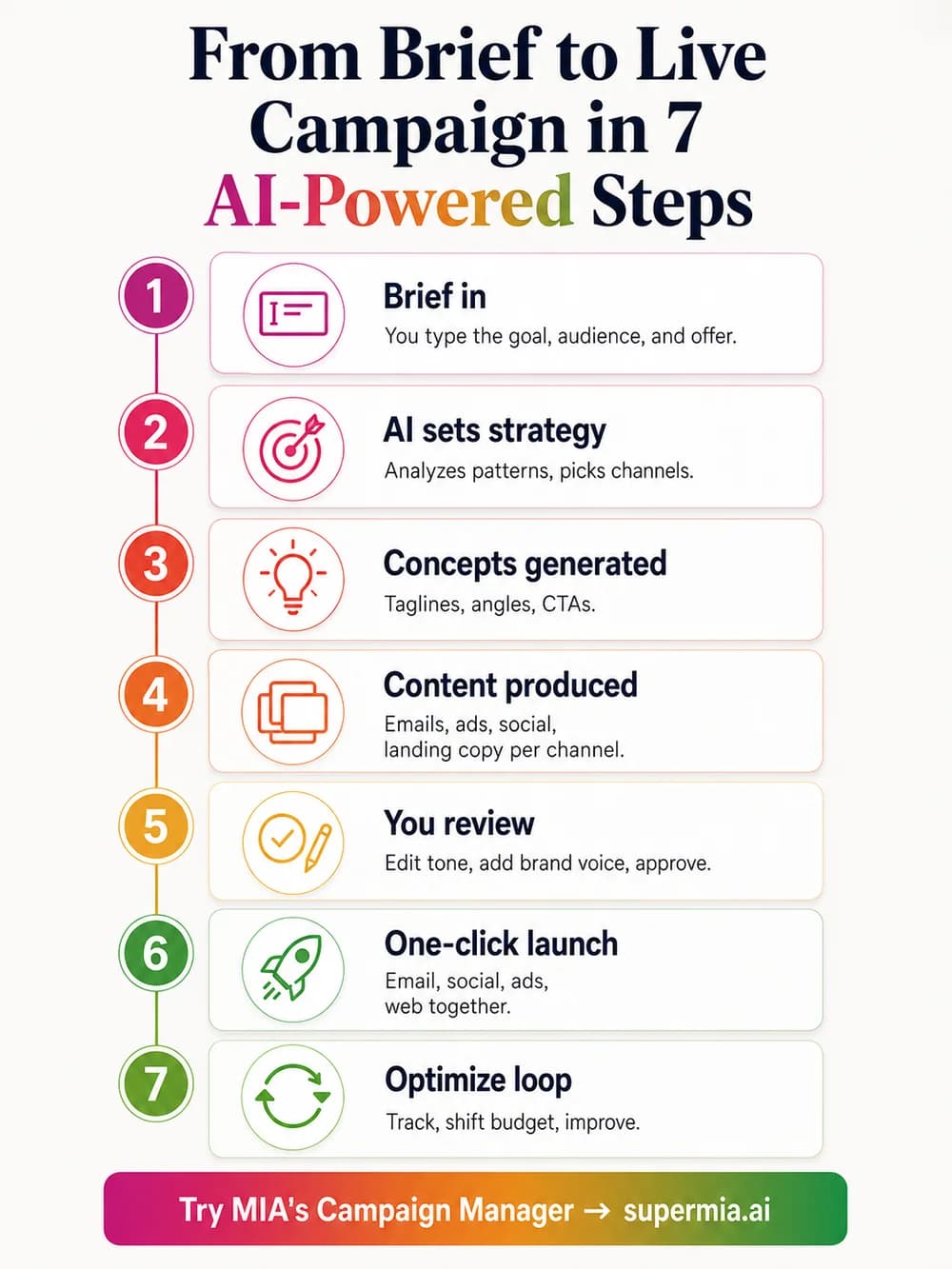
Here is the full workflow, start to finish. Steps 1 through 7 run in one place inside MIA — and Step 7 feeds back into Step 1, so each campaign gets smarter.
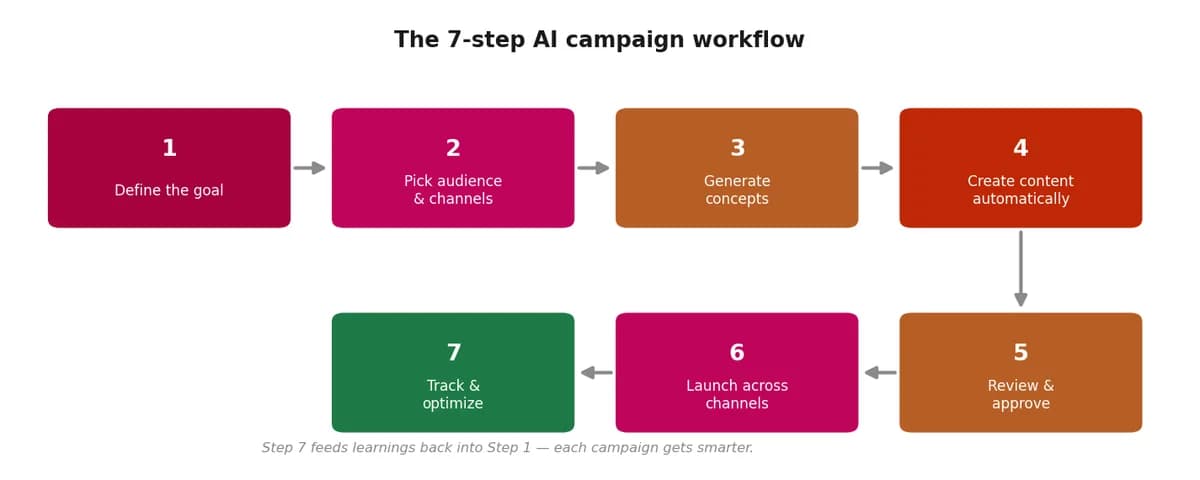
The seven-step AI campaign workflow.
Step 1: Define your campaign goal
Every campaign starts with one clear goal. Awareness or conversions? A product launch or lead nurture? Which channels matter — email, LinkedIn, Instagram? Feed MIA the objective and it analyzes patterns from similar campaigns to shape a goal-driven strategy.
Step 2: Choose audience & channel mix
Generic targeting wastes budget. Using segmentation, MIA helps decide who to reach, where, and when — then synchronizes channels. It might pair a LinkedIn push for B2B leads with a retargeting display ad, or a social + email combo for a consumer launch. The same logic runs your MIA Chat Agent touchpoints too.
Step 3: Generate concepts & messaging
Now the creative spark, powered by data. MIA's campaign generator produces taglines, value props, tone recommendations, content outlines, and CTAs. Want a faster path for a single channel? See how to create campaigns easily with MIA. For known customers, Personalized MIA tailors the message.
Step 4: Create content automatically
This is where AI transforms the process. MIA generates ready-to-use assets: email subject lines and sequences, ad headlines for Google, Meta, and LinkedIn, social captions and hashtags, and landing-page copy — each adapted to its platform. Email still earns some of the highest returns in marketing, so getting those sequences right matters.
Step 5: Review, customize & approve
Even the best AI needs a human pass. Review everything in MIA's dashboard, tweak tone, add brand language, and pick variants. This is the step that keeps your campaign from sounding like everyone else's — more on that below.
Step 6: Launch across channels
With one action, MIA publishes across selected platforms — email, social, ads, and website banners — together. What used to be a 10-step coordination scramble becomes one unified launch, connected to your AI workflow automation. For multi-channel sends, see social, email & SMS campaigns with MIA.
Step 7: Track, analyze & optimize
Launch is the start, not the finish. MIA monitors engagement, click-through, conversions, and sentiment in real time, then recommends moves: shift budget to what's working, fix weak headlines, retarget interested audiences. Each campaign teaches the next.
Manual vs a generic AI tool vs an AI campaign platform
Most marketers are choosing between three options. Here's how they compare on the things that decide whether a campaign actually ships.
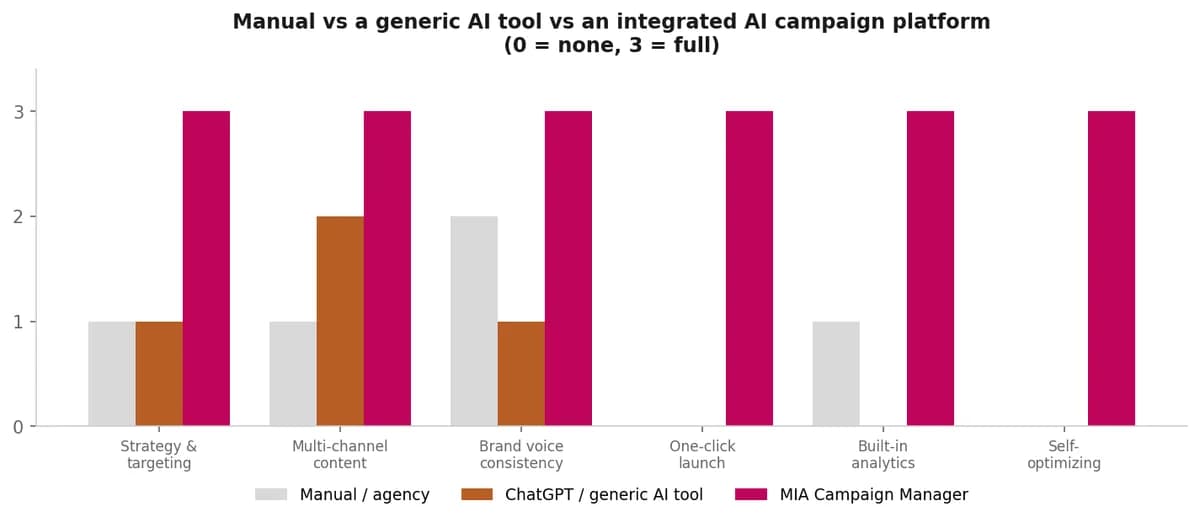
Where an integrated platform pulls ahead of doing it by hand or with a single generic tool.
Generic tools like ChatGPT are great at writing a draft. They don't pick your audience, launch across channels, or report on results. An integrated platform does — which is why the gap above is widest on launch and analytics.
Why AI is the future of marketing campaigns
The debate about whether AI understands creativity is over. Today's best campaigns pair human imagination with machine speed. Here's what AI brings:
| Advantage | Description |
|---|---|
| Speed | Automate ideation to launch in hours, not weeks. |
| Consistency | Unified messaging across every platform. |
| Scalability | Run many campaigns at once without extra headcount. |
| Personalization | Tailor messages to segments automatically. |
| Data-driven optimization | Learn and improve through analytics feedback. |
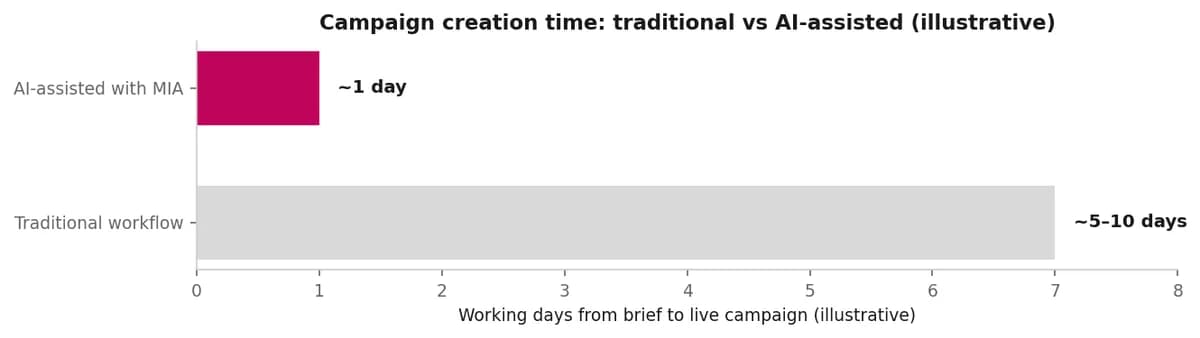
Illustrative: automating production compresses the timeline from brief to launch.
Why AI marketing campaigns fall flat (and how to fix it)
Plenty of teams try AI and get mediocre results. It's almost never the model — it's how it's used. The three usual culprits:
- Generic output. Raw AI writes what everyone else writes, so the campaign blends in — and search engines have little reason to rank it. Fix: feed it your brand voice, real customer pains, and specific offers, then edit.
- Lost brand voice. Unedited copy feels disconnected from your brand. Fix: keep Step 5 — a human approval pass — non-negotiable.
- Inaccuracy and over-automation. Models can state things confidently and wrongly, and consumers react badly to fully AI-made ads. Fix: fact-check before launch and keep a person in the loop.
Used well, AI is a force multiplier. Used lazily, it's a generic-content machine. The difference is the brief and the edit.
Use case: a startup launched a campaign in a day
A SaaS founder wanted a beta-invite campaign for a new productivity app — normally a week of coordination. The brief to MIA:
"Announce our app's beta release for early sign-ups. Target tech-savvy professionals across LinkedIn, email, and X."
In about 20 minutes, MIA drafted headlines and email copy, generated three ad variants for LinkedIn and Google, suggested content-calendar timing, and set up a retargeting sequence for people who clicked but didn't sign up. By end of day the campaign was live across channels — consistent, automated, and measurable.
From manual execution to intelligent orchestration
Most tools help you execute a campaign; few help you think about one. MIA's Campaign Manager plans, writes, automates, and learns — an in-house strategist, copywriter, and analyst in one. It's built for marketers, agencies, and founders who want to scale outreach without scaling headcount, and it connects to the same place MIA runs your other business workflows.
Frequently asked questions
Conclusion: the smartest way to launch your next campaign
Building a campaign no longer needs a dozen tools or a dozen days. With MIA you create campaigns guided by AI, automate content and scheduling, launch across channels at once, and improve automatically. Whether you're refining strategy or wearing every hat at a startup, AI helps you do more with less. See MIA pricing to pick a plan.
Try MIA's AI Marketing Campaign Manager and launch your next campaign →

Harikrishna Patel
Harikrishna Patel is the founder of MIA – My Intelligent Assistant, the AI automation platform built under Botfinity Inc. in Dallas, Texas. With 15+ years in software engineering, AI/ML, and enterprise solution design, he focuses on creating practical, scalable AI tools that help businesses automate support, workflows, and operations through voice and chat.