
Table of Contents
- What is AI recruitment?
- Why hiring eats your team's week
- What to automate at each hiring stage
- How to automate your hiring process in 5 steps
- The AI hiring tools you actually need
- How to measure AI hiring
- Where AI hiring goes wrong (bias & compliance)
- Do it for you: IntelliHire
- Frequently asked questions
To automate your hiring process with AI, apply it stage by stage: use AI to source and screen candidates, schedule interviews, and handle candidate communication - while keeping interviewing and the final decision human. Start with your highest-volume, most repetitive stage (usually screening or scheduling), pick a tool that fits your ATS, measure time-to-hire and quality-of-hire, and keep a human reviewing AI output to catch bias and errors.
Book a hiring-automation demo →
Key takeaways
- Automate the funnel, not the judgment. AI handles sourcing, screening, scheduling, comms; humans own interviews and the decision.
- Start where the volume is. Screening and scheduling are the biggest time sinks and easiest wins.
- Measure time-to-hire and quality-of-hire. Speed means nothing if the hires are worse.
- Keep a human in the loop. AI screening can amplify bias and hallucinate - review its output.
- Compliance still applies. EEOC and local rules govern automated decisions; document how your AI screens.
What is AI recruitment?
AI recruitment is the use of artificial intelligence to automate and improve hiring tasks - sourcing, resume screening, interview scheduling, and candidate communication. It handles the repetitive, high-volume work so recruiters can focus on judgment, relationships, and the final decision. It is not a robot that hires for you; it is an assistant that clears the admin so humans can do the human part.
Adoption has moved from experiment to standard practice across talent teams - see SHRM research on AI in talent acquisition.
Why hiring eats your team's week
The bottleneck in hiring is rarely the decision - it's everything before it. A single open role can mean 200+ resumes to read, dozens of scheduling emails, and constant status updates. The strategic work - assessing fit, selling the role, aligning with hiring managers - gets squeezed into the gaps.
The average cost-per-hire is around $4,129, and most of that time is spent on screening and coordination. That's exactly the work AI is good at - the productivity gap research on AI in recruiting keeps highlighting.
What to automate at each hiring stage
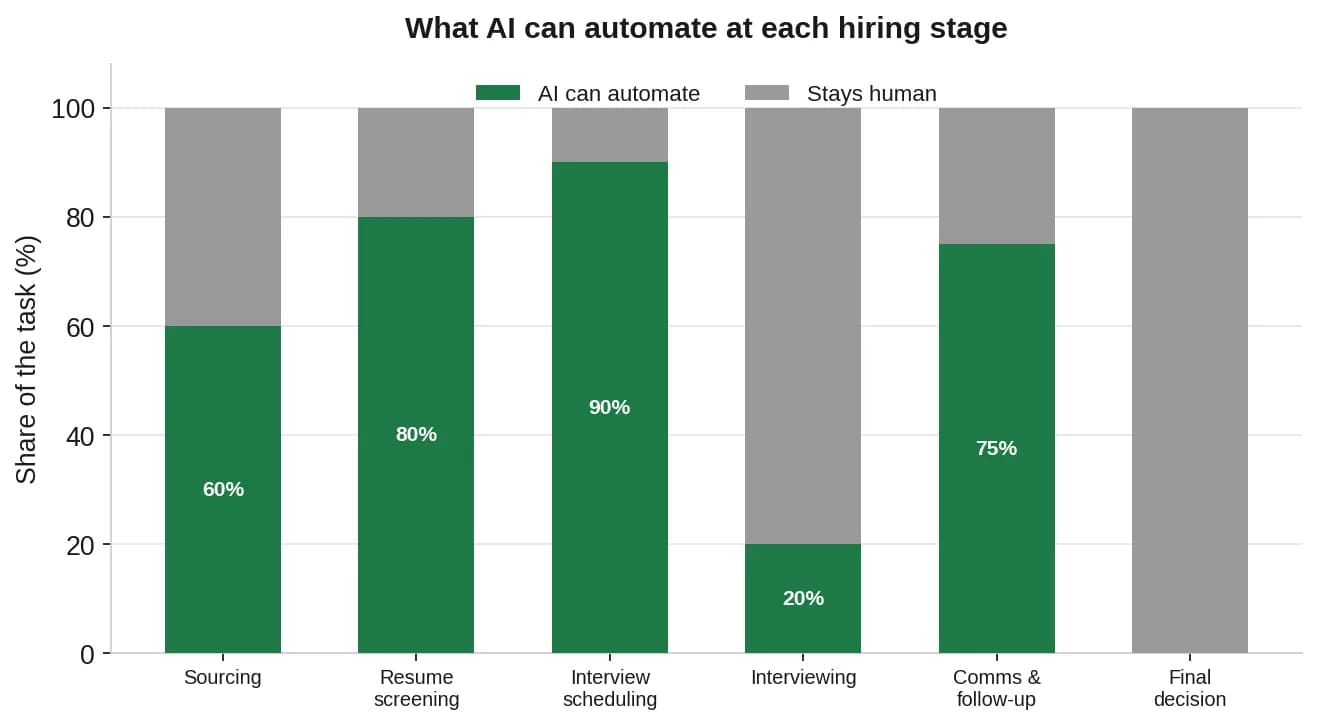
AI can automate sourcing, screening, scheduling, and communication; interviewing and the final decision stay human. Here's the handoff, stage by stage.
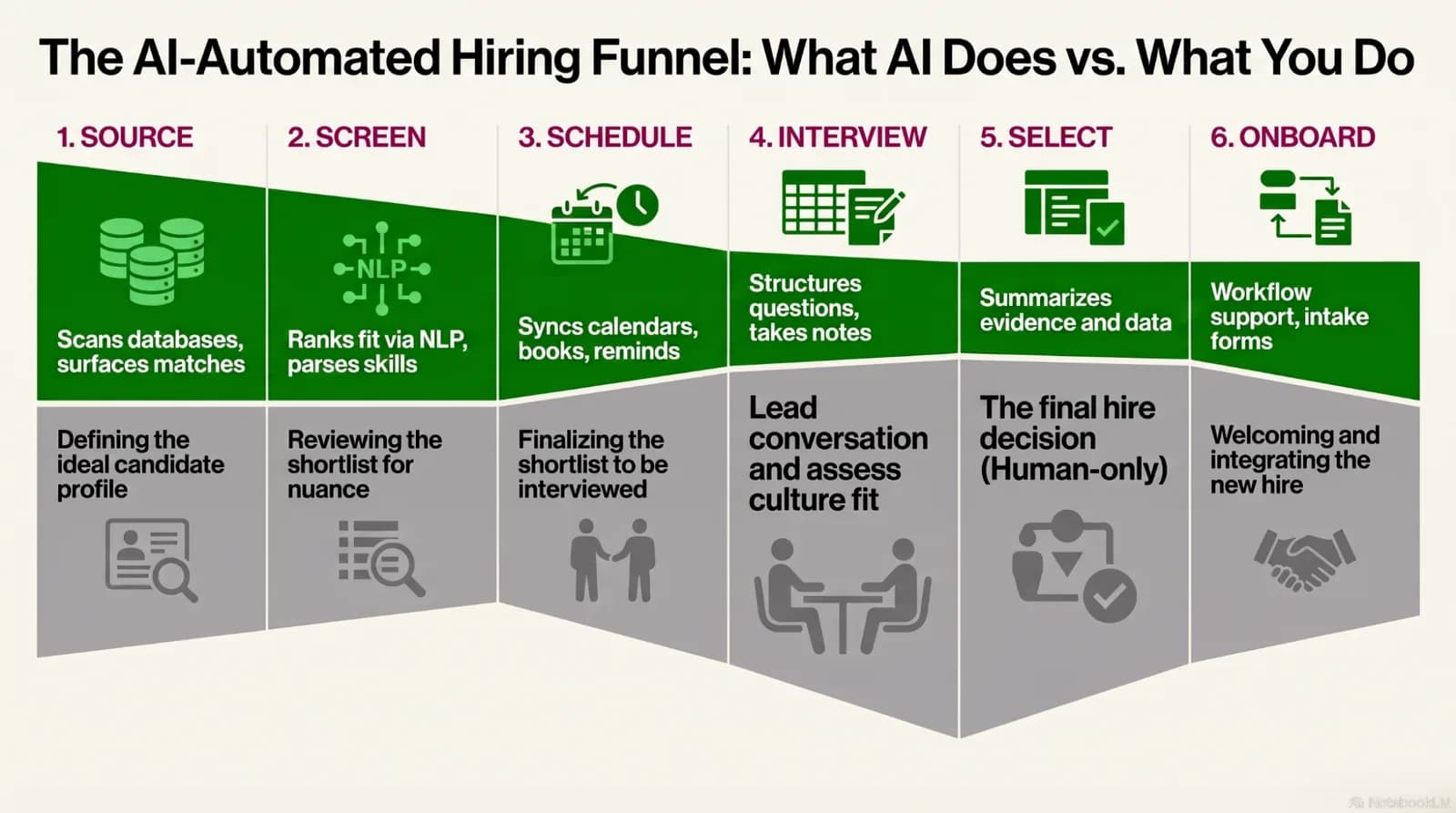
| Stage | What AI does | What stays human |
|---|---|---|
| Sourcing | Scans boards/databases, surfaces matches | Defining the ideal profile |
| Resume screening | Ranks by fit, parses skills/experience | Reviewing the shortlist for nuance |
| Interview scheduling | Syncs calendars, books, reminds | Choosing who to interview |
| Interviewing | Structures questions, takes notes | The actual conversation & judgment |
| Communication | Status updates, FAQs, follow-ups | Sensitive or personal messages |
| Final decision | Summarizes evidence | The hire decision - always |
Sourcing
AI scans job boards, your database, and professional networks to surface matches - including passive candidates you'd have missed. You define what "good" looks like; it finds it.
Resume screening
The biggest time sink, and the biggest win. AI ranks applicants by fit using NLP rather than keyword matching. Keep a human reviewing the shortlist. For a deeper look, see AI candidate screening in depth.
Interview scheduling
The classic email ping-pong. AI syncs calendars across interviewers and candidates, books optimal slots, handles time zones, and sends reminders - cutting days of coordination to minutes.
Interviewing
This stays human. AI can structure questions and take notes, but the conversation, the read on a person, and the judgment are yours.
Communication & follow-up
AI keeps candidates informed with status updates and answers common questions - the silence that loses candidates. An AI recruiting chatbot for candidate Q&A handles this around the clock.
Final decision
AI summarizes the evidence; you make the call. Never hand the hire decision to an algorithm.
See how an AI recruiter handles your funnel →
How to automate your hiring process in 5 steps
- Map your hiring funnel. Document each stage and mark where your team loses the most time.
- Start with the biggest time sink. Usually screening or scheduling - the highest-volume, most repetitive stage.
- Pick a tool that fits your ATS. Integration with your applicant tracking system and calendars matters more than features.
- Keep a human in the loop. Have a recruiter review AI screening and ranking to catch bias and errors before decisions.
- Measure and refine. Track the KPIs below, tune your criteria, and let workflow automation behind the scenes connect the steps.
The AI hiring tools you actually need
You need tools for four jobs: sourcing, screening, scheduling, and communication. Small teams stitch point tools together; others use a single AI recruiting agent that covers the funnel.
| Job | What to look for | Watch out for |
|---|---|---|
| Sourcing | Database + passive-candidate reach | Stale or thin candidate pools |
| Screening | NLP fit-scoring, bias controls | Keyword-only matching, black-box scores |
| Scheduling | Calendar + time-zone handling | Tools that don't sync both sides |
| Communication | 24/7 candidate Q&A, status updates | Robotic, off-brand messaging |
If you run high volume or want the whole funnel handled, an AI recruiter that screens and schedules for you removes the coordination tax point tools create. For staffing firms specifically, see AI interview automation for staffing agencies.
How to measure AI hiring
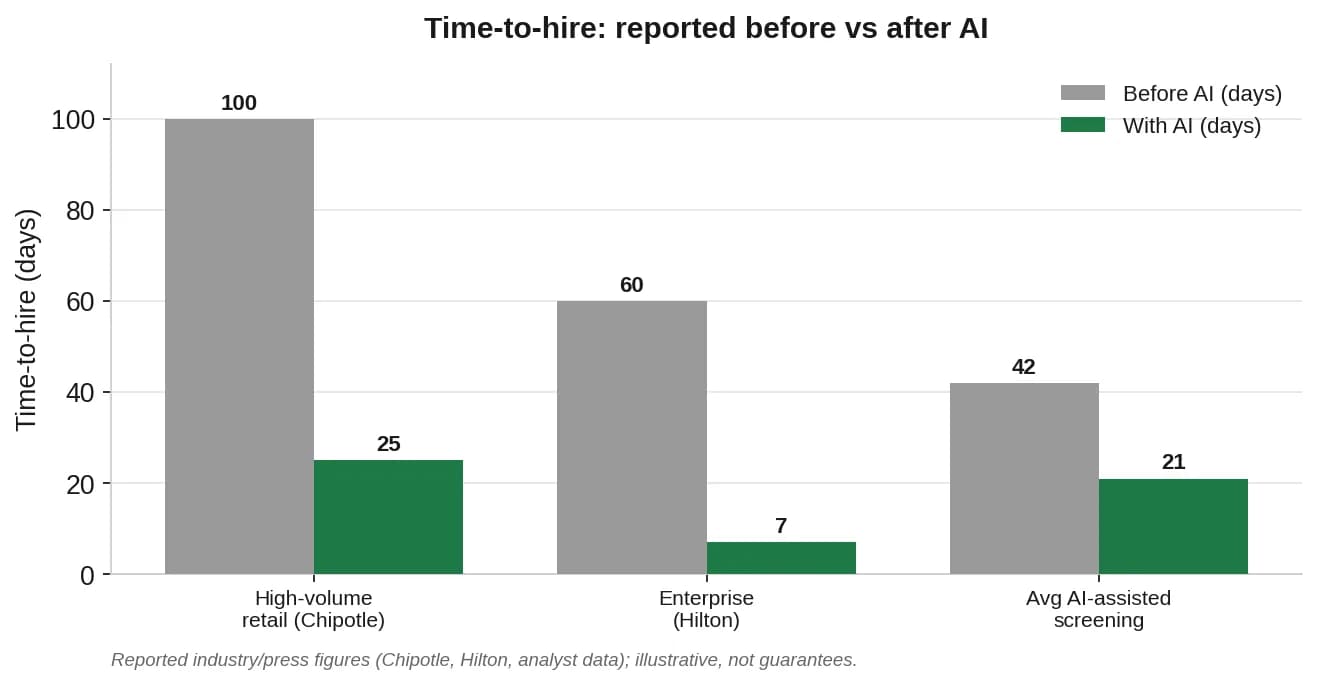
Measure time-to-hire, cost-per-hire, quality-of-hire, screening time, and candidate response rate. Baseline them before you automate so you can prove the lift - and catch quality drops.
| KPI | What it tells you | Watch for |
|---|---|---|
| Time-to-hire | Speed of the whole funnel | Faster but worse hires = over-automation |
| Quality-of-hire | Whether the hires work out | The metric that keeps speed honest |
| Cost-per-hire | Efficiency of the process | Hidden tool + integration costs |
| Screening time | AI's biggest direct win | Should drop sharply |
| Candidate response rate | Experience & engagement | Low rate = robotic comms |
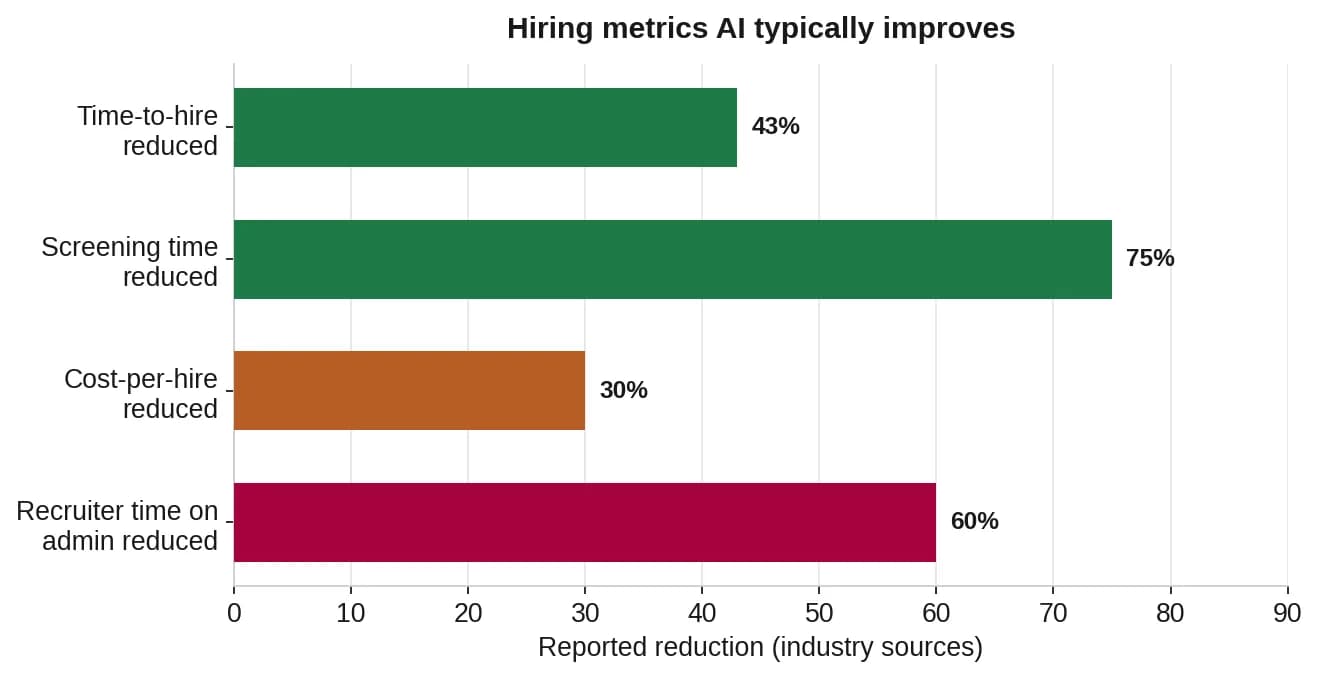
⚠️ Named figures and reductions here are industry/press-reported or illustrative - not SuperMIA results. Verify against the original source before citing them in your own reporting.
Where AI hiring goes wrong (bias & compliance)
AI hiring is legal but regulated, and it can amplify bias if trained on biased data. This is where most teams get into trouble - and where the honest vendors differ from the hype.
- Bias amplification. If past hiring favored one profile, AI trained on it will too. Use AI to screen candidates IN, audit outputs, and diversify criteria.
- Hallucinated screening. AI can misread a resume or invent qualifications. A human must review the shortlist.
- Compliance. In the US, the EEOC and laws like NYC Local Law 144 govern automated employment decisions. Document how your AI screens and keep a human accountable. Follow EEOC guidance on AI in hiring.
- Over-automation. Automate execution, not judgment. The interview and the decision stay human.
Do it for you: IntelliHire
If you'd rather not assemble the stack yourself, IntelliHire, our AI interview agent, handles the funnel - screening, scheduling, candidate comms, and analytics - with a human in the loop for the decisions that matter. It connects to your ATS and calendars, so you keep your process and lose the admin. You still interview and decide; IntelliHire clears everything around it.
Book a hiring-automation demo → see IntelliHire on your roles
Frequently asked questions
How do you automate the hiring process with AI?
Apply AI stage by stage: use it to source and screen candidates, schedule interviews, and handle candidate communication, while keeping interviewing and the final decision human. Start with your highest-volume repetitive stage, pick a tool that fits your ATS, measure time-to-hire and quality-of-hire, and keep a recruiter reviewing AI output to catch bias and errors.
What is AI recruitment?
AI recruitment is the use of artificial intelligence to automate and improve hiring tasks such as sourcing, resume screening, interview scheduling, and candidate communication. It handles the repetitive, high-volume work so recruiters can focus on judgment, relationships, and the final hiring decision.
Can AI do the entire hiring process on its own?
No. AI can automate sourcing, screening, scheduling, and communication, but interviewing and the final decision should stay human. AI also needs human oversight to catch bias and errors. The best approach is AI for repetitive execution and humans for judgment and the hire decision.
Will AI replace recruiters?
No. AI replaces repetitive recruiting tasks, not recruiters. It removes the administrative load of screening and scheduling so recruiters can spend more time on candidate relationships, hiring-manager alignment, and the judgment calls AI cannot make.
Is AI hiring biased or illegal?
AI hiring is legal but regulated, and it can amplify bias if trained on biased data. In the US, the EEOC and laws like New York City's Local Law 144 govern automated employment decisions. Use AI to screen candidates in rather than out, audit it for bias, keep a human reviewing decisions, and document how it works.

Vicky Lalwani
Vicky Lalwani is Marketing Manager at SuperMIA, focused on practical AI education, buyer's guides, and solution explainers that help business teams evaluate and adopt conversational AI across support, sales, and operations.