
Table of Contents
- Why picking a platform is harder in 2026
- The 10 criteria every enterprise buyer should score
- How to weight the criteria for your organisation
- Platform archetypes — where each type wins
- The scorecard in action — a filled example
- 5 red flags that eliminate a vendor in 60 seconds
- When SuperMIA is the right fit
- Frequently asked questions
To choose a conversational AI platform for an enterprise business in 2026, score every vendor against ten weighted criteria — use-case fit, enterprise integrations, security and compliance, scalability, vendor viability, governance, deploy time, total cost of ownership, multilingual coverage, and extensibility — then eliminate any vendor that fails a single red-flag test on security, roadmap, or integration surface.
Book a 20-minute walkthrough — see where an AI voice + chat agent fits your stack →
Key takeaways
- Use three tools together — a weighted scorecard, a platform-archetype map, and a red-flags list.
- Two criteria carry the most weight: use-case fit (15%) and enterprise integrations (15%).
- Deploy time separates the archetypes: build-your-own and enterprise CCaaS suites take 6–12 months; AI voice + chat agent overlays deploy in 1–4 weeks.
- Vendor viability + roadmap risk is the most under-scored criterion — and the one that kills deployments after month 12.
- Five red flags disqualify a vendor in 60 seconds — check them before you agree to a full demo.
Why picking a conversational AI platform is harder in 2026
Two years ago, most conversational AI buys came down to a chatbot decision. In 2026 the category has widened. Enterprise buyers are evaluating platforms that combine voice agents, chat agents, workflow automation, and agent orchestration — often across two or three separate business units at once. The list of viable vendors grew, the deploy risks grew with it, and the analyst reports haven't caught up.
The result: buyers are making six-figure and seven-figure decisions on tooling whose real-world behaviour is one Gartner cycle behind the marketing. This checklist is the antidote — a copy-and-use scorecard for procurement, IT, and the business owner to score every vendor on the same terms.
The 10 criteria every enterprise buyer should score
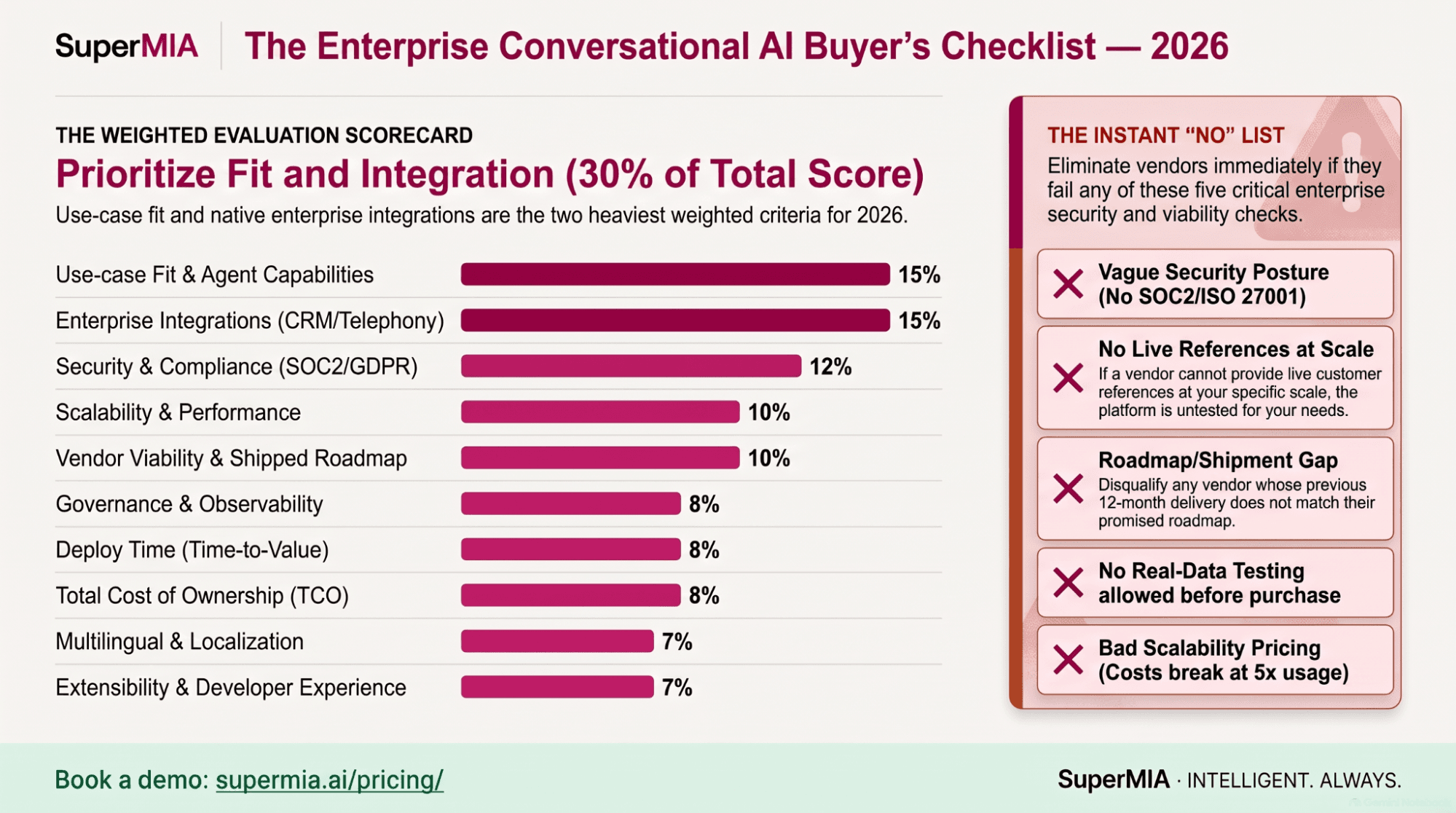
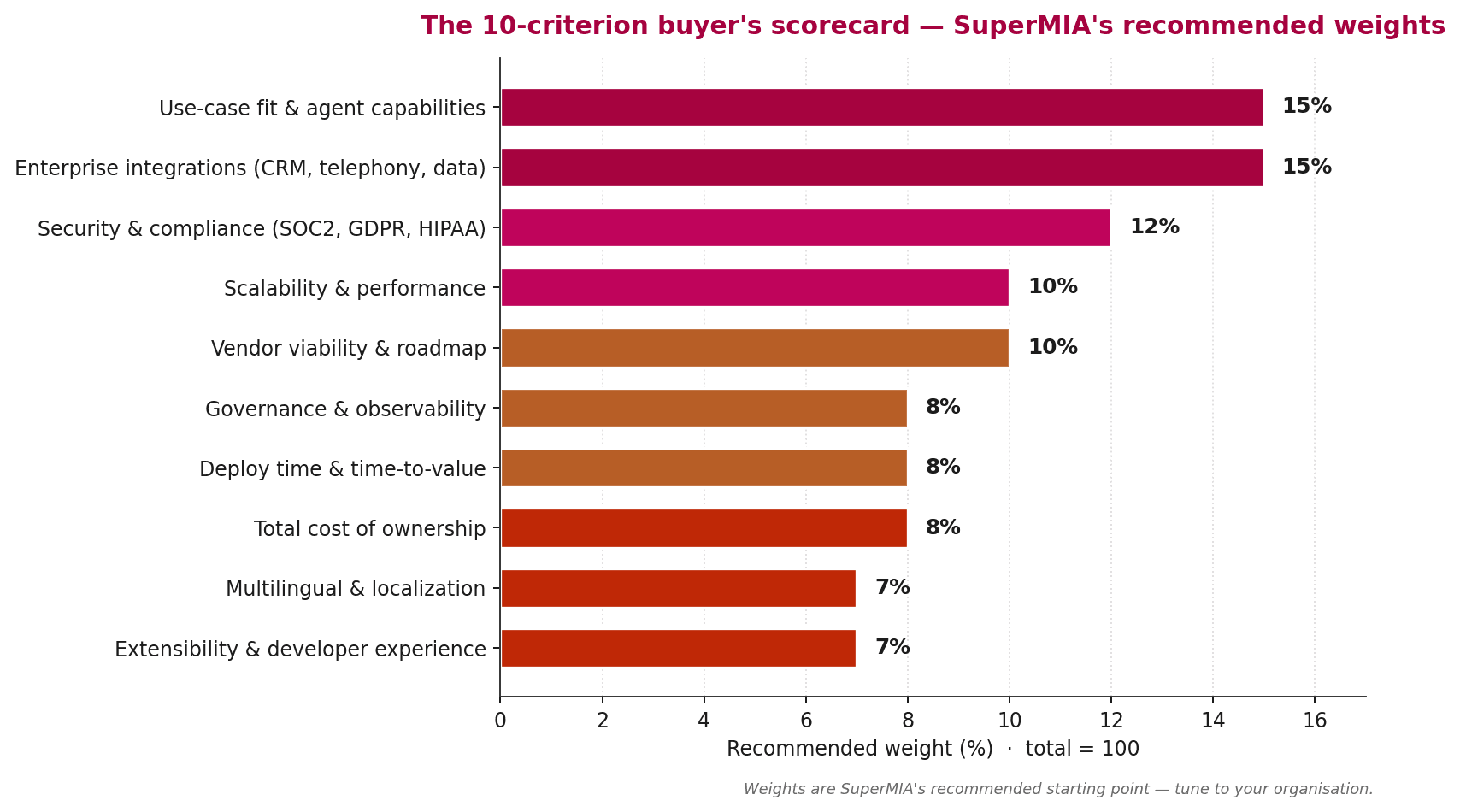
These ten criteria are the full evaluation surface. Every serious enterprise conversational AI evaluation should cover all ten — different organisations will weight them differently, but skipping any one is where deployments quietly fail 12 months later.
1. Use-case fit and agent capabilities · 15%
Score whether the platform covers the primary channels the business actually runs on — voice, chat, email, WhatsApp — and the agent types the use cases require: a simple FAQ bot, a workflow agent that does bookings and lookups, or an autonomous voice agent that answers the phone end-to-end. Ask: which of these agent types are in production today with a customer at our scale? A demo that only shows the flagship agent type is a warning sign.
2. Enterprise integrations · 15%
Score every required integration — CRM (Salesforce, HubSpot, Zoho), telephony (Twilio, RingCentral, Genesys), data warehouse (Snowflake, BigQuery, Databricks), ticketing (Zendesk, ServiceNow), calendar (Google, Microsoft). Ask for native connectors and reference implementations at your data volume. Any gap becomes an engineering project, and engineering projects are how deploy budgets double.
3. Security and compliance · 12%
Score SOC2 Type II, ISO 27001, GDPR posture, regional data residency, HIPAA readiness (for healthcare buyers), and ISO/IEC 42001 alignment for AI management. Ask for the specific certifications by name and for the BAA / DPA templates before the second demo. Vague answers here are a disqualifier.
4. Scalability and performance · 10%
Score concurrent conversation capacity, latency at peak, and whether the platform can absorb a 10× traffic spike without a re-architecture. Ask for a load test from a similar customer or run one yourself in a proof-of-value. Latency numbers on a slide are marketing; latency numbers under production traffic are the real signal.
5. Vendor viability and roadmap · 10%
Score funding runway, customer base, and the roadmap the vendor actually shipped in the last 12 months — not the promised roadmap for the next 12. A promised roadmap is a wish list; a shipped roadmap is evidence of execution capacity. This is the single most under-scored criterion in enterprise conversational AI evaluations, and the one that kills deployments after month 12 when a vendor gets acquired, pivots, or slows down.
6. Governance and observability · 8%
Score audit logs, prompt-and-flow versioning, analytics dashboards, and human-in-the-loop controls. Ask how the platform lets a governance officer roll back a change, review who trained the model, and see every prompt that touched a production conversation. NIST's AI Risk Management Framework and ISO/IEC 42001 are the reference standards to name in this conversation.
7. Deploy time and time-to-value · 8%
Score realistic deploy time to first live use case — not the vendor's best-case slide. Ask three current customers how long their first production use case took, from contract signature to first live conversation. If the vendor won't introduce you to three, that's a signal.
8. Total cost of ownership · 8%
Score licensing plus integration engineering, model usage, prompt and flow maintenance, and the humans who supervise the AI. A per-seat or per-minute headline price rarely tells the true story. TCO is usually 2× to 3× the license line in year one and 1.5× in a steady state — build the model with the vendor before the negotiation.
9. Multilingual and localization · 7%
Score every language and dialect the business actually needs — not the vendor's language count on a slide. Ask for a live demo in each language, with the accent and the local idioms your customers use. Support for 100 languages is meaningless if the accuracy in your top three is at parity with a machine-translated FAQ.
10. Extensibility and developer experience · 7%
Score API surface, SDK quality, custom-logic support, and how well the platform lets engineers extend it without vendor tickets. Enterprises with mature engineering functions will lose more speed to a bad SDK than to a missing feature. Ask to see the docs, run a live SDK smoke test, and check how many custom integrations the vendor's biggest customer maintains.
How to weight the criteria for your organisation
The weights above are SuperMIA's recommended starting point, tuned for a mid-to-large enterprise buying its first serious conversational AI platform. Regulated industries (financial services, healthcare, public sector) usually push security and governance up. Enterprises with mature engineering functions usually push extensibility up. Buyers with a fixed six-month deadline push deploy time up. Adjust — but keep the total at 100 and revisit the weights before every vendor scoring session so no criterion silently drifts.
Platform archetypes — where each type wins
Before scoring individual vendors, eliminate the archetypes that don't fit the business. Seven archetypes cover the enterprise conversational AI market. Two axes separate them — deploy speed and enterprise fit. Buyers who skip this step often score a build-your-own vendor against an AI overlay and wonder why the numbers look nothing alike.
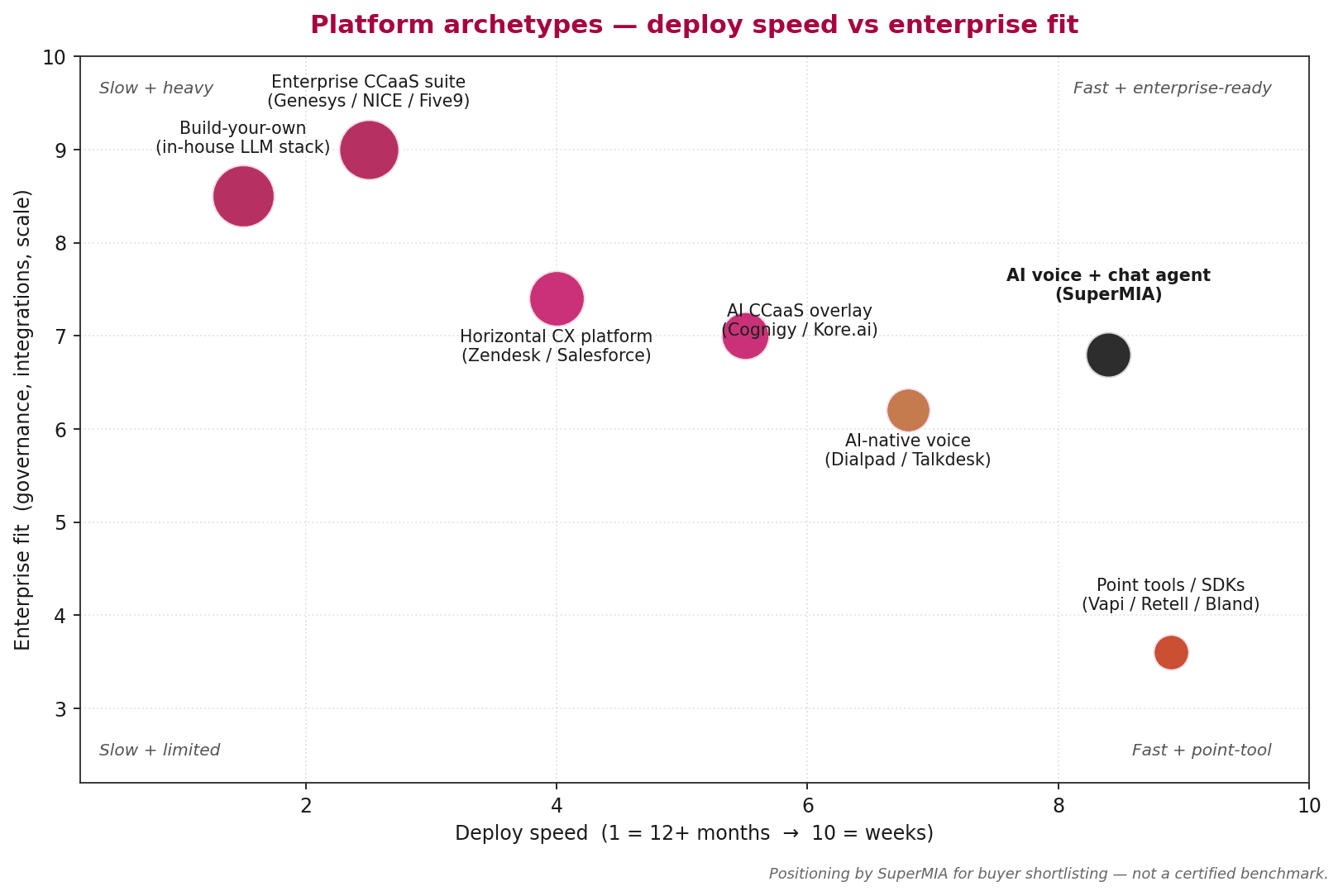
- Build-your-own — the enterprise assembles LLMs, vector stores, and voice stacks in-house. Highest control, slowest deploy, heaviest engineering commitment.
- Enterprise CCaaS suite (Genesys, NICE, Five9) — deep routing, WFM, and analytics with AI added as a layer. Strong on governance; 6–12 month deploys are the norm.
- Horizontal CX platform (Zendesk, Salesforce) — the AI sits inside an existing CX suite. Good if the enterprise already runs on that suite; painful if it doesn't.
- AI CCaaS overlay (Cognigy, Kore.ai) — AI-native contact-center platforms with pre-built flows. Faster than the enterprise CCaaS suites, less deep.
- AI-native voice (Dialpad Ai, Talkdesk) — cloud phone systems with AI threaded through. Fast and modern; contact-center depth is lighter.
- AI voice + chat agent (SuperMIA) — one agent covers inbound + outbound voice, chat, bookings, and routing; sits in front of the existing phone / CRM / calendar; deploys in 1–4 weeks.
- Point tools and SDKs (Vapi, Retell, Bland) — building blocks. Cheap per unit, but the enterprise has to compose them into a platform itself.
The scorecard in action — a filled example
Below is a scored vendor. This is what a first-pass scorecard looks like after a discovery call and a live demo. The verdict block at the bottom is the two-sentence output procurement can circulate.
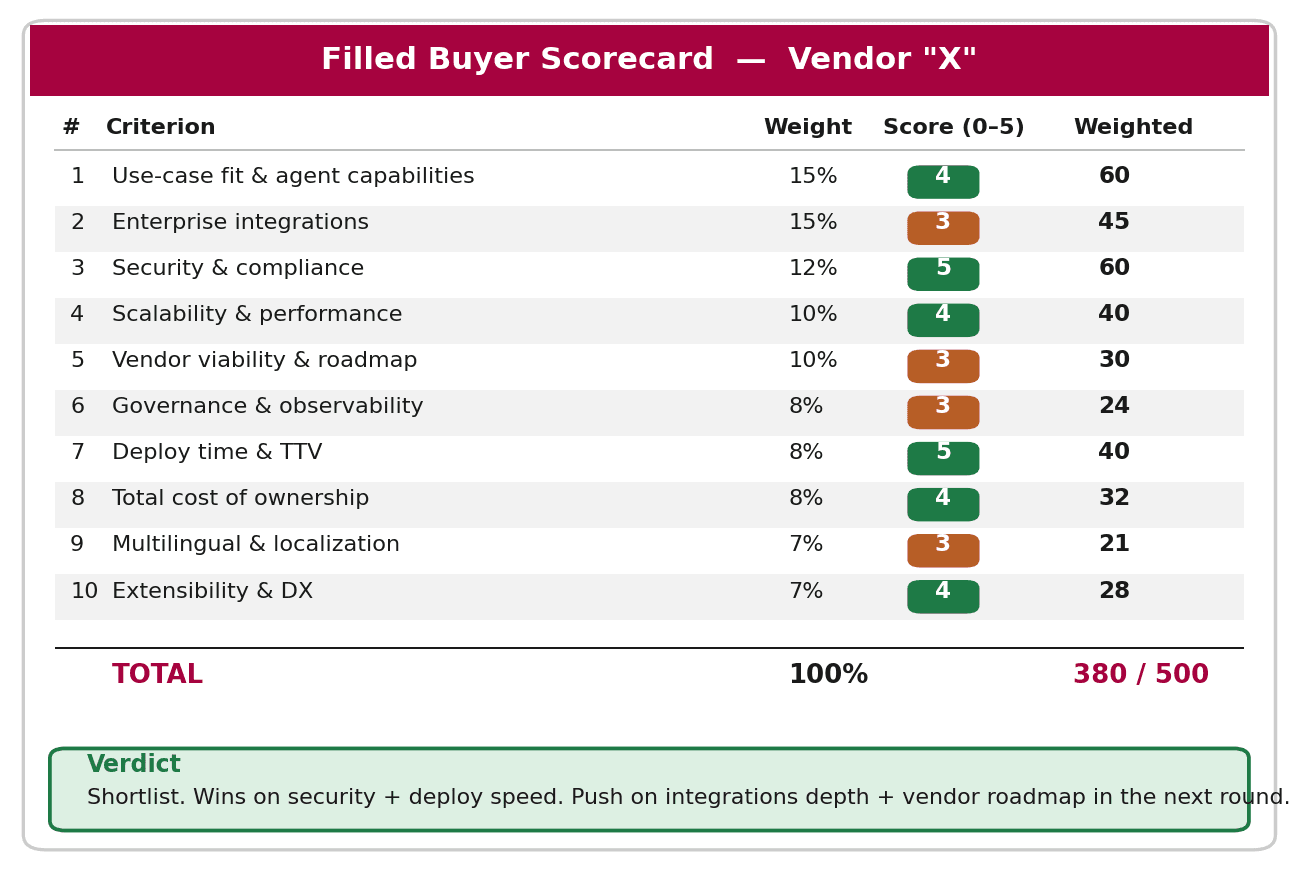
How to read it. Each weighted score is (weight × raw score). The total (380 of a possible 500) is 76% — comfortably a shortlist. But two rows are amber: enterprise integrations (score 3) and vendor roadmap (score 3). Those become the two must-answer questions in round two. Every serious evaluation will end with a page of scorecards and a page of round-two questions — this format keeps procurement, IT, and the business owner aligned.
5 red flags that eliminate a vendor in 60 seconds
Any one of these ends the evaluation before a second demo. Use them at the top of the funnel to protect the team's time.
- No clear security posture. If a vendor cannot name SOC2 Type II status, ISO 27001 status, and regional data residency in the first email, they will not meet enterprise security review. Move on.
- No live customer references at your scale. If the biggest customer is 50 seats and you are 500, the platform has not been tested where it matters. Ask for a reference at or above your scale before the second demo.
- A roadmap that doesn't map to what shipped last year. Ask what the vendor promised for the last twelve months and what they actually shipped. A gap wider than a third is a signal the roadmap is a wish list.
- No way to test with real data before purchase. Enterprise evaluations should include a proof-of-value with your own call logs, chat transcripts, and integrations. A vendor who won't let you test is protecting a demo that wouldn't survive real data.
- Pricing that scales badly with growth. Model the three-year cost at 2× and 5× your current volume. If the model breaks the deal at 5×, the platform is a short-term fix and the switching cost is coming.
When SuperMIA is the right fit
SuperMIA is one archetype on the map above — the AI voice + chat agent overlay. It is the right pick when three things line up. If you can only check one or two, one of the other archetypes will score higher, and that is the honest answer.
- You want to keep your existing phone system, CRM, and calendar — not replace them — and add an AI agent in front of them.
- A large share of your inbound or outbound work follows a scriptable pattern (bookings, FAQs, routing, screening, campaigns).
- You want first live use case in weeks, not months, and pricing that stays flat as usage grows.
If those three fit, SuperMIA can cover the repeatable share of your conversation volume while your team handles the rest. If you are specifically evaluating chatbots rather than a full platform, our sibling guide on picking an AI chatbot for your business is the narrower read. For the voice-specific terminology, see voice agent vs voice bot.
Frequently asked questions
What is the most important criterion when choosing a conversational AI platform for an enterprise?
Use-case fit and enterprise integrations are the two heaviest criteria — SuperMIA's recommended scorecard weights each at 15%. If the platform cannot cover the primary channels the business runs on, or cannot integrate cleanly with the CRM, telephony, and data warehouse, no amount of AI depth will make it work.
How long does it take to deploy an enterprise conversational AI platform?
It depends on the archetype. Build-your-own stacks and enterprise CCaaS suites usually take 6 to 12 months. Horizontal CX platforms take 3 to 6 months. AI voice + chat agent overlays like SuperMIA can be live in 1 to 4 weeks because they connect to an existing phone system, CRM, and calendar rather than replacing them.
How should an enterprise weight the 10 buyer's criteria?
SuperMIA recommends starting weights of 15% use-case fit, 15% enterprise integrations, 12% security and compliance, 10% scalability, 10% vendor viability, 8% governance, 8% deploy time, 8% total cost of ownership, 7% multilingual, and 7% extensibility. Adjust based on the enterprise's regulatory context, deploy horizon, and existing stack.
What red flags should disqualify a conversational AI vendor immediately?
Five red flags eliminate a vendor in 60 seconds: no clear security posture (SOC2, ISO/IEC 42001, data residency), no live customer references at your scale, a roadmap that doesn't map to what they shipped last year, no way to test with real data before purchase, and pricing that scales badly with growth. Any one of these is enough.
How much does a conversational AI platform cost for an enterprise?
Enterprise conversational AI pricing varies by archetype. Enterprise CCaaS suites usually price per seat and per feature tier, with total contract values often above six figures a year. AI voice + chat agent overlays like SuperMIA are usually priced per plan or per minute, and stay flatter as usage grows. Point tools and SDKs are cheapest per unit but move cost into engineering. Compare SuperMIA plans for current pricing.
Is a conversational AI platform the same as an AI chatbot?
No. A conversational AI platform is the broader category — voice, chat, agents, and orchestration under one roof. An AI chatbot is one channel within that category. If the enterprise only needs a chatbot, a chatbot-first tool is often the faster pick; if the enterprise needs voice plus chat plus workflow agents, a platform is the right level.
Ready to score SuperMIA against the checklist? Book a 20-minute walkthrough →

Urvil Dhanani
Urvil Dhanani is the AI/ML Lead at SuperMIA, focused on the architecture behind reliable conversational AI - agent design patterns, voice and chat orchestration, and platform evaluation. He writes practical, vendor-neutral guides that help technical teams build and choose AI systems that hold up in production.