
Table of Contents
- The short answer — safe when six layers are in place
- What can go wrong when the layers are missing
- The 6-layer safety framework
- FERPA and COPPA in plain English
- 10 questions to ask any vendor
- A safe 60-day pilot — how to sequence it
- When conversational AI is not the right fit
- Frequently asked questions
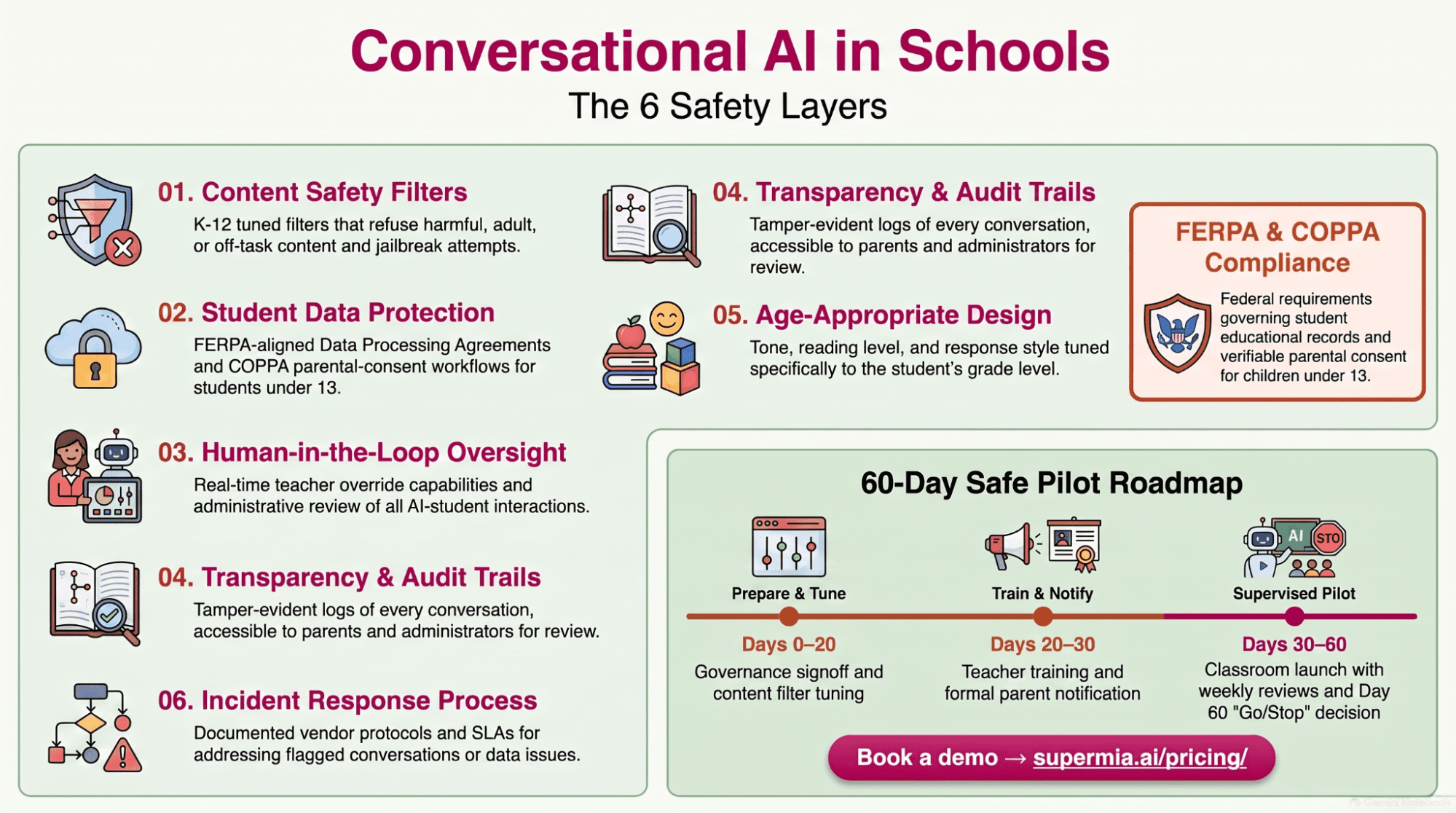
A conversational AI can be safe for school students when it sits behind six safety layers — content safety filters, student data protection under FERPA and COPPA, human-in-the-loop teacher and admin oversight, transparency and audit logging, age-appropriate design, and a documented incident-response process. Without those six layers, no vendor should have direct access to students.
Book a 20-minute walkthrough — we'll go through the safety scorecard in your context →
Key takeaways
- "Is it safe" is not a yes-or-no question — it depends on implementation, not the product alone.
- Six safety layers cover the full surface: content filters, data protection, human oversight, transparency, age-appropriate design, and incident response.
- FERPA and COPPA are the two US federal laws every vendor must meet — state laws add more.
- The 10-question vendor scorecard is the tactical artifact schools should use in procurement.
- A safe 60-day pilot keeps students away from the AI until day 30 — governance and tuning come first.
The short answer — safe when six layers are in place
The honest answer to "is conversational AI safe for students" is: it depends on the layers you require the vendor to have. A well-configured conversational AI, running under teacher and admin oversight with FERPA-aligned data handling, can be safe. A general-purpose consumer chatbot dropped into a classroom without any of those layers is not.
This guide is written for the people making that call — school administrators, IT directors, superintendents, and involved parents. It is deliberately not written to be shared with students. The framework below is a procurement and governance tool, not a student-facing message.
What can go wrong when the layers are missing
Three risks matter more than others. First, student personal information can be exposed if the vendor's data handling is unclear or unbound by a Data Processing Agreement. Second, harmful or age-inappropriate content can reach a student if the content filter is weak, untuned for K–12, or not monitored. Third, teacher and parent oversight can quietly erode if the AI is deployed without logging or review — the humans who should be responsible for the interaction stop seeing what happens.
All three are avoidable. None of them are speculative. They are the specific failure modes every serious safety framework is designed to prevent.
The 6-layer safety framework
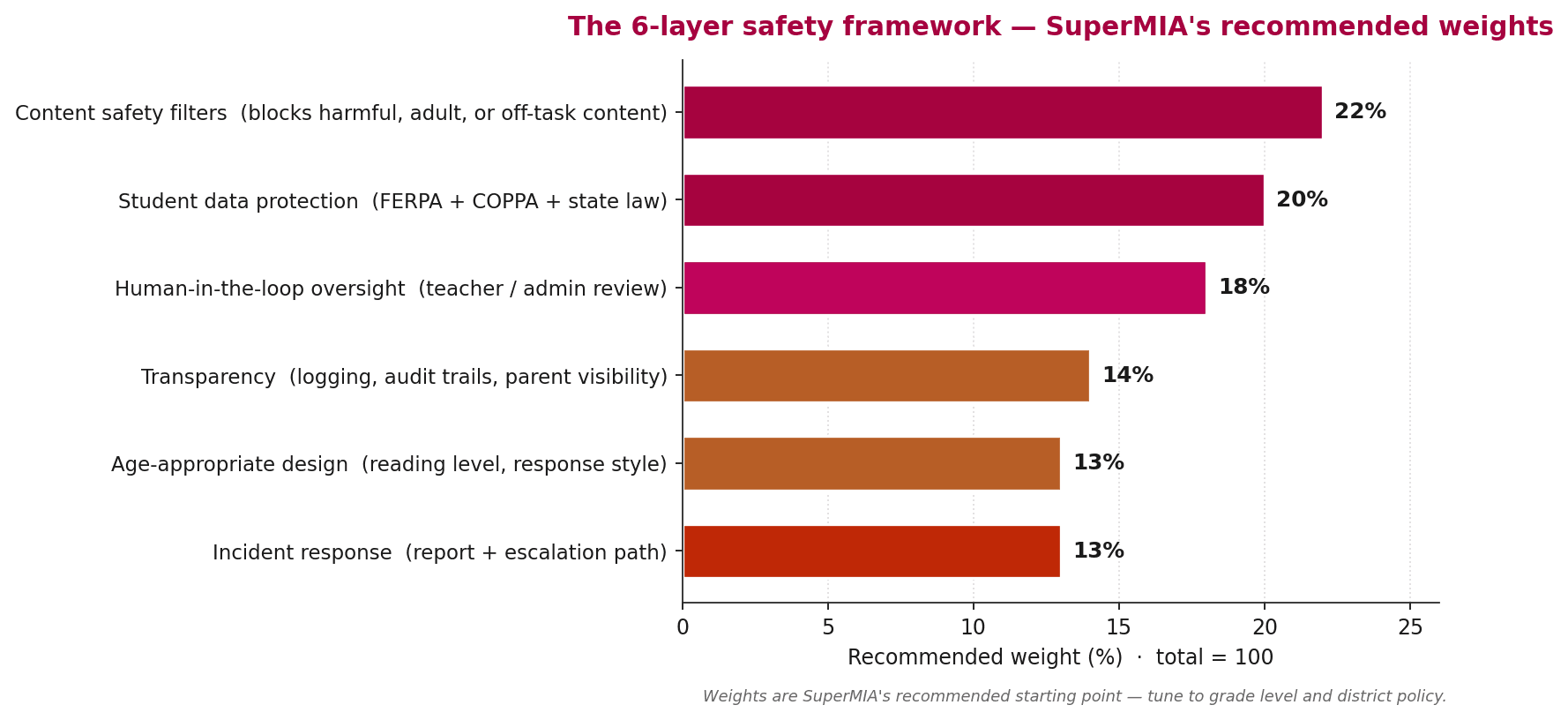
Below is a working framework schools can use to structure a vendor evaluation. Weights are SuperMIA's recommended starting point for a district evaluating a student-facing AI; individual schools should tune the weights to their grade level, state law, and existing policies.
1. Content safety filters · 22%
The AI must refuse harmful, adult, or off-task content — jailbreak attempts, self-harm content, adult material, hate speech, and anything a school's acceptable-use policy prohibits. Filters must be tuned for K–12, not the general internet, and the school should be able to review and adjust them. This is the heaviest layer because it is the most immediate risk if it fails.
2. Student data protection · 20%
The vendor must sign a FERPA-aligned Data Processing Agreement, support a COPPA parental-consent workflow for anyone under 13, and be able to name the state student-privacy laws they are aligned with. Data must be stored in a location the school can approve — usually US-only for US schools — and it must never be used to train models without explicit consent from the school and parents.
3. Human-in-the-loop teacher and admin oversight · 18%
Teachers must be able to see what happened in every AI conversation with their students, pause or override the AI mid-conversation, and adjust settings for their classroom. Admins must be able to review conversations across the school. This layer is what keeps the humans who are legally and morally responsible for these students still responsible.
4. Transparency, logging, and audit trails · 14%
Every conversation logged, per student, retained for a defined period, and reviewable. Parents must be able to request their child's data and, if the district requires it, request deletion. Audit trails must be tamper-evident so any incident review can trust the record.
5. Age-appropriate design · 13%
Reading level, response style, and permitted topics should match the grade level. A middle-school-facing AI should not sound like an enterprise support agent. Response length, tone, and the way the AI handles emotional topics should be tuned with input from teachers and counselors — not left to the vendor's defaults.
6. Documented incident-response process · 13%
What happens when something goes wrong — a flagged conversation, a suspected data issue, a report from a parent. The vendor should have a documented incident-response process, an SLA for notification, and a clear line to a human at the vendor within business hours. If a vendor cannot describe this in writing, they are not ready for a K–12 environment.
FERPA and COPPA in plain English
Two US federal laws set the floor. FERPA — the Family Educational Rights and Privacy Act — governs how student educational records are shared. In practice this means a conversational AI vendor must sign a FERPA-aligned Data Processing Agreement that limits what they can do with student data. The US Department of Education's Student Privacy Policy Office is the reference resource.
COPPA — the Children's Online Privacy Protection Act — requires verifiable parental consent before an online service collects personal information from children under 13. In a K–8 setting this usually means the school obtains consent on behalf of parents under the "school authority exception," and the vendor supports that workflow. The FTC's Children's Privacy page is the reference resource here.
State laws add another layer. Illinois SOPPA, California CalOPPA, and New York's Education Law 2-d are the three most-cited; other states have similar rules with different specifics. The safe posture is to ask a vendor which state laws they are aligned with by name, not to accept a generic "we comply with state privacy laws" line.
10 questions to ask any vendor (the scorecard)
The scorecard below is the tactical artifact schools should use in vendor conversations. Ten specific questions, each with a required answer and a pass / review / fail verdict. Copy this pattern; do not accept a vendor demo without answers to all ten.
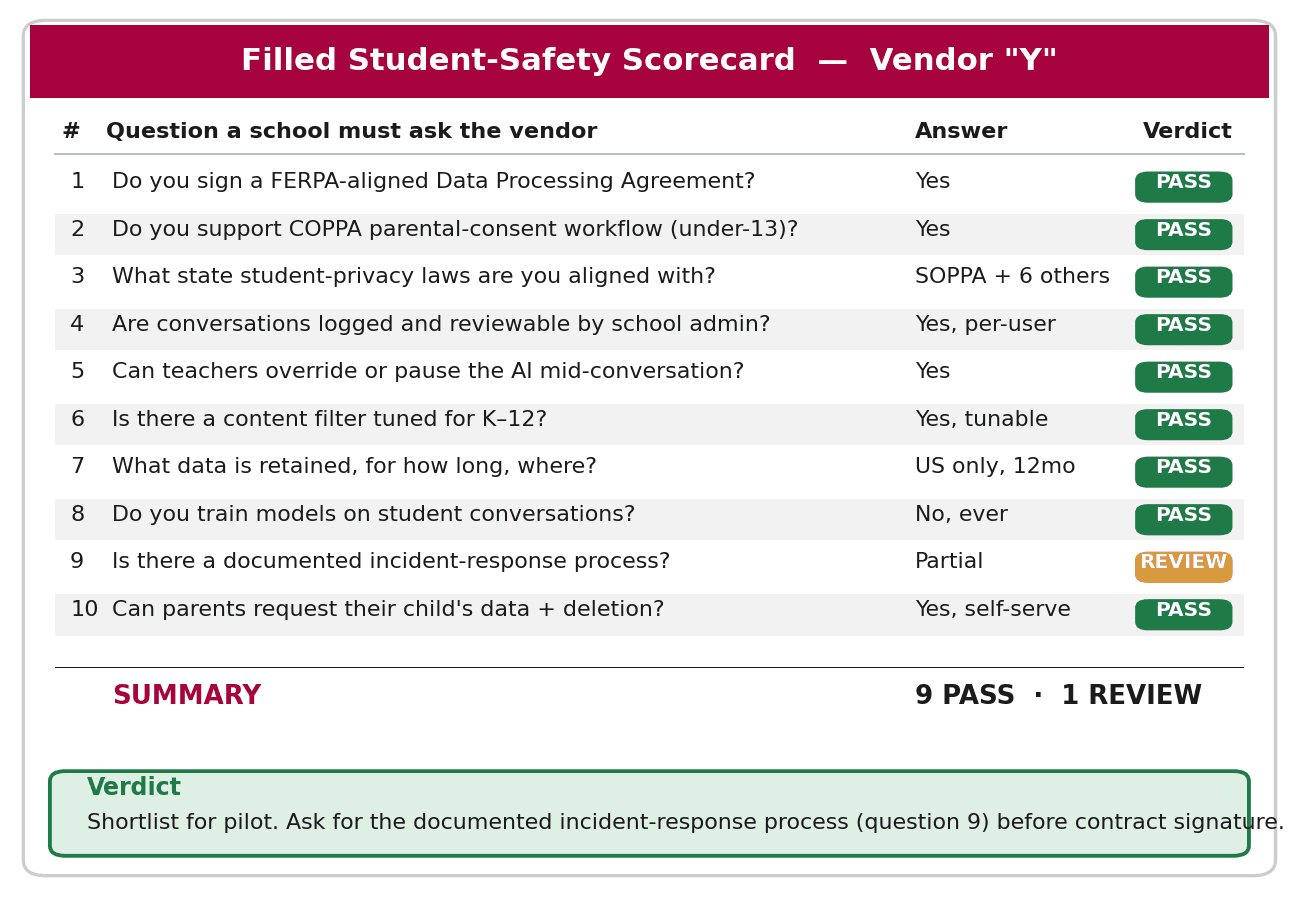
Two lines to read carefully. First, if any answer is "we're working on it" for questions 1, 2, or 3 — the compliance questions — the vendor is not ready. Second, question 8 ("Do you train models on student conversations?") should be a firm no. A vendor whose answer here is "yes, but with anonymization" is not the same tier as a vendor whose answer is "no, ever."
A safe 60-day pilot — how to sequence it
The right sequence protects everyone. No student should meet the AI until governance has signed off, filters are tuned, teachers are trained, and parents are notified. SuperMIA's recommended 60-day pilot puts students in front of the AI only from day 30 onward, and only in an opt-in supervised setting.
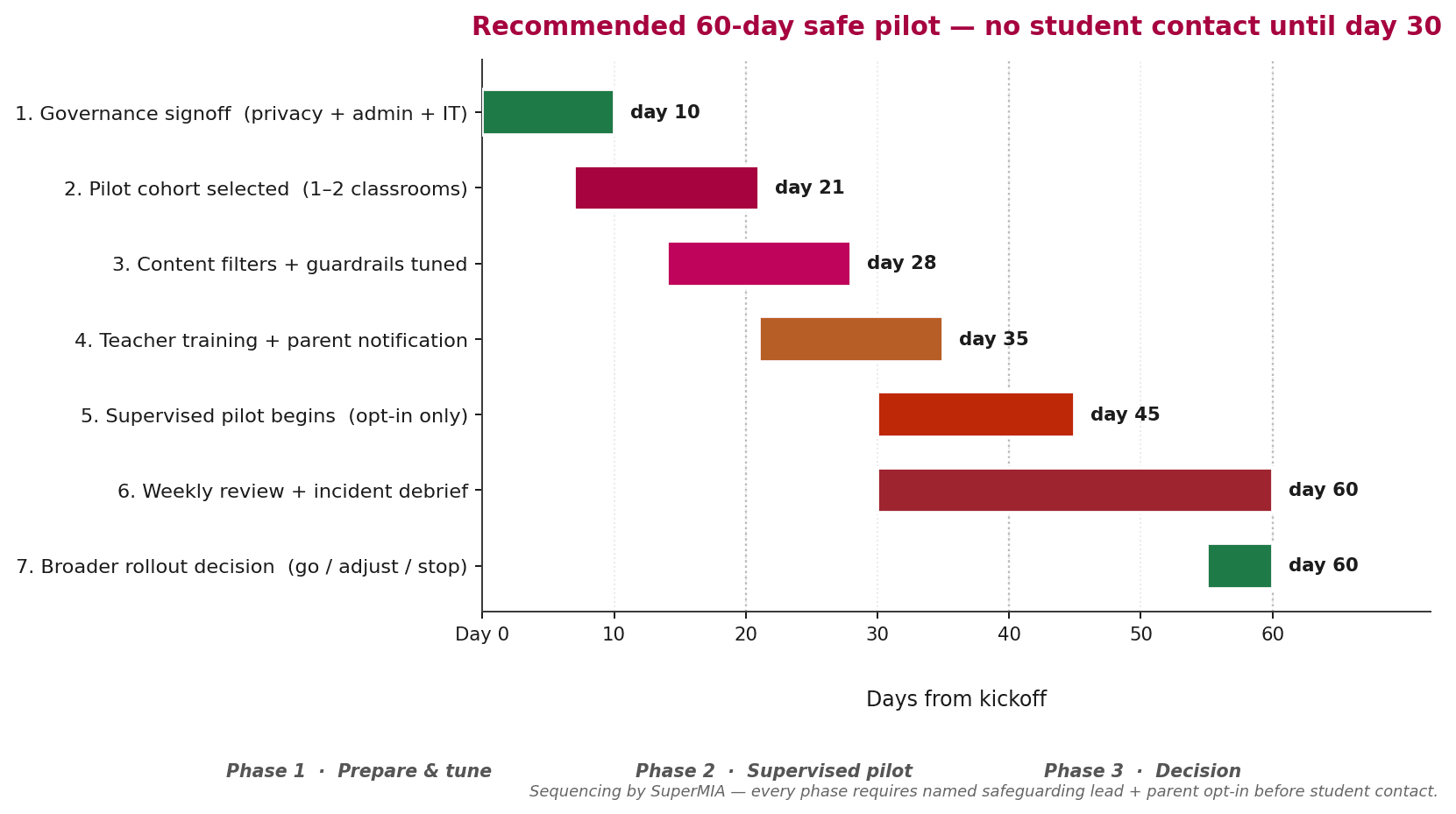
Phase 1 (days 0–20) — prepare and tune. Governance signoff from privacy, admin, and IT leadership. Pilot cohort selected — usually one or two classrooms with willing teachers. Content filters and guardrails tuned. Phase 2 (days 20–45) — supervised pilot. Teacher training and parent notification finish; the pilot begins on an opt-in basis; every conversation is reviewed weekly. Phase 3 (days 45–60) — decision. Continue with expanded rollout, adjust the guardrails, or stop. A stop is not a failure — it is the process working.
When conversational AI is not the right fit for a classroom
There are settings where a conversational AI should not be introduced yet. Naming them protects everyone.
- Very young students (roughly K–2) where the developmental case for AI-mediated interaction has not been established.
- Any setting where the school cannot commit to weekly review of logged conversations during the pilot.
- Districts without a signed FERPA-aligned DPA on file with the vendor.
- Emotional-support or mental-health use cases — those need trained humans, not conversational AI.
- Any use case where a teacher or admin cannot pause or override the AI in real time.
How SuperMIA approaches student safety
SuperMIA's student-facing products — MIA StudyMate and MIA MentorX — are designed with the six safety layers in mind. Content filters are tunable for grade level; conversations are logged and reviewable by teachers and admins; parents can request data and deletion; models are not trained on student conversations. A FERPA-aligned DPA is available on eligible plans.
This is not a claim that SuperMIA is "the safe one" — no vendor should make that claim. It is a statement that the same ten questions in the scorecard above have specific answers in our documentation, and we welcome schools to score us using this framework alongside every other vendor. For a case study of student-facing use, see the AI tutor use case, or the wider SuperMIA for education overview.
Frequently asked questions
Is conversational AI safe for school students?
A conversational AI can be safe for school students when it sits behind six safety layers — content safety filters, student data protection under FERPA and COPPA, human-in-the-loop teacher and admin oversight, transparency and audit logging, age-appropriate design, and a documented incident-response process. Without those six layers, no vendor should have direct access to students.
What laws apply to conversational AI in US schools?
Two federal US laws apply. FERPA (Family Educational Rights and Privacy Act) governs how student educational records are shared, and requires the vendor to sign a FERPA-aligned Data Processing Agreement. COPPA (Children's Online Privacy Protection Act) requires verifiable parental consent before collecting personal information from children under 13. State laws such as Illinois SOPPA, California CalOPPA, and New York's Ed Law 2-d add extra requirements that vary by district.
What questions should a school ask an AI vendor?
A school should ask ten questions: (1) Do you sign a FERPA-aligned DPA? (2) Do you support a COPPA parental-consent workflow? (3) Which state student-privacy laws are you aligned with? (4) Are conversations logged and reviewable by school admin? (5) Can teachers override or pause the AI mid-conversation? (6) Is there a K-12 content filter? (7) What data is retained, for how long, and where? (8) Do you train models on student conversations? (9) Is there a documented incident-response process? (10) Can parents request their child's data and deletion?
Should students use conversational AI without supervision?
No. Student-facing conversational AI in a school setting should always operate under teacher and admin oversight, with logging, review, and the ability for a teacher to override or pause the AI. Unsupervised student interaction with a general-purpose AI is not the same as a supervised classroom deployment and is not the setting this guide covers.
How long should a school pilot conversational AI before scaling?
SuperMIA recommends a 60-day safe pilot. Days 0–20 are governance signoff, cohort selection, and content-filter tuning. Days 20–30 add teacher training and parent notification. Days 30–45 run a supervised opt-in pilot with 1–2 classrooms. Days 30–60 add weekly reviews of every logged conversation and every incident. Day 60 is the go / adjust / stop decision.
What are the biggest risks of conversational AI in schools?
The three largest risks are exposure of student personal information if the vendor's data handling is unclear, harmful or age-inappropriate content reaching a student because filters are weak or untuned, and erosion of teacher / parent oversight if the AI is deployed without governance or logging. All three are avoidable with the six-layer framework, a signed FERPA-aligned DPA, and a supervised pilot. Compare SuperMIA plans for eligibility details.
Walk through the safety framework in your context — book a conversation →

Vicky Lalwani
Vicky Lalwani is Marketing Manager at SuperMIA, focused on practical AI education, buyer's guides, and solution explainers that help business teams evaluate and adopt conversational AI across support, sales, and operations.