
Table of Contents
- What is a multilingual AI receptionist?
- The patients your English-only phone line is missing
- What it should handle — and what needs a qualified interpreter
- How language detection actually works
- Language access, civil rights, and where AI fits
- Privacy and compliance questions to ask a vendor
- How to roll it out in a practice
- Frequently asked questions
What is a multilingual AI receptionist? A virtual front-desk assistant that detects a caller's language and responds in it — handling appointments, reminders, directions and routine questions without the patient navigating an English-only menu. It is a front-desk tool, not a medical interpreter: symptoms, consent and anything clinical must go to staff or a qualified professional interpreter.
Book a demo — and hear it answer a call in Spanish →
Key takeaways
- The cost of an English-only front desk is invisible. There's no missed-call alert for a patient who quietly decided your practice was too hard to reach.
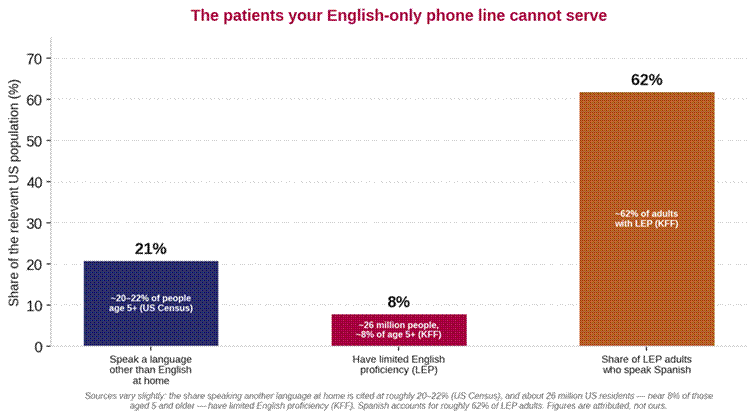
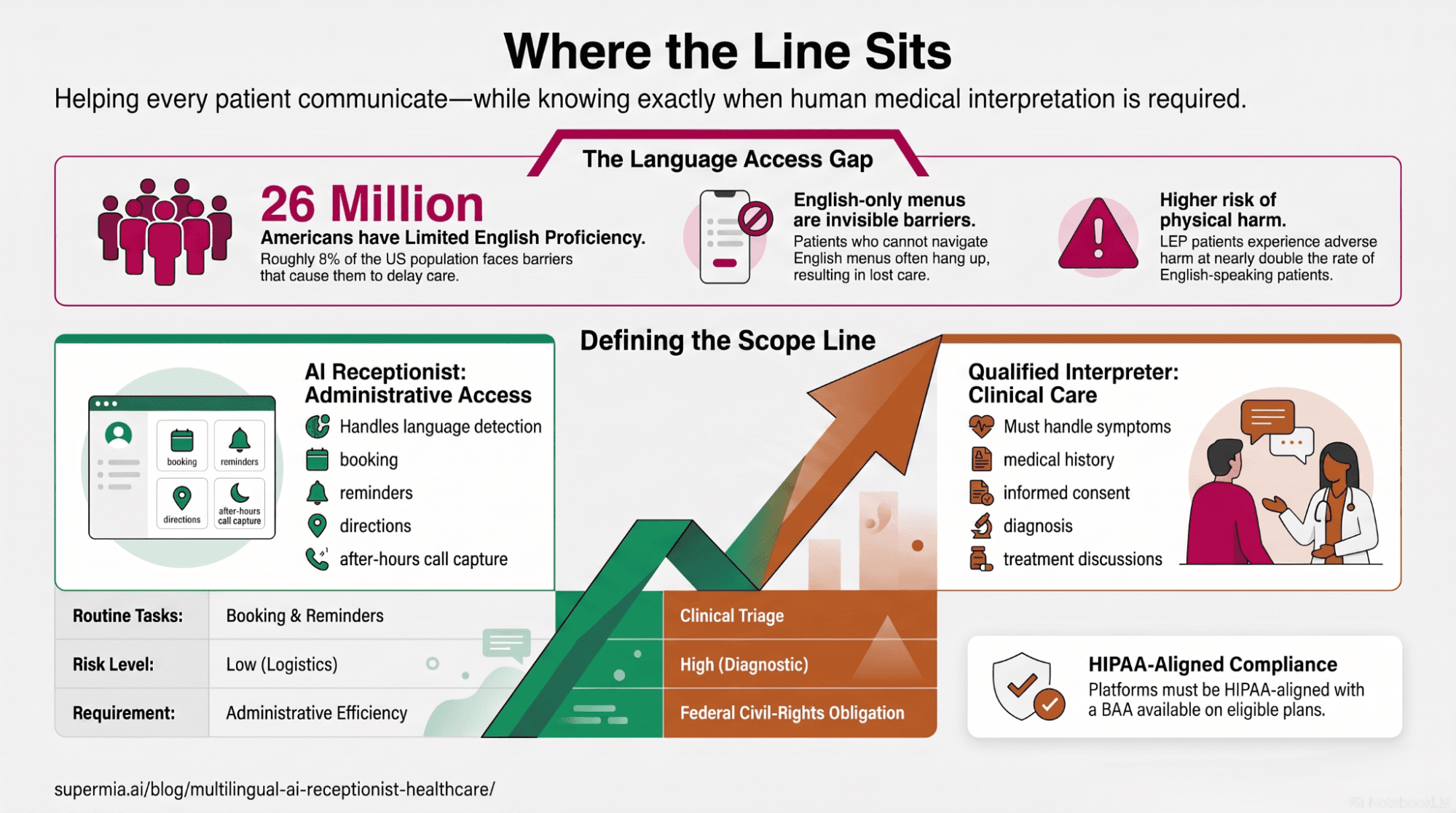
- It's a large population. Around 26 million people in the US have limited English proficiency (KFF) — roughly 8% of everyone aged five and older.
- Spanish covers most of the gap. Roughly 62% of US adults with LEP speak Spanish, per KFF — but the rest of the mix depends entirely on your area.
- The scope line is the whole design. Access tasks belong to the assistant; symptoms, consent and clinical content belong with people.
- Be sceptical of 'fully HIPAA-compliant' claims. Look for HIPAA-aligned with a BAA available on the plan you're actually buying.
A patient calls your practice. They need to reschedule a follow-up, and they speak Spanish. What they hear is an English-only menu. Maybe they press buttons hopefully; maybe they wait for someone who turns out not to speak their language; more often, they hang up and put off the appointment. From your side, nothing happened — there is no missed-call alert for a patient who quietly decided your practice was too hard to reach. That is the part worth sitting with: the cost of an English-only front desk is invisible on every report you look at.
This is not a small population. Around 26 million people have limited English proficiency in the US — roughly 8% of everyone aged five and older, according to KFF — and Census figures put the share who speak a language other than English at home at somewhere between 20% and 22%, depending on which year and cut you read. A multilingual AI receptionist is one practical answer. But it comes with a boundary that most vendors are strangely quiet about, and drawing that boundary properly is what the rest of this guide is for.
What is a multilingual AI receptionist?
A multilingual AI receptionist is a virtual front-desk assistant that detects a caller's language and responds in it. Instead of routing a Spanish-speaking or Vietnamese-speaking patient through an English menu toward a staff member who may not be able to help, it simply answers in their language and gets the task done — booking or moving an appointment, confirming an address, explaining what to bring, taking an after-hours message. It is the same core capability as any AI receptionist for healthcare practices, with language handling as the defining feature.
What it is not is a medical interpreter. That distinction sounds pedantic until you consider what interpretation actually involves — conveying symptoms, risks, and consent accurately between a clinician and a patient, where a mistranslated word changes care. Federal guidance is clear that there is significant risk of error when patients with limited English proficiency are handled without qualified professional interpretation. So the useful way to think about a multilingual AI receptionist is as a front-desk tool that removes an access barrier, sitting alongside — never replacing — the interpretation resources your clinical staff rely on.
The patients your English-only phone line is missing
The chart above puts the numbers together. Beyond the headline population figures, two details shape how you should prioritise. First, Spanish dominates: KFF data indicates roughly 62% of US adults with limited English proficiency speak Spanish, which means Spanish-language coverage alone addresses the majority of the gap for most practices. Second, the remainder is genuinely varied — Mandarin, Vietnamese, Tagalog, Korean and Arabic feature prominently in many US healthcare markets, but the actual mix depends entirely on your area. A practice in Houston and a practice in Minneapolis have different language needs, and neither should be choosing a vendor based on a headline count of supported languages.
There is also a harder dimension to this than convenience. Research cited in this area reports that patients with limited English proficiency experience notably higher rates of physical harm from language-related adverse events than English-speaking patients — one frequently referenced comparison puts it at 49.1% versus 29.5%. Those figures come from patient-safety research rather than from us, and they describe the whole care journey rather than the front desk specifically. But they are the reason language access is treated as a safety and civil-rights matter rather than a customer-experience upgrade, and the reason it is worth getting the front-desk layer right as one part of a broader effort.
The practical alternative most practices weigh this against is interpretation services, typically reported in the region of $30 to $150 per hour, or hiring bilingual staff — which works well but usually covers one or two languages and depends on that person being available. Automating the routine front-desk layer in many languages is not a replacement for either; it just means fewer situations where an interpreter or a bilingual staff member is being used to reschedule an appointment.
What it should handle — and what needs a qualified interpreter
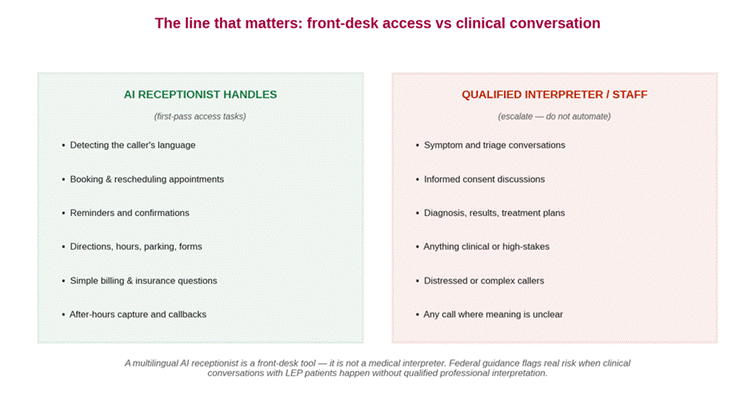
This is the section most vendor pages skip, and it is the one that determines whether deploying this improves care or quietly degrades it. The chart above draws the line. The principle is simple: the assistant handles access, people handle care.
Front-desk tasks the assistant handles
- Detecting the language and switching to it. The patient should never have to navigate English to reach their own language.
- Booking, rescheduling, and cancelling appointments. The highest-volume reason patients call, and a clean fit for automation. Our guide to how AI handles appointment scheduling covers the booking side in more depth — the same logic applies once the conversation is happening in the patient's language.
- Reminders and confirmations. Delivered in the patient's language, which is exactly where reminders stop working when they are English-only.
- Directions, hours, parking, and what to bring. Low-risk logistics that consume a surprising amount of front-desk time.
- Simple billing and insurance questions, and after-hours capture. Routine enquiries and out-of-hours messages, with anything unclear passed on.
Conversations to escalate
- Symptoms and triage. Any description of how a patient feels or how urgent something is belongs with a clinician — through a qualified interpreter where needed.
- Informed consent. Consent requires genuine comprehension. This is interpreter territory, without exception.
- Diagnoses, results, and treatment plans. Clinical content where nuance matters and a small error carries real consequences.
- Distressed callers, or any call where meaning is unclear. If the assistant cannot follow the caller confidently, the correct behaviour is to route to a person rather than guess.
Configure the escalation before you go live, not after. The failure mode worth designing against is an assistant that handles a clinical question competently enough to sound reassuring while getting a detail wrong. Decide in writing which conversations always route to a human, test that the handoff fires, and make sure staff know a transferred call may need an interpreter.
How language detection actually works
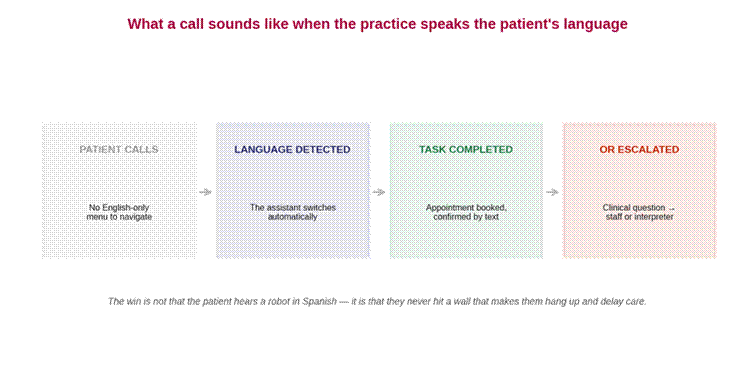
The mechanism is less exotic than it sounds. The assistant identifies the language from the caller's first words and switches to it, which is why a well-configured system needs no 'press 2 for Spanish' step at all — that menu is itself a barrier, since it is usually announced in English. The chart above shows the resulting call shape: the patient speaks, the language is recognised, and either the task completes or the call is escalated.
Three configuration details matter more than raw language counts. First, you can usually prioritise the languages most common in your area, which improves recognition accuracy where it counts. Second, there should be a defined fallback when the language is unsupported or the audio is poor — routing to a person, not guessing. Third, the same language handling should carry across channels, so a patient who calls in Spanish and later texts is not switched back to English. The underlying capability is the same AI voice agent technology used for English-language reception, with language identification layered on top.
Language access, civil rights, and where AI fits
It is worth being clear about the legal texture here, because it changes how you should evaluate this category. Patients with limited English proficiency hold protections under federal civil-rights law, and the Department of Health and Human Services Office for Civil Rights sets out language-access obligations for providers receiving federal financial assistance. Federal language-access requirements were further strengthened in 2024. In other words, meaningful access for LEP patients is not a differentiator a practice earns credit for — it is closer to a baseline expectation.
Where does an AI receptionist fit into that? Honestly: it helps with one layer of it. Making your phone line answerable in a patient's language removes a real barrier to getting an appointment at all, and that is meaningful. It does not, by itself, discharge a practice's language-access responsibilities — particularly around clinical encounters, where qualified professional interpretation remains the standard. The right framing when presenting this internally is that you are improving access at the front door while leaving the clinical interpretation pathway intact.
General guidance, not legal advice. Language-access requirements depend on your funding, jurisdiction, and setting, and they change. Confirm your specific obligations with your compliance team or counsel rather than treating any vendor's summary — including this one — as definitive.
Privacy and compliance questions to ask a vendor
Every patient conversation this system touches is protected health information, so the compliance conversation deserves more scepticism than the language conversation. A note on how to read vendor claims: several platforms in this category describe themselves as 'fully HIPAA-compliant.' Compliance is not really a badge a product carries on its own — it emerges from how a system is configured, what is contracted, and how your practice uses it. A more accurate way to describe a good platform is HIPAA-aligned, with a business associate agreement available on eligible plans — and that is the language we use about our own product.
Questions worth asking before you connect anything:
- Is the platform HIPAA-aligned, and is a business associate agreement available on the plan you are actually buying?
- What happens to call recordings and transcripts — where are they stored, for how long, and who can access them?
- Is any patient data used to train models, and can that be turned off?
- How does the escalation path work in practice, and can you configure which topics always route to a human?
- What happens when the assistant does not understand — does it transfer, or does it keep trying?
For the broader compliance picture beyond language, our HIPAA compliance checklist goes through what to verify before deploying any conversational AI in a healthcare setting.
How to roll it out in a practice
A sensible sequence: start from your own patient population rather than a vendor's language list — registration data and interpreter requests will tell you which languages actually matter. Write down the scope line before configuring anything, so it is a decision rather than a default. Check the compliance terms with whoever owns that in your practice. Then connect scheduling, and test real call flows in each language, including deliberately triggering an escalation to confirm the handoff reaches a person. After launch, review transcripts in each language for misunderstandings and watch how often escalations fire — too rarely is a warning sign, not a success metric.
Where does SuperMIA fit? We are one option among several, and we would rather be the right fit than the loudest pitch. SuperMIA handles multilingual patient conversations across voice and chat, books into your systems, and lets you define which topics always escalate to your team — and our platform is HIPAA-aligned, with a business associate agreement available on eligible plans. If you want to see how this works alongside the rest of your patient communication, our healthcare solution covers the wider picture. The most useful next step is hearing it handle a call in the language your patients actually speak.
Book a demo — and hear it answer a call in Spanish →
Frequently asked questions
What is a multilingual AI receptionist?
A multilingual AI receptionist is a virtual front-desk assistant that detects a caller's language and responds in it — handling appointments, reminders, directions, and routine questions without the patient navigating an English-only menu. It is a front-desk tool, not a medical interpreter: symptom, consent, and clinical conversations should be escalated to staff or a qualified professional interpreter.
Can an AI receptionist replace a medical interpreter?
No. An AI receptionist handles front-desk access tasks such as booking, reminders, directions, and after-hours capture in a patient's language. Clinical conversations — symptoms, triage, informed consent, diagnoses, and treatment discussions — should be handled by qualified staff or a professional medical interpreter. Federal guidance points to a high risk of error when patients with limited English proficiency are handled without qualified interpretation.
How does an AI receptionist detect a patient's language?
It identifies the language from the caller's first words and switches automatically, so the patient never has to navigate an English-only menu to reach their language. Well-configured systems also let a practice prioritise the languages most common in its area, and route to a human when the language is unsupported or the audio is unclear.
Is a multilingual AI receptionist HIPAA compliant?
Compliance is a property of how a system is configured and contracted, not a label a product carries on its own. Look for a HIPAA-aligned platform with a business associate agreement available on eligible plans, clear data handling and retention terms, and access controls. Treat blanket claims of full compliance with caution, and confirm the specifics with the vendor and your own compliance team.
Which languages matter most for US healthcare practices?
Spanish is by far the most significant — it accounts for roughly 62% of US adults with limited English proficiency, according to KFF. After Spanish, the most common languages in many US healthcare markets include Mandarin, Vietnamese, Tagalog, Korean, and Arabic, though the mix varies considerably by region. Choose based on your own patient population rather than a vendor's headline language count.

Urvil Dhanani
Urvil Dhanani is the AI/ML Lead at SuperMIA, focused on the architecture behind reliable conversational AI - agent design patterns, voice and chat orchestration, and platform evaluation. He writes practical, vendor-neutral guides that help technical teams build and choose AI systems that hold up in production.