
Table of Contents
- What is an AI SMS chatbot?
- How missed call text back actually works
- When SMS wins — and when you should answer the phone instead
- Writing texts people actually reply to
- The compliance rules that decide whether your texts arrive
- Booking, reminders, and no-shows
- How to set it up without breaking anything
- Frequently asked questions
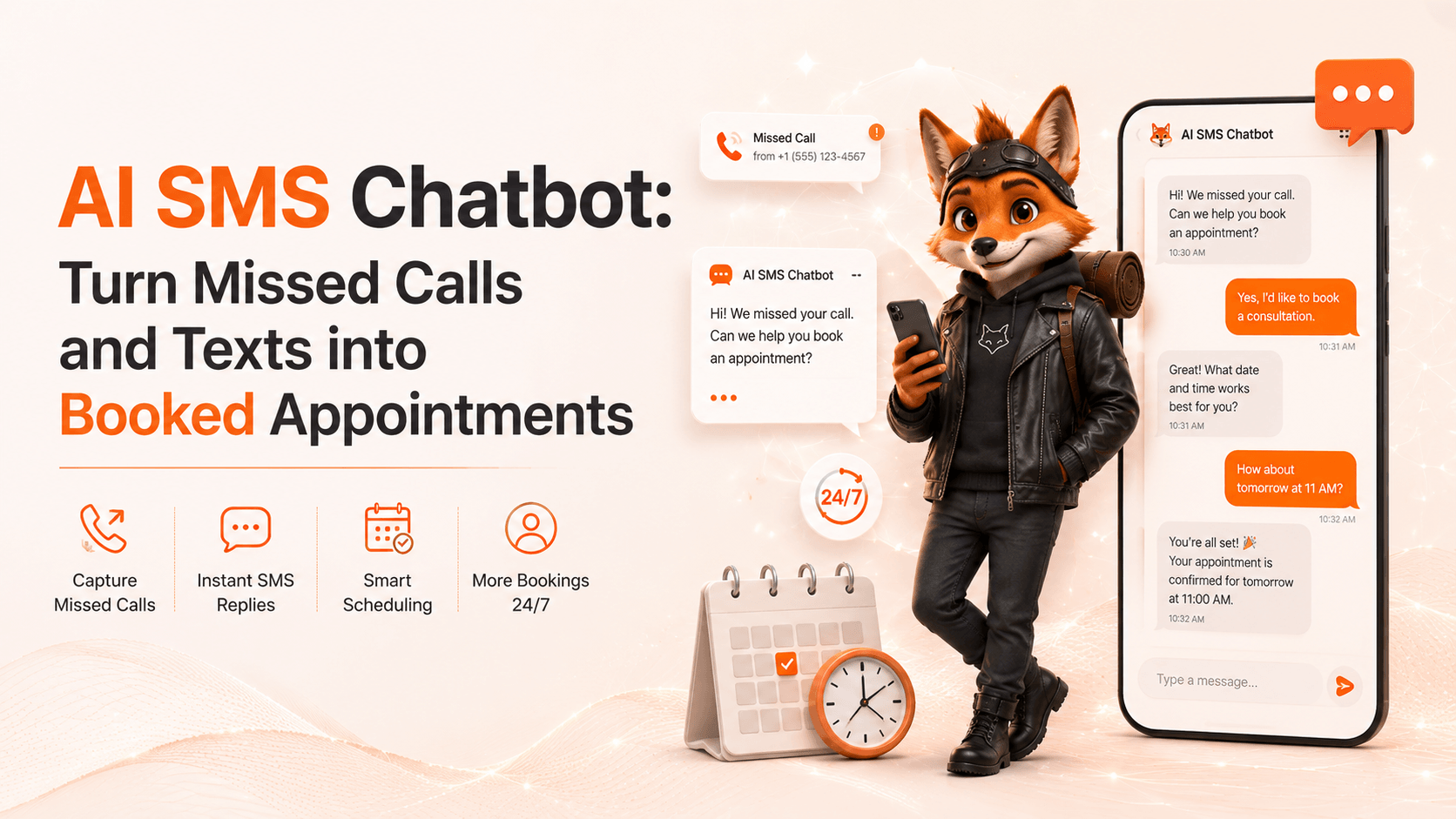
What is an AI SMS chatbot? Software that holds real two-way text conversations with your customers automatically. It answers inbound texts instantly and fires a text to anyone whose call you missed — then answers their questions, checks your calendar, and books the appointment over SMS. It runs 24/7 on any mobile phone, and hands urgent or complex conversations to a person.
Book a demo — and see a text-back flow end to end →
Key takeaways
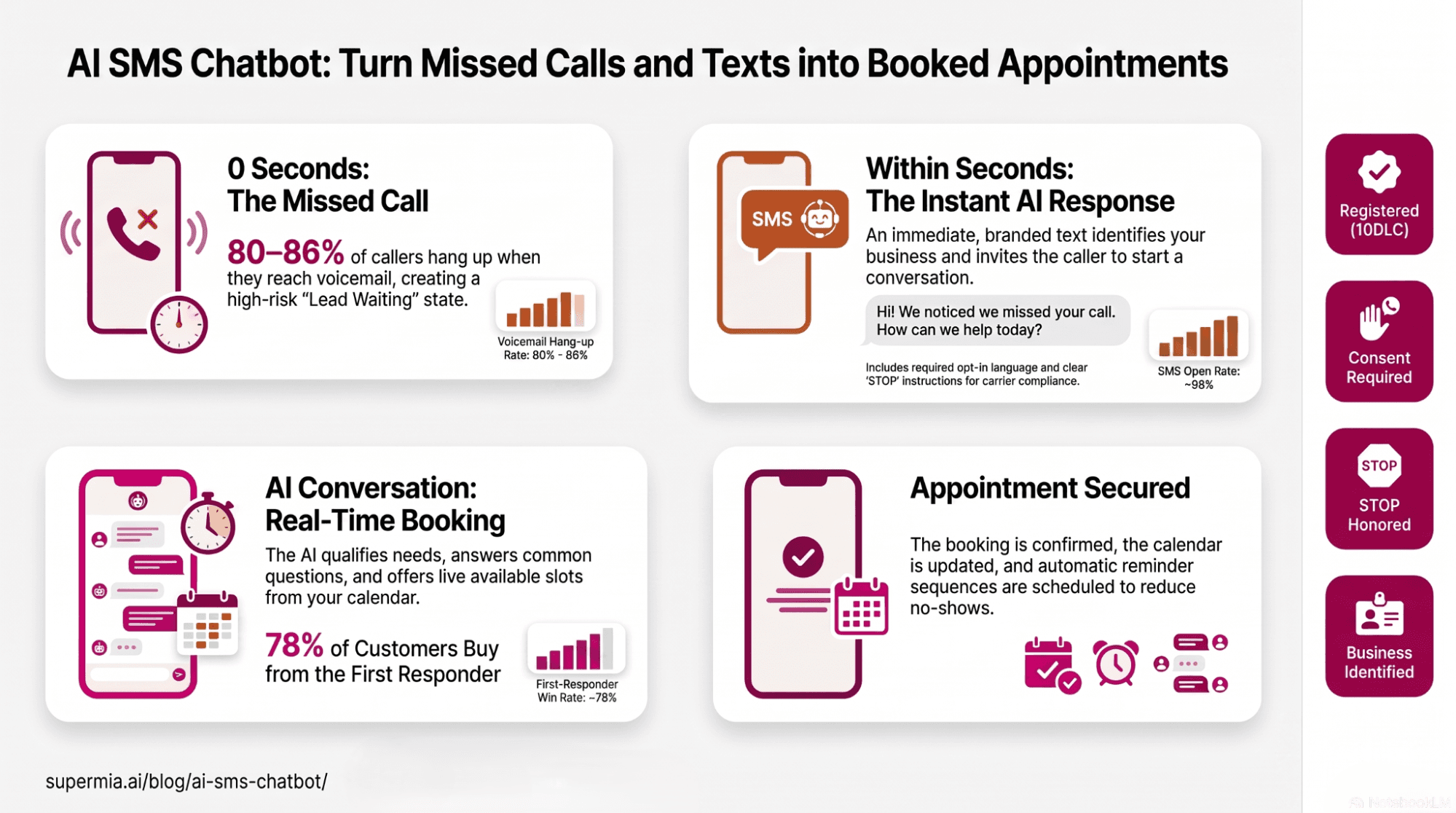
- Voicemail loses the customer. Figures cited across the industry put voicemail hang-up somewhere between 80% and 86%.
- Speed is the whole advantage. Around 78% of customers buy from whoever responds first, and SMS open rates are usually quoted near 98% — both industry figures, not ours.
- Text-back is a safety net, not a strategy. It only runs after a call is already lost; not missing the call is the better fix.
- Compliance decides whether texts arrive at all. Without A2P 10DLC registration, carriers filter your messages and nothing looks broken.
- Calendar integration is what makes it real. Without it, the bot collects a request instead of booking a slot.
Someone calls your business. The line is busy, or it’s 8pm, or the one person who answers the phone is with a customer. The call goes unanswered — and here’s the part that matters: that person is still holding their phone, still needs the thing they called about, and is roughly ten seconds away from calling the next business on the list. A voicemail won’t save it. Most people who reach voicemail just hang up — figures cited across the industry put it somewhere in the region of 80% to 86%, depending on whose data you read.
A text, though, arrives while their phone is still in their hand. That’s the whole premise of an AI SMS chatbot: answer by text within seconds, hold a real conversation, and finish with a booked appointment instead of a missed opportunity. This guide is a channel guide rather than a sales pitch — it covers what SMS is genuinely good at, what it isn’t, how it sits alongside voice and WhatsApp, how to write texts people actually reply to, and the US compliance rules that quietly stop most texting programs from working at all.
What is an AI SMS chatbot?
An AI SMS chatbot is software that holds real two-way text conversations with your customers automatically. It answers inbound texts instantly — someone messaging your business number gets a useful reply rather than silence — and it can fire a text to anyone whose call you missed. From there it behaves like a capable front-desk person working over SMS: answering questions about hours, pricing, or availability, capturing what the customer actually needs, offering real appointment slots, and passing anything urgent or delicate to a human.
The word doing the heavy lifting is conversation. A basic auto-responder that fires “Sorry we missed your call, we’ll get back to you” is a dead end — it acknowledges the customer without helping them, and they still call your competitor. An AI assistant built on a proper AI chatbot platform understands the reply, answers the follow-up question, and moves toward a booking. That difference — auto-reply versus conversation — is what separates a text-back gimmick from a channel that actually books work.
How missed call text back actually works
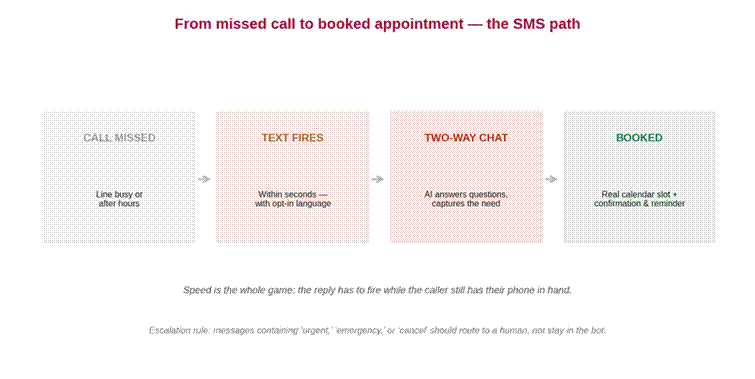
Mechanically it’s simpler than most people expect. The chart above shows the path; here it is step by step.
- The system watches your business line for unanswered calls — either by enabling texting on your existing number or by routing unanswered calls through a number that supports SMS.
- The moment a call goes unanswered, a text fires to that caller — within seconds, not minutes. Speed is the entire advantage; a text that arrives twenty minutes later lands after they’ve already booked elsewhere.
- The message identifies your business, references the call they just made, invites a reply, and includes the opt-in and opt-out language the rules require.
- If they reply, the AI assistant takes over the thread: answering questions, capturing the job or the need, and offering genuine appointment slots from your calendar.
- The booking is confirmed by text, a reminder sequence attaches automatically, and anything flagged as urgent goes to a person.
Why does speed matter this much? Because the customer is comparison-shopping in real time. The commonly cited figure is that around 78% of customers buy from whichever company responds first, and text is the fastest channel to reach someone who has just put their phone down — SMS open rates are usually quoted at around 98%. Both figures come from industry sources rather than our own data, but the direction is consistent everywhere: responding first wins the job, and text is how you respond first.
When SMS wins — and when you should answer the phone instead
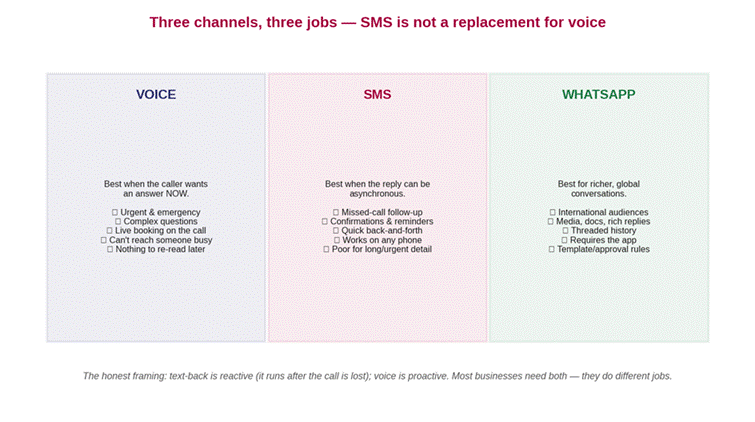
Here’s where most content on this topic gets self-serving. Companies selling text-back tell you it’s essential; companies selling AI voice agents point out — correctly — that text-back is reactive, running only after the call has already been lost, and that a caller who gets a text instead of an answer is already a bit frustrated. Both camps are describing something true. The useful answer is that SMS and voice are different channels doing different jobs, not competitors for the same job. The chart above lays out the split.
Where SMS is strongest
Text wins whenever the exchange can be asynchronous. Missed-call follow-up is the obvious case, but the bigger long-term value is in appointment confirmations, reminders, rescheduling, and quick back-and-forth questions — the customer replies when convenient, there’s a written record both sides can re-read, and it works on any phone without an app. For anything you would otherwise chase by phone tag, text is simply the better tool.
Where voice is strongest
Voice wins when the customer wants an answer now. Emergencies, complicated questions, anything emotional, and any situation where the caller wants to be reassured by a responsive human-sounding conversation. And the honest structural point the voice vendors make is worth taking seriously: the best outcome isn’t a fast text-back — it’s not missing the call in the first place. If your phone goes unanswered regularly, an AI voice agent that picks up every call is the more direct fix, and text-back becomes the safety net beneath it rather than the whole strategy. Plenty of businesses run both: answer the call live when possible, text back when it isn’t.
Where WhatsApp fits
If a meaningful share of your customers are international, WhatsApp is often the channel they actually use — it supports richer messages, media, and a threaded history, though it comes with its own template and approval requirements. For most US-only service businesses, SMS is the pragmatic default; for global or immigrant-heavy customer bases, our WhatsApp AI chatbot guide covers the differences in detail. Together, voice, SMS, and WhatsApp cover essentially every way a customer might try to reach you.
Writing texts people actually reply to
The message itself decides whether this works. The pattern that fails is the vague acknowledgement — “Sorry we missed your call, we’ll be in touch” — which gives the customer nothing to do and no reason to wait. The messages that get replies are short, specific, and conversational: they name the business, reference what just happened, and ask one easy question.
Hi — this is [Business Name]. Sorry we missed your call just now.
I can help right here by text. What do you need, and what day works for you?
Reply STOP to opt out.
Note what it does: identifies the business immediately (anonymous texts read as spam to humans and to carriers), acknowledges the specific call, offers to solve the problem in this channel rather than promising a callback, asks a single open question, and carries the opt-out language. A few other things worth building in:
- Ask one question at a time. Texting is a narrow channel. A message with four questions gets one answer, or none.
- Offer real slots, not ‘we’ll check.’ ‘I have Thursday 10am or Friday 2pm — which works?’ converts far better than an offer to look into it.
- Escalate the words that signal trouble. Messages containing ‘urgent,’ ‘emergency,’ or ‘cancel’ should route to a human immediately. Automation is a bad look on an emergency.
- Keep the thread in one inbox. If the customer replies and it lands somewhere nobody watches, you’ve rebuilt voicemail with extra steps.
The compliance rules that decide whether your texts arrive
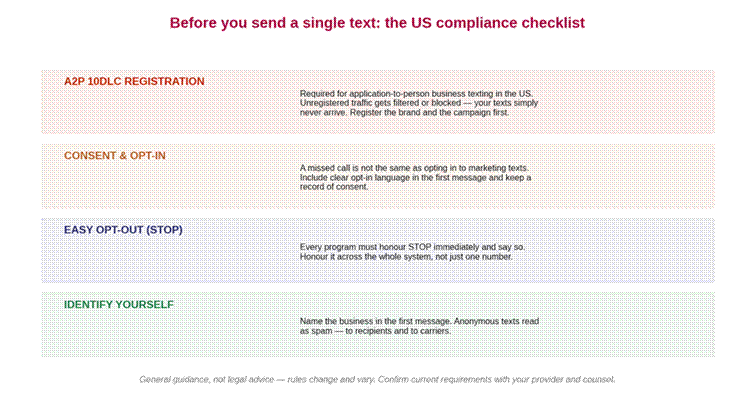
This is the part most guides skip, and it’s the part that silently breaks texting programs — because when you get it wrong, nothing looks broken. Your system reports messages as sent. Your customers just never receive them. The chart above is the checklist; here’s what sits behind it.
- A2P 10DLC registration. In the US, automated application-to-person business texting generally requires registering your brand and your campaign. Unregistered traffic is commonly filtered or blocked by carriers — so this is not paperwork you do later, it’s the first step before you send anything.
- Consent. Somebody calling you is not the same thing as somebody agreeing to receive automated marketing texts. Include clear opt-in language in that first message, keep the initial reply focused on the reason they called rather than promotion, and keep a record of consent.
- Honour STOP, everywhere. Every program must accept opt-out requests and act on them immediately — across your whole system, not just the number that received the message.
- Identify yourself. Name the business in the first message. It improves replies and it keeps you out of the pattern carriers treat as spam.
General guidance, not legal advice. Texting rules change, vary by jurisdiction, and depend on how you collect consent. Confirm current requirements with your messaging provider and, where the stakes justify it, your own counsel before launching a program.
Booking, reminders, and no-shows
Getting a reply is only half the win — the point is a confirmed appointment. That requires the assistant to be connected to your actual calendar, so it can offer genuine availability inside the text thread and write the booking straight in. Without that connection, the best it can do is collect a request for someone to action later, which reintroduces the delay you were trying to remove.
The underrated part is what happens afterwards. Because text is read quickly and replied to easily, it’s the strongest channel for confirmations and reminders — and reminder sequences are one of the most reliable ways to reduce no-shows. Rescheduling by text also beats rescheduling by phone: a customer who can move an appointment with two messages will move it, whereas one who has to call during business hours often just doesn’t show. Same channel, three separate wins: booking, confirming, and keeping the slot filled.
How to set it up without breaking anything
A sane order of operations: register for 10DLC first (before writing a single message), then enable texting on the number your customers already recognise, then write the first message with opt-in and STOP built in, then connect your calendar and CRM so bookings and history land where your team works, and finally set your escalation rules. Test the whole path end to end before you rely on it — deliberately miss a call, receive the text, reply as a customer would, and confirm a booking actually appears in the calendar.
It’s also worth deciding where text-back sits in your overall setup. If you’re missing a lot of calls, fixing the answering problem usually pays back faster than perfecting the follow-up — our vertical guides, like the one on running an HVAC answering service, walk through that side for specific trades, and the same logic applies to an answering service for retail. Text-back is the safety net under a phone system that’s already answering as many calls as it can.
Where does SuperMIA fit? We’re one option among several, and we’d rather be the right fit than the loudest pitch. SuperMIA runs conversations across voice and text from one system, so the same assistant that answers the phone can carry a conversation over SMS and book into your calendar — which is the combination this guide argues most businesses actually need. The most useful next step isn’t reading more; it’s watching the flow run once with your own numbers.
Book a demo — and see a text-back flow end to end →
Frequently asked questions
What is an AI SMS chatbot?
An AI SMS chatbot is software that holds real two-way text conversations with your customers automatically. It answers inbound texts instantly, and it can fire a text to anyone whose call you missed — then answer their questions, check your calendar, and book the appointment over SMS. It runs 24/7 on any mobile phone, and hands urgent or complex conversations to a person.
How does missed call text back work?
The system watches your business line for unanswered calls. When one is missed, it automatically sends an SMS to that caller within seconds — identifying your business and inviting a reply. If the caller responds, an AI assistant continues the conversation over text: answering questions, capturing what they need, and offering real appointment slots. Complex or urgent messages are routed to a human.
Is SMS better than a phone call for following up?
Neither is better — they do different jobs. SMS wins for asynchronous follow-up, confirmations, and reminders, because the customer can reply when convenient and messages get read quickly. Voice wins when the caller wants an answer immediately, when the question is complex, or in an emergency. Text-back is reactive by nature: it runs after a call is already missed. Most businesses get the best results using both.
Do I need 10DLC registration to text my customers?
In the United States, automated application-to-person business texting generally requires A2P 10DLC registration of your brand and campaign. Without it, carriers commonly filter or block your messages — which means your texts silently never arrive. You also need clear consent, must identify your business, and must honour opt-out requests such as STOP. This is general guidance, not legal advice; confirm current requirements with your provider.
Can an SMS chatbot book appointments?
Yes, if it is connected to your calendar. A capable SMS chatbot checks live availability, offers real slots in the text thread, confirms the booking, and then sends confirmations and reminders by text — which is one of the most reliable ways to reduce no-shows. Without calendar integration it can only collect a request for someone to follow up manually.

Urvil Dhanani
Urvil Dhanani is the AI/ML Lead at SuperMIA, focused on the architecture behind reliable conversational AI - agent design patterns, voice and chat orchestration, and platform evaluation. He writes practical, vendor-neutral guides that help technical teams build and choose AI systems that hold up in production.