
Table of Contents
- The one-person front desk doing a three-person job
- What is an AI receptionist for healthcare?
- The 30-second booking workflow (how it actually works)
- AI receptionist vs answering service vs in-house staff
- Why small healthcare practices need this more than large health systems
- How AI receptionists cut no-shows by up to 59%
- HIPAA compliance: what to verify before choosing an AI receptionist
- How SuperMIA’s AI receptionist works for healthcare practices
- Frequently asked questions
- Your front desk deserves backup
Quick Answer
An AI receptionist for healthcare is a voice-based AI system that answers patient phone calls 24/7, schedules appointments directly into your EHR, handles insurance and service questions, triages emergencies, and sends automated confirmations and reminders — all without a human picking up the phone. It costs $200–$600/month vs $3,500–$4,500 for an in-house receptionist, and one practice cut no-shows 59% and grew revenue 57% after deploying it.
The one-person front desk doing a three-person job
A dermatology practice owner posted on Reddit last month. The practice had grown from 12 patients a day to 28. Revenue was up. Everything else was on fire.
The owner’s words: her front desk person was “juggling phones, patient intake, appointment scheduling, referral coordination, and prior authorizations. She’s one person doing a three-person job, and things are slipping: missed prior auths, phone calls going to voicemail, patients waiting 15 minutes just to check in.” That post got 192 upvotes because every small practice owner recognized their own front desk in it.
The financial picture was worse. Monthly payroll had gone from $8K to $30K. The practice was netting $35K total. One person was stretched past breaking, and hiring another would eat what little margin remained.
Meanwhile, on r/healthIT, a multi-site primary care IT manager shared that their no-show rate had been stuck at 22–24% for two years. Their front desk was burning 2–3 FTE hours daily making outbound confirmation calls with a contact rate under 10%.
“My front desk person is juggling phones, patient intake, appointment scheduling, referral coordination, and prior authorizations. She’s great but she’s one person doing a three-person job, and things are slipping.”
— r/smallbusiness, dermatology practice owner, 192 upvotes
This is the reality for small healthcare practices in 2026. The front desk is the bottleneck. Phones go to voicemail. Patients leave. Revenue leaks. Staff burns out. And hiring is too expensive and too slow to fix it.
That’s why AI receptionist solutions for healthcare practices are becoming essential infrastructure — not because AI is trendy, but because the math doesn’t work any other way.
Replace your answering service
See how an AI receptionist answers every call and books patients in 30 seconds.
Book a Demo →What is an AI receptionist for healthcare?
Definition
An AI receptionist for healthcare is a voice-based artificial intelligence system that answers patient phone calls, schedules appointments directly into your EHR or practice management system, handles common patient questions (insurance, hours, directions, services), triages emergencies, and sends automated confirmations and reminders — all without a human picking up the phone. It operates 24/7 and handles unlimited simultaneous calls.
Think of it as an AI voice bot that does everything your front desk receptionist does on the phone, but never takes lunch, never calls in sick, and never puts a patient on hold. For practices that also want digital intake and web conversations covered, the same workflow can extend through patient chat on one unified platform.
The key difference from traditional answering services: an AI receptionist doesn’t just take messages. It completes the entire booking workflow in real time. Patient calls at 8 PM, AI answers, asks for insurance and preferences, checks provider availability, books the appointment, and sends a confirmation text. Total time: about 30 seconds. No callback needed.
The 30-second booking workflow (how it actually works)
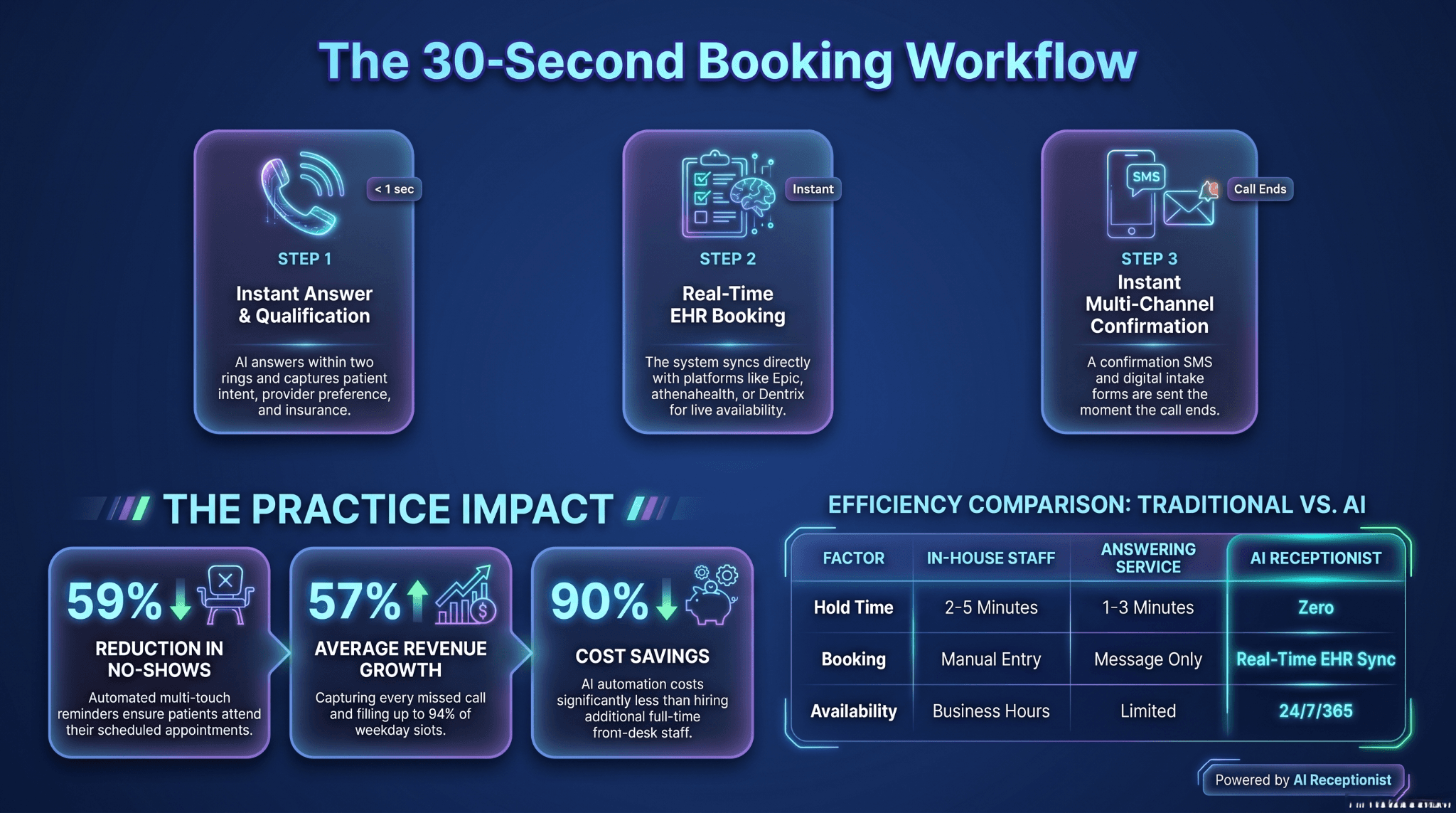
Second 0–5: Instant answer
Phone rings. AI picks up within two rings. Greets the patient by practice name in a natural, conversational voice. No hold music. No “press 1 for appointments.”
The MIA Voice Agent answers in under one second — no hold music, no IVR tree, no voicemail.
Second 5–15: Qualification
AI asks: new or returning patient? What brings you in? Do you have a preferred provider? Insurance carrier? Collects the information your front desk would — but instantly, without fumbling between screens.
Second 15–25: Real-time booking
AI checks live availability in your EHR (Epic, athenahealth, Dentrix, Open Dental, Eaglesoft) and offers the best matching slot. Patient confirms. Appointment created.
Second 25–30: Confirmation
AI sends a confirmation text with date, time, provider name, and directions. Pre-visit intake forms follow automatically. Done.
The patient hangs up with an appointment booked, a confirmation in hand, and zero hold time. Your front desk staff never touched the phone.
AI receptionist vs answering service vs in-house staff
| Factor | In-House Receptionist | Answering Service | AI Receptionist |
|---|---|---|---|
| Monthly cost | $3,500–$4,500 (fully loaded) | $500–$2,000 | $200–$600 |
| 24/7 availability | No (business hours only) | Yes (some) | Yes — always |
| Books into EHR directly | Yes (manual) | No (takes messages) | Yes — real-time auto |
| Simultaneous calls | 1 | 2–3 (varies) | Unlimited |
| Patient hold time | 2–5 minutes avg | 1–3 minutes | Zero |
| Follow-up reminders | Manual | No | Automatic (SMS + email + voice) |
| HIPAA compliance | Training-dependent | Varies | Built-in (BAA + encryption) |
| No-show reduction | Minimal | None | 25–59% reduction |
| Turnover risk | 3–6 month avg | Low | None |
| Burnout risk | Extreme | Low | None |
The Reddit dermatology practice owner whose payroll went from $8K to $30K asked the wrong question. The question wasn’t “should I hire another receptionist?” It was “what tasks can I automate so my existing team can focus on patients in the room?”
See an AI receptionist in action
Watch how it answers a call, qualifies the patient, and books an appointment in 30 seconds.
30-Second Demo →Why small healthcare practices need this more than large health systems
Large hospital systems have call centers with 20–50 agents. They can absorb missed calls. Small practices cannot.
Here’s the math that nobody shows small practice owners:
The missed-call math
- Practices miss 20–35% of incoming calls during business hours (industry data)
- 75% of callers who reach voicemail don’t leave a message
- Each missed call costs approximately $200–$500 in lost production
- 62% of healthcare inquiries happen outside business hours
- $150,000 per year lost to missed calls and scheduling inefficiency (benchmark this against current MGMA staffing data)
“No one answers the calls anyway but they will respond to text.”
— r/healthIT, Epic administrator, 6 upvotes
An AI receptionist captures that reality — it answers instantly AND sends text confirmations that patients actually read. For deeper context on scheduling automation, see our AI appointment scheduling for healthcare guide, then compare rollout options on our pricing page.
How AI receptionists cut no-shows by up to 59%
The r/healthIT manager who shared their 23% no-show rate tried everything: portal reminders (useless for no-show patients), outbound calls (under 10% contact rate), even extra staffing. Nothing moved the number.
“No-show rate had been stuck at 22–24% for two years. Leadership kept asking IT to fix it. Outbound calls from front desk: contact rates under 10%. 2–3 FTE hours burned daily. Not scalable.”
— r/healthIT, multi-site primary care IT manager, 130 upvotes
What worked: two-touch SMS reminders (48 hours + 2 hours before appointment) combined with instant confirmations at booking. Their no-show rate in the confirmed segment dropped to approximately 11%, which tracks with appointment-reminder evidence summarized in this systematic review.
SuperMIA’s AI takes this further. At Media Brite Smile Dental, the combination of AI-answered inbound calls, instant booking, and multi-channel reminders (SMS + email + voice) cut no-shows from 14.2% to 5.8% — a 59% reduction.
| Metric | Before SuperMIA | After SuperMIA |
|---|---|---|
| No-show rate | 14.2% | 5.8% (−59%) |
| Revenue growth | — | +57% |
| Weekday slot fill rate | — | 94% |
| Platforms tested | 12 platforms, 1,500+ calls | SuperMIA outperformed all |
HIPAA compliance: what to verify before choosing an AI receptionist
Any AI handling patient calls is processing ePHI. The compliance bar is non-negotiable. Before signing with any vendor, verify these five items (detailed in our HIPAA compliant chatbot checklist). HHS is explicit that covered entities and business associates need appropriate safeguards and a valid BAA for ePHI workflows: see the HIPAA Security Rule summary.
- Signed BAA — no BAA means the vendor cannot legally handle your patient data
- AES-256 encryption at rest + TLS 1.2+ in transit
- HIPAA-eligible cloud hosting (not just any AWS instance)
- Audit logging — who accessed what PHI, when, from where
- SOC 2 Type II — ask for the actual audit report, not a website badge
How SuperMIA’s AI receptionist works for healthcare practices
SuperMIA’s AI receptionist solutions for healthcare practices are built for the exact workflows small practices need, from phone automation to broader patient communication on one platform:
- Answers every call 24/7. No patient ever hears voicemail. Nights, weekends, holidays, lunch breaks.
- Books directly into your EHR. Real-time bidirectional sync with Epic, athenahealth, Dentrix, Open Dental, Eaglesoft. Right provider, right slot, right duration.
- Manages emergency triage. Decision-tree protocols: severe pain → same-day emergency, life-threatening → 911, after-hours → on-call provider alert.
- Sends automated reminders. Confirmation texts after every call. Reminders at 48hr + 2hr. One-tap reschedule via SMS.
- Backfills from waitlist. Canceled slots offered to next patient on waitlist automatically.
- HIPAA compliant. Signed BAA, AES-256 encryption, HIPAA-eligible hosting.
- Deploys in 48 hours. Connect your phone system, configure scripts, go live. No IT team required.
Never miss a patient call again
SuperMIA answers every call, books into your EHR, and deploys in 48 hours.
Book a Demo →Frequently asked questions
Your front desk deserves backup
The dermatology practice owner whose payroll tripled while margins shrank to near-zero is not an outlier. That is the standard trajectory of every growing small healthcare practice that tries to scale by hiring.
The math is simple. Every missed call costs $200 to $500. Every no-show costs $200. Every hour your receptionist spends on the phone leaving voicemails nobody returns is an hour not spent on the patients in the waiting room.
An AI receptionist does not replace your front desk team. It catches the calls they cannot physically answer — the after-hours emergency, the lunch-break new patient, the four calls that ring simultaneously during the 2 PM rush.
Media Brite Smile Dental tested 12 platforms and chose SuperMIA. No-shows dropped 59%. Revenue grew 57%. Their front desk stopped drowning and started focusing on patients.
From phone ring to patient booked in 30 seconds. That is what your practice deserves.
Never miss a patient call again.
SuperMIA answers every call, books into your EHR, and deploys in 48 hours. See it live.
Replace Your Answering Service →
Harikrishna Patel
Harikrishna Patel is the founder of MIA – My Intelligent Assistant, the AI automation platform built under Botfinity Inc. in Dallas, Texas. With 15+ years in software engineering, AI/ML, and enterprise solution design, he focuses on creating practical, scalable AI tools that help businesses automate support, workflows, and operations through voice and chat.