
Table of Contents
Why This Comparison Exists
If you’re comparing Vapi and SuperMIA, you’re past the “what is AI voice” stage. You’ve shortlisted vendors and you need decision-grade numbers. This guide gives them - with three concrete call-volume scenarios (1,000, 10,000, and 100,000 calls per month), the hidden cost stack most vendor pages don’t itemize, a feature-by-feature comparison, and an honest section on where Vapi is the right choice over SuperMIA.
We’re writing this because the same question lands in our inbox every week: “We’re evaluating Vapi. What does your pricing actually look like at 10K calls per month? And where would you genuinely recommend them over you?” Here’s the answer in writing, so you don’t need the call to start the comparison.
Important: All pricing figures cited are based on published Vapi rates as of writing (May 2026). Vapi’s per-minute and component pricing changes regularly - verify current rates at vapi.ai/pricing before signing. SuperMIA figures reflect current usage-tier pricing.
Calculate your voice agent costs.
We’ll show you the exact flow and savings math for your use case.
Calculate your voice agent costs →Quick Answer
Vapi is a developer-first AI voice infrastructure platform with usage-based per-minute pricing plus passthrough costs for LLM (GPT-4o/Claude), TTS (ElevenLabs/Cartesia), and telephony (Twilio). All-in cost typically lands between $0.13–$0.40 per minute depending on configuration. SuperMIA uses predictable usage tiers that bundle voice, LLM, TTS, telephony, compliance, and CRM integrations into a single line item - sacrificing some configuration flexibility for cost predictability and dev-time savings. At 1,000 monthly calls Vapi is usually cheaper. At 10,000 calls the two are close. At 100,000 calls SuperMIA wins on TCO once dev time and compliance work are included.
How Vapi Pricing Actually Works
Vapi’s published model (as of writing) is component-based. You pay for each layer of the voice stack separately, plus a Vapi platform fee.
| Component | Provider Examples | Approx. Cost / Min | What It Does |
|---|---|---|---|
| Vapi platform fee | Vapi | ~$0.05 | Orchestration, session management, dashboards |
| Speech-to-text (STT) | Deepgram, Whisper | ~$0.004–$0.012 | Converts caller audio to text |
| LLM reasoning | OpenAI GPT-4o, Claude | ~$0.06–$0.18 | Interprets intent, generates responses |
| Text-to-speech (TTS) | ElevenLabs, Cartesia, PlayHT | ~$0.05–$0.25 | Synthesizes voice from text |
| Telephony | Twilio, Plivo | ~$0.014–$0.020 | Voice provider passthrough |
| Recording / storage | Various | ~$0.001–$0.005 | Call recording and retention |
Realistic all-in per-minute cost on standard config: $0.13–$0.20. On premium config with ElevenLabs Turbo + GPT-4o + recording: $0.30–$0.40. Conversation length matters too - a 45-second qualification call costs different from a 4-minute support call.
How SuperMIA Pricing Works
SuperMIA uses usage-tier pricing. One line item covers voice agent platform, LLM, TTS, STT, telephony, compliance (TCPA + DNC scrubbing), CRM integrations (HubSpot, Salesforce, Pipedrive native), calendar booking, and human-in-the-loop transfer routing. Tiers scale with monthly call minutes.
| Tier | Monthly Minutes | All-In Effective Rate | Best For |
|---|---|---|---|
| Starter | Up to 2,000 min | ~$0.18–$0.22/min | Single use case, SMB pilots |
| Growth | 2,000–10,000 min | ~$0.14–$0.18/min | Mid-market sales + support |
| Scale | 10,000–100,000 min | ~$0.10–$0.14/min | Enterprise outbound or contact center |
| Enterprise | 100,000+ min | Custom | Multi-region, custom SLAs, dedicated infra |
Effective rates are blended - SuperMIA doesn’t bill per LLM token or per TTS character separately. Compliance, integrations, and live transfer come included rather than as add-ons. The tradeoff: less granular configuration than Vapi for teams that want to pick their own STT/TTS/LLM stack.
For full tier details and add-on options, see all SuperMIA pricing tiers.
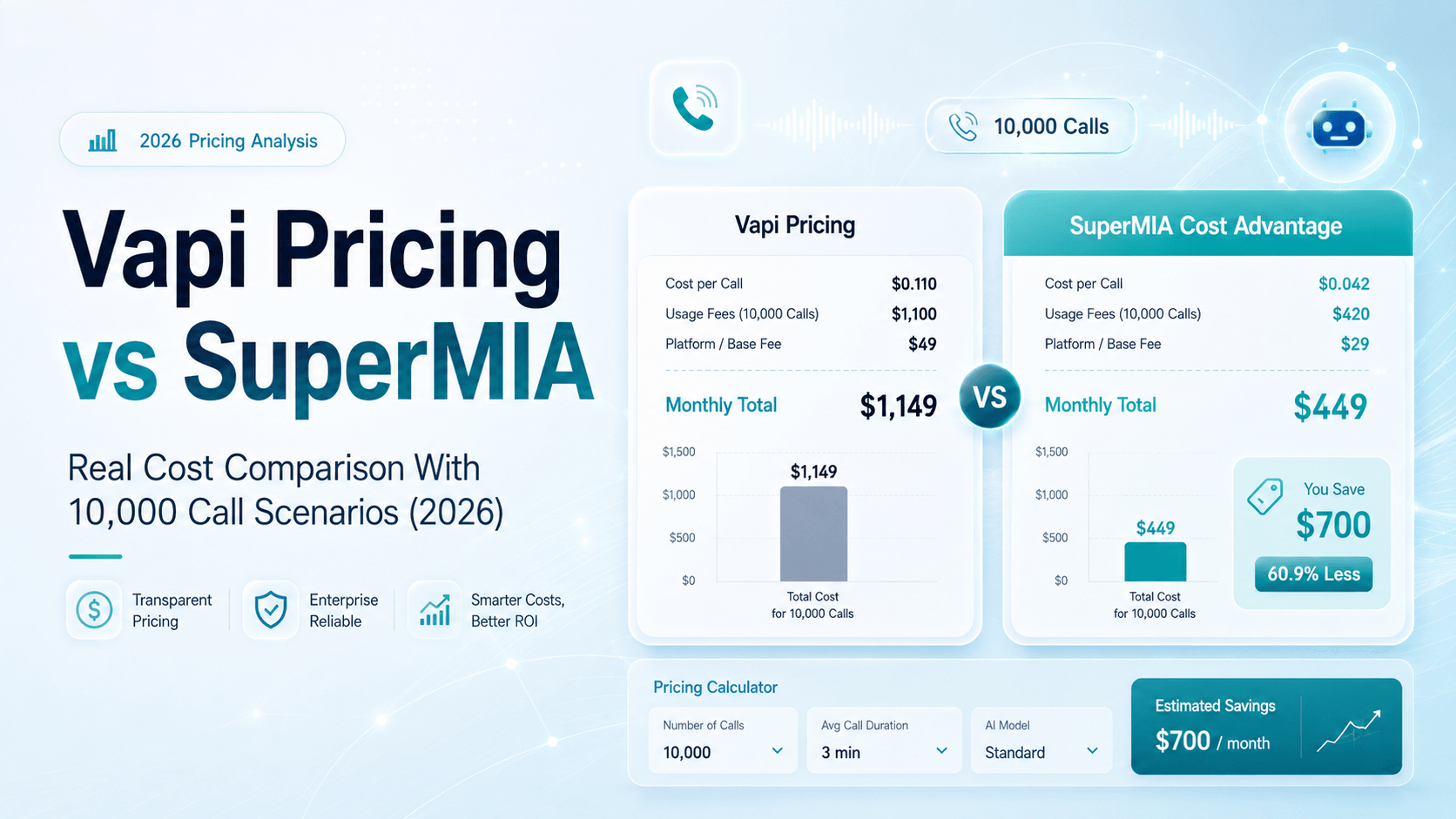
Side-by-Side: 1,000 vs 10,000 vs 100,000 Calls Per Month
| SCENARIO + PLATFORM | MONTHLY COST (scaled to $18K max) | COST |
|---|---|---|
| 1K calls / Vapi (standard) | $340 | |
| 1K calls / SuperMIA Starter | $420 | |
| 10K calls / Vapi (standard) | $3.4K | |
| 10K calls / SuperMIA Growth | $3.2K | |
| 100K calls / Vapi (standard) | >$18K | |
| 100K calls / SuperMIA Scale | >$18K |
Assumptions: 2-minute average call duration, standard config (Deepgram STT + GPT-4o + ElevenLabs Standard TTS + Twilio), no recording. Bars are scaled to $18K max for visual readability; 100K-call values exceed the bar range and are noted on the right.
10,000-Call Scenario - Detailed Math
| Cost Component | Vapi | SuperMIA Growth Tier |
|---|---|---|
| Monthly minutes (10K calls × 2 min avg) | 20,000 | 20,000 |
| Vapi platform fee ($0.05/min) | $1,000 | - (bundled) |
| LLM (GPT-4o avg $0.10/min) | $2,000 | - (bundled) |
| TTS (ElevenLabs Standard $0.05/min) | $1,000 | - (bundled) |
| STT (Deepgram $0.008/min) | $160 | - (bundled) |
| Telephony (Twilio $0.014/min) | $280 | - (bundled) |
| Compliance + DNC scrubbing | Self-managed | Included |
| CRM integrations | Self-built | Native |
| Dev time (Year 1 build + maintenance) | ~$15K–$30K one-time + monthly | Included |
| PUBLISHED PLATFORM COST | $4,440 | ~$3,200 |
| TCO Year 1 (incl. dev time amortized) | $6,000–$7,000/mo | ~$3,200/mo |
At 10K calls/month, platform-only cost is similar. The gap opens up when you include dev time, compliance work, and integration build. SuperMIA wins on TCO; Vapi wins on configuration flexibility for teams that want to pick every component.
Get a custom SuperMIA quote.
We’ll put together a transparent pricing plan for your volume.
Get a custom SuperMIA quote →Feature Comparison: Vapi vs SuperMIA
| Capability | Vapi | SuperMIA |
|---|---|---|
| LLM choice | ✅ Pick any (GPT-4o, Claude, Llama, Groq) | ⚠ Curated set, swap with quote |
| TTS choice | ✅ Any provider | ⚠ Curated set |
| STT choice | ✅ Any provider | ⚠ Curated set |
| Latency target | ~400ms | <500ms (387ms tested) |
| TCPA compliance | Self-managed | ✅ Native + DNC scrubbing |
| CRM integrations | Build via API (HubSpot, Salesforce) | ✅ Native (HubSpot, Salesforce, Pipedrive) |
| Calendar booking | Build via API | ✅ Native (Calendly, Google, Outlook) |
| Live human transfer | Configure manually | ✅ Native with context handoff |
| Conversation analytics | Build dashboards | ✅ Built-in dashboards |
| Pricing model | Component pay-as-you-go | Usage tier (predictable) |
| Dev time required | Significant | Minimal (config only) |
| Best for | Developers building custom | Sales + ops deploying fast |
Vapi wins on configuration flexibility. SuperMIA wins on time-to-deployment and predictable pricing. Both deliver under-500ms latency on standard config.
Where Vapi Is the Right Choice Over SuperMIA
We genuinely recommend Vapi when these conditions apply:
- Your team is developer-first. If you have engineers who want to pick GPT-4o vs Claude vs Llama, swap TTS providers per use case, and own the orchestration layer - Vapi gives you that. SuperMIA’s curated stack is the wrong tradeoff for your team.
- You need component-level cost control. Vapi’s component model lets you tune cost vs quality per call type at a granularity SuperMIA doesn’t expose. Cheap TTS for one workflow, premium for another.
- You’re building experimental or highly custom workflows. If you have novel call flows that need custom code (specialized authentication, proprietary CRM, unusual transfer logic), Vapi’s API-first architecture is more flexible than SuperMIA’s out-of-the-box flows.
- You’re running pilots under 500 calls/month. At very low call volumes (< 500/month), Vapi’s pay-as-you-go can come in under SuperMIA’s lowest tier. Save the subscription, pay-per-call.
- You explicitly want infrastructure-only and will own the rest. Some teams prefer Twilio + Vapi + their own integrations because they need each piece swappable. That’s legitimate - SuperMIA bundles those pieces and you can’t separate them.
If 3 or more of those match, talk to Vapi first. If 0–2 match, the rest of this comparison applies.
Where SuperMIA Is the Right Choice Over Vapi
SuperMIA is the better fit when:
- You’re a sales/ops team, not a dev team. Sales, ops, or RevOps teams without dedicated voice engineering resources deploy SuperMIA in days. Vapi requires weeks of dev work to reach equivalent production state.
- You need predictable budgeting. Usage tiers turn voice spend into a budget line rather than a variable cost. CFOs prefer this. Procurement prefers this.
- You need native CRM and calendar integrations now. HubSpot, Salesforce, Pipedrive, Calendly, Google Calendar are native - not API builds. Faster time-to-value, less ongoing maintenance.
- Compliance has to be operational on day one. TCPA, DNC scrubbing, AI disclosure handling, recording compliance - SuperMIA ships these on by default. With Vapi you build and maintain them.
- Volume is in the 10K+ calls/month range. At 10K+ monthly calls, SuperMIA’s blended tier rate beats Vapi’s component-stacked rate even before counting dev time.
Decision Flow: Which Should You Pick?
| Question | If YES → | If NO → |
|---|---|---|
| Q1: Does your team have voice engineers who want to own the stack? | Vapi | Continue to Q2 |
| Q2: Are monthly call volumes under 500? | Vapi (pay-as-you-go) | Continue to Q3 |
| Q3: Do you need native CRM/calendar/compliance from day one? | SuperMIA | Continue to Q4 |
| Q4: Is predictable monthly budget more important than component flexibility? | SuperMIA | Vapi |
Edge cases: hybrid is real. Some teams run Vapi for experimental use cases and SuperMIA for production. Some run SuperMIA primary with Vapi for one specialized workflow. The decision flow above is the default - not a constraint.
Use Case Recommendations
- For outbound sales calling at scale: see our AI cold calling test results - 1,000-call test data across 4 industries showing cost per appointment.
- For inbound contact center IVR replacement: see our inbound call center automation playbook - $487K average annual savings from 3 migrations.
- For broader voice agent context (tech stack, platform landscape, build vs buy): complete guide to AI voice agents - our pillar coverage.
Frequently Asked Questions
The Bottom Line
Vapi and SuperMIA are good products solving different versions of the same problem. Vapi is infrastructure for engineers who want to own every layer. SuperMIA is a deployment-ready platform for sales and ops teams who want voice working in production this quarter, not next quarter.
If you’re building experimental voice products with novel call flows, custom authentication, or component-level cost tuning - Vapi. If you’re running outbound sales, inbound contact center, or AI receptionist use cases with standard integrations and need it live fast - SuperMIA. The economics tip at scale, but the team-fit question matters more than the spreadsheet math.
If you want a 15-minute side-by-side walkthrough with your specific call volume and use case loaded into both calculators, book a call below.
Compare side-by-side in 15 min.
We’ll put together a transparent pricing plan for your volume.
Compare side-by-side in 15 min →
Harikrishna Patel
Harikrishna Patel is the founder of MIA – My Intelligent Assistant, the AI automation platform built under Botfinity Inc. in Dallas, Texas. With 15+ years in software engineering, AI/ML, and enterprise solution design, he focuses on creating practical, scalable AI tools that help businesses automate support, workflows, and operations through voice and chat.