
Table of Contents
An AI appointment setter is software that qualifies a lead, checks your calendar, books the appointment, and confirms it — 24/7, without a human on the line. No-code tools run $59–$500 a month, far below a human setter's $3,000–$5,000. The best pick depends on your industry: dental and healthcare need HIPAA-aligned, PMS-connected setters; real estate needs speed-to-lead voice that books on your calendar.
See an AI setter book on your calendar →
Key takeaways
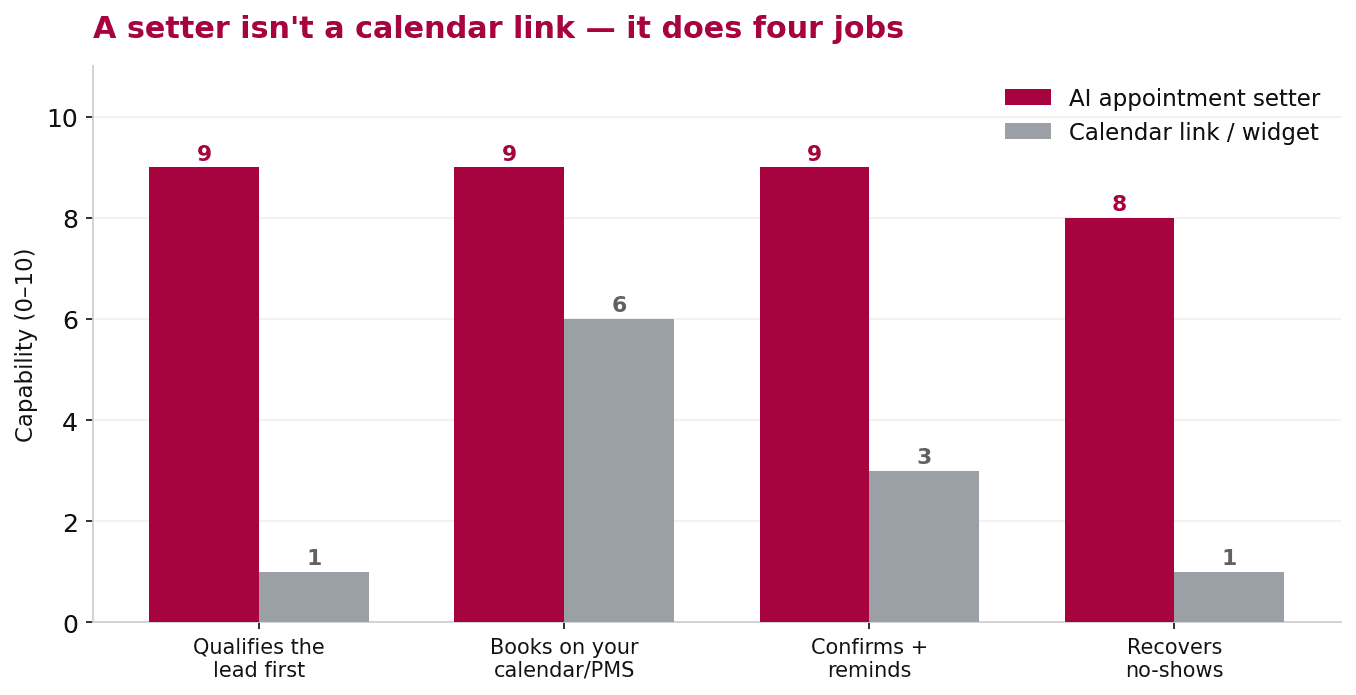
- A setter does four jobs a calendar link can't: qualify, book, confirm/remind, and recover no-shows.
- No-code setters cost $59–$500/month — roughly 70–90% less than a human setter's loaded cost.
- The best pick is vertical-specific: dental/healthcare need HIPAA + PMS integration; real estate needs speed-to-lead voice.
- Integration is the whole game — if it doesn't write to your PMS or CRM, it's just a fancier calendar widget.
- Any outbound reminder or callback triggers TCPA — get consent, honor opt-outs, and keep a human for the complex cases.
What is an AI appointment setter? (and how it beats a calendar link)
An AI appointment setter is software that qualifies a lead, checks your calendar, books the appointment, and confirms it — usually over voice, SMS, or chat. Unlike a scheduling link that just shows open slots, a setter runs the whole conversation and only pings you when something needs a human.
The difference is four jobs. A calendar widget shows times. A real setter qualifies the lead first, books the right slot, sends the confirmation and reminder, and re-engages the no-show. Miss any of those and the appointment doesn't happen.
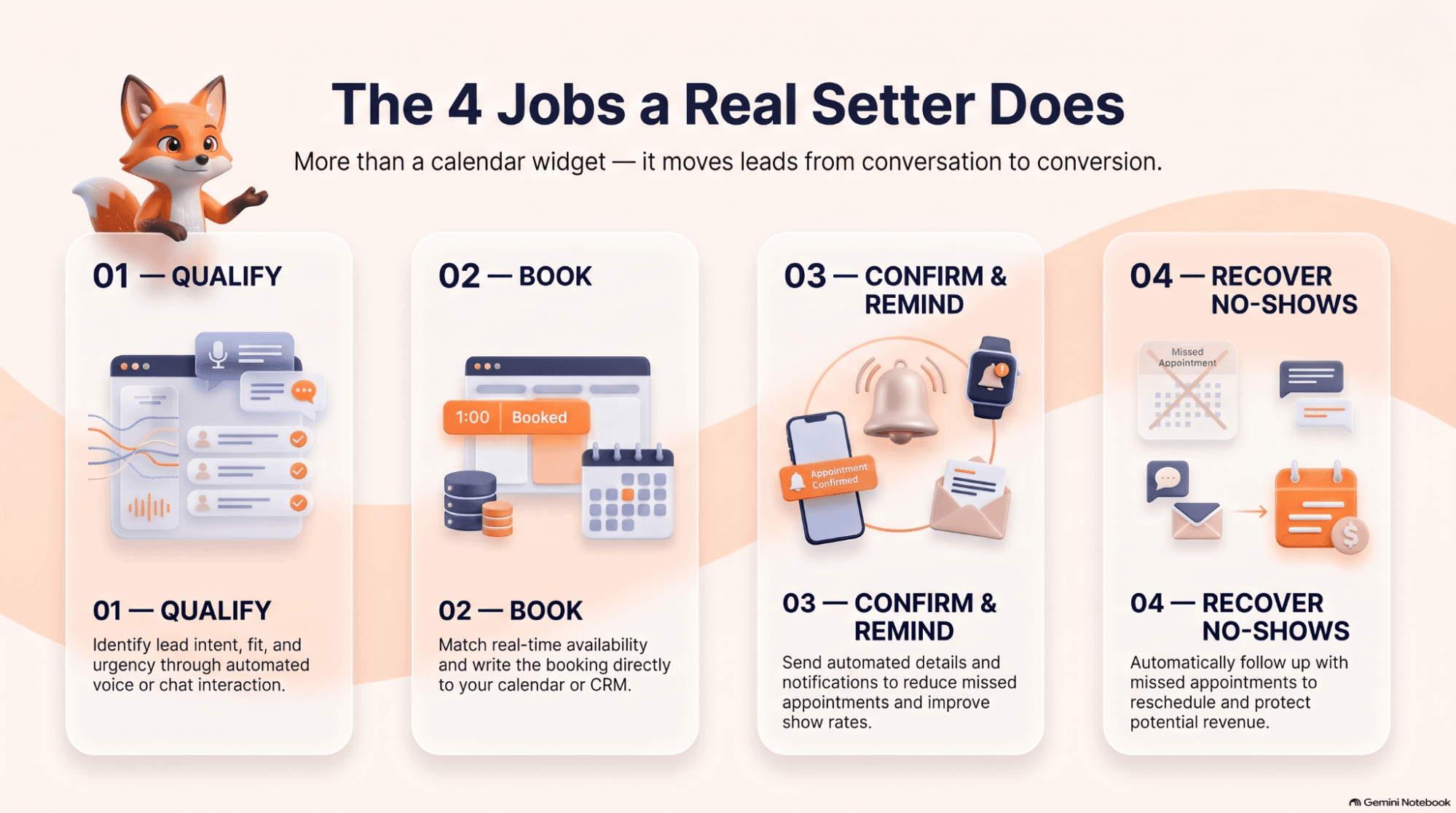
SuperMIA's AI voice agent runs all four jobs on the phone. This guide stays vendor-neutral and organizes the market by the industry you're in.
How we compared them
We're a voice-AI company, so here's our bias up front: SuperMIA builds a setter. We still held every category to the same test, and we route you to your industry's best fit rather than ranking one tool #1. Four things decided the shortlist:
- Qualification before booking — does it ask intake questions, or book anyone?
- Real booking — does it write to your calendar/PMS/CRM, or just email a request?
- Confirmation, reminders, and no-show recovery — the lifecycle, not a one-shot.
- Integration + compliance for your vertical — HIPAA, TCPA, and the systems you already run.
The best AI appointment setters by industry
The "best" setter isn't universal — it's whatever fits the way your industry books. Here's the market sorted by vertical.
| Industry | What the setter must do | What to prioritize |
|---|---|---|
| Dental & healthcare | Book into the PMS/EHR, verify basic eligibility, route urgent cases | HIPAA-aligned workflows + Dentrix/Open Dental/Epic integration |
| Real estate | Answer instantly, qualify budget/timeline, book the showing | Speed-to-lead voice + Follow Up Boss/kvCORE write-back |
| General service & sales | Qualify inbound, book the meeting, run reminders | Multichannel (voice + SMS) + HubSpot/Salesforce |
Dental & healthcare: HIPAA + PMS-connected setters
Here the setter touches patient data, so compliance isn't optional. It must support HIPAA-aligned workflows with a BAA on eligible plans, and it must book into your practice management system — a setter that emails you a callback request just moved the work, it didn't do it. Keep a human in the loop for anything clinical.
For the deep dive, see AI appointment scheduling for healthcare and the AI dental front-desk guide.
Real estate: speed-to-lead voice that books showings
Real estate is a speed-to-lead business — the first agent to respond usually wins. The right setter answers on the first ring, qualifies budget and timeline, and books the showing on your calendar before the lead calls the next listing. Voice matters more than text here, because sellers and buyers call.
More in an AI voice agent for real estate.
General service businesses & sales teams
For everyone else — home services, agencies, B2B sales — the priority is multichannel qualification (call first, text if no answer) and a clean write-back to HubSpot or Salesforce. This is where most of the SERP's tools live; they're strong here and thin on the regulated verticals above.
Find the setter that fits your industry →
How much does an AI appointment setter cost?
No-code AI appointment setters typically cost $59–$500 a month depending on channels and volume. Done-for-you services run higher — roughly $300–$1,000/month. All of them sit far below a human appointment setter, which costs $3,000–$5,000/month once you include benefits and management.
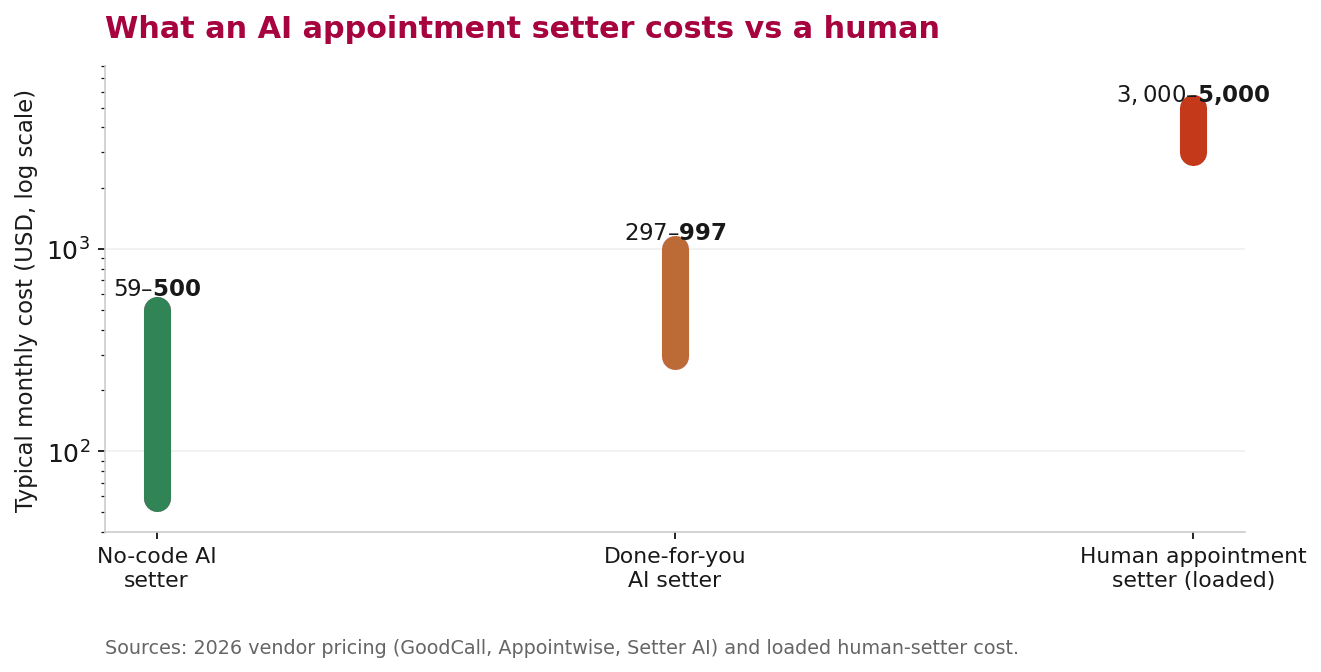
The math is simple: one booked patient, showing, or consultation is usually worth more than a month of the tool. The trap to avoid is per-lead or per-minute pricing that spikes in a busy season — for steady volume, a flat plan is the safer bet.
Setter vs receptionist vs scheduling widget
These three get mixed up, and buying the wrong one wastes money:
- Scheduling widget (Calendly): shows your open slots. The lead does the work. No qualification, no follow-up.
- AI appointment setter: qualifies the lead, books the slot, confirms, and recovers no-shows. Turns a lead into an appointment.
- AI receptionist: answers every inbound call and handles front-desk tasks — booking is one of them, but so is routing, FAQs, and messages.
If your goal is "turn leads into booked appointments," you want a setter. If it's "never miss a call," you want a receptionist — see the AI receptionist software comparison for that category.
The compliance line: HIPAA & TCPA
This is the part the sales-focused listicles skip, and it decides whether a setter is safe to deploy:
- HIPAA (dental & healthcare). If the setter touches patient data, it needs HIPAA-aligned workflows and a BAA on eligible plans. Confirm both before any patient information flows through it.
- TCPA (any outbound). The moment your setter makes an outbound reminder call or text, TCPA applies — get prior express consent, honor opt-outs, and respect calling windows.
See HIPAA requirements (HHS) and the TCPA rules (FCC) directly, and our own breakdown of TCPA rules for outbound calling.
The honest rule. Automate qualification and booking; keep a human for clinical judgment and high-stakes conversations. And never run outbound reminders without consent — the fine is bigger than the booking.
How to pick yours
- Start with your industry — dental/healthcare, real estate, or general — and its compliance needs.
- Confirm it writes to your actual system (PMS, CRM, or calendar), not just an email request.
- Pick the channel your leads use — voice for phone-heavy verticals, multichannel for the rest.
- Choose flat pricing over per-lead/per-minute if your volume swings seasonally.
- Test it on real bookings for two weeks and measure show-rate, not just bookings made.
Frequently asked questions
What is an AI appointment setter?
An AI appointment setter is software that qualifies a lead, checks your calendar, books the appointment, and confirms it, usually over voice, SMS, or chat. Unlike a scheduling link that just shows open slots, a setter runs the whole conversation, asks intake questions, books the right slot, and follows up on confirmations and no-shows.
How much does an AI appointment setter cost?
No-code AI appointment setters typically cost $59 to $500 per month depending on channels and volume. Done-for-you services run higher, around $300 to $1,000 per month. All of these are far below a human appointment setter, which costs roughly $3,000 to $5,000 per month once you include benefits and management.
What is the best AI appointment setter for a medical or dental office?
For dental and healthcare, the best setter is one that supports HIPAA-aligned workflows with a BAA on eligible plans and connects to your practice management system so it can book real slots. Prioritize PMS or EHR integration and compliance over raw features, and keep a human in the loop for anything clinical.
Can an AI appointment setter book directly on my calendar or PMS?
Yes, and this is the feature that matters most. A capable setter reads real availability and writes the booking back to your calendar, CRM, or practice management system during the conversation. If a tool only emails you a request instead of booking the slot, it is a lead-capture form, not a true appointment setter.
Is an AI appointment setter better than a human setter?
For high-volume, repetitive booking, an AI setter wins on cost, speed, and 24/7 availability, answering instantly at a fraction of a human's loaded cost. A human still wins on complex, high-consideration conversations and relationship building. Many teams use AI for first-touch qualification and booking and route the nuanced cases to a person.
Start with your industry, then your systems
Don't shop by feature list. Start with your vertical and its compliance needs, confirm the setter writes to the system you already run, and test it on real bookings. The right one pays for itself the first month it fills slots you'd otherwise have lost.
Want to see an AI setter qualify a lead and book it on your calendar? Book a demo and we'll show SuperMIA's AI voice agent doing it for your industry.

Urvil Dhanani
Urvil Dhanani is the AI/ML Lead at SuperMIA, focused on the architecture behind reliable conversational AI - agent design patterns, voice and chat orchestration, and platform evaluation. He writes practical, vendor-neutral guides that help technical teams build and choose AI systems that hold up in production.