
Table of Contents
- What is an AI chatbot - and what should it actually do?
- The 7 criteria for choosing an AI chatbot
- Resolution vs deflection: the metric most buyers miss
- Types of AI chatbots - and which one fits your job
- How much does an AI chatbot cost?
- Which chatbot is right for your business size?
- Where buyers go wrong (the 6-month regrets)
- How to run the evaluation
- Deploy a chat agent with SuperMIA
- Frequently asked questions
To choose an AI chatbot for your business, score vendors on seven criteria: resolution rate (not just deflection), knowledge/training quality, integration depth, escalation to humans, total cost of ownership, channels, and compliance. Define your primary use case first, weight the criteria for your situation, then run a live demo using your own hardest questions. The best chatbot is the one that resolves issues, not the one with the slickest demo.
Book a 30-minute evaluation demo →
Key takeaways
- Score resolution, not deflection. Deflection sends users away; resolution solves the problem. It's the biggest predictor of value.
- Use a weighted scorecard. Rate each vendor 1–5 on seven criteria so the decision is evidence, not demo dazzle.
- Match the type to the job. Rule-based for simple FAQs, AI-driven for nuance, hybrid for both.
- Price the total cost. Integration, overage, and support often double the advertised number.
- Test with your own hard questions. A demo on generic queries proves nothing; use your real edge cases.
What is an AI chatbot - and what should it actually do?
An AI chatbot is software that understands a customer's question in natural language and responds - and, increasingly, takes action - without a human agent. The bar in 2026 is higher than "answers FAQs." A capable chatbot reads your knowledge base, pulls a customer's order or account, resolves the issue end to end, and hands off cleanly when it can't.
That's the difference between a widget and a worker. The same engine powers our MIA Chat Agent - but the goal of this guide is to help you evaluate any vendor, not to sell you one. For the wider market context, analysts publish useful selection frameworks; see analyst guidance on conversational AI selection and independent chatbot market growth data. Let's start with how to actually decide.
The 7 criteria for choosing an AI chatbot
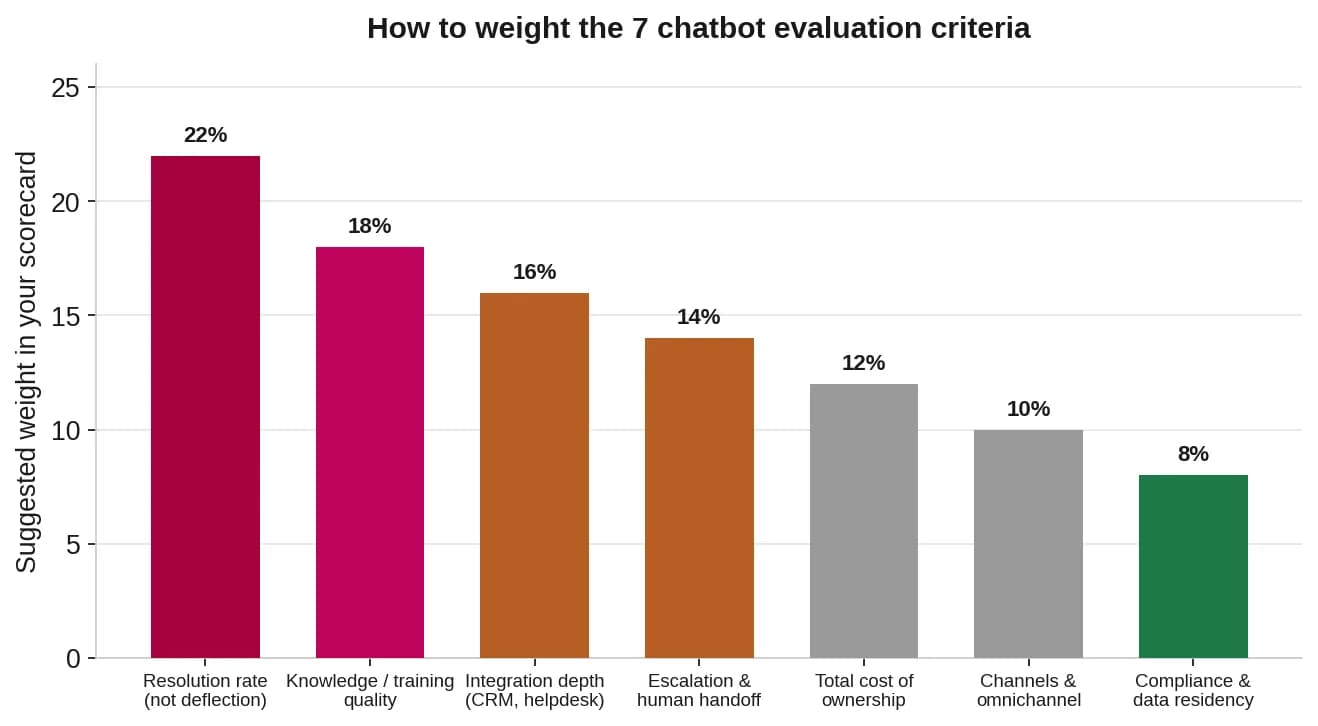
To choose an AI chatbot, score each vendor 1–5 on seven criteria, then weight them for your situation. Here's a starting weight for each - adjust to your priorities.
1. Resolution rate (not deflection)
The most important criterion. Ask every vendor for resolution rate on real deployments, not deflection. A bot that sends users to a help-center homepage "deflected" the ticket but didn't solve anything.
2. Knowledge & training quality
Accuracy lives or dies on the knowledge base. Ask how the bot is trained, how often it re-indexes your content, and whether it cites the source page for each answer so you can audit it.
3. Integration depth
A bot that can't see your CRM gives generic answers. Look for native, bidirectional integration with your CRM, helpdesk, and booking system, plus the workflow automation behind the bot so it can take action, not just talk.
4. Escalation & human handoff
When the bot can't resolve something, it should hand off to a human with full context - conversation history, what was tried, the customer's details - so no one has to repeat themselves.
5. Total cost of ownership
The sticker price is rarely the real price. Add integration, overage, training, and support. Price every vendor at three times your current volume to see how it scales.
6. Channels & omnichannel
Your customers aren't single-channel. Check whether the same bot - with the same knowledge and context - runs on your website, WhatsApp, and other channels, or whether each one is a separate build.
7. Compliance & data residency
Where is conversation data stored and processed? For regulated work this has legal weight. If you're in healthcare, use a dedicated HIPAA chatbot compliance checklist before you sign anything.
Resolution vs deflection: the metric most buyers miss
Deflection sends a user away from a human agent; resolution actually solves their problem. Many vendors quote high deflection rates that just mean customers got pushed to a help page and did the work themselves - or gave up.
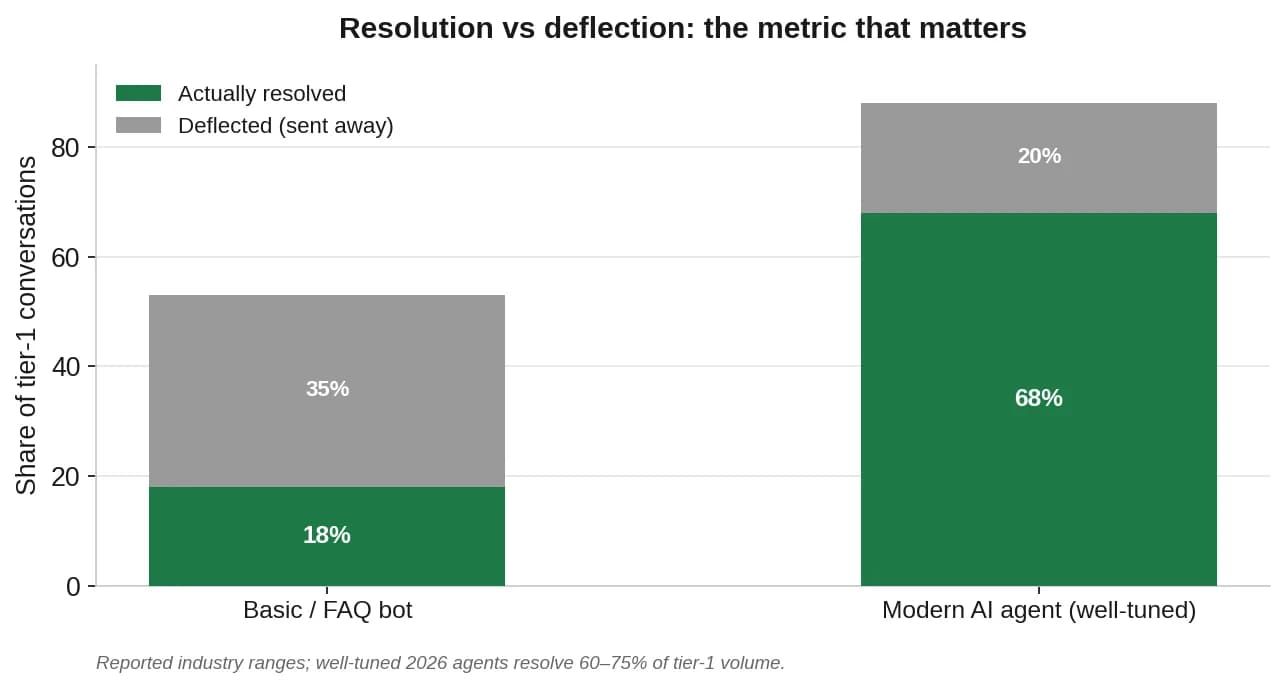
Ask for resolution rate on tier-one volume. Well-tuned 2026 agents resolve 60–75%, where basic bots top out far lower. If a vendor only quotes deflection, treat it as a red flag.
Types of AI chatbots - and which one fits your job
There are three types: rule-based, AI-driven, and hybrid. The right one depends on how varied and complex your customer questions are.
| Type | How it works | Best for |
|---|---|---|
| Rule-based | Follows predefined scripts and decision trees | Simple, predictable FAQs |
| AI-driven | Understands natural language, learns over time | Varied phrasing, nuanced help |
| Hybrid | Scripted flows + AI for the rest | Both consistency and flexibility |
Choosing between a chatbot, a voice agent, or a broader AI agent is a related decision - see AI agent vs chatbot vs voice agent and voice agent vs IVR vs chatbot.
How much does an AI chatbot cost?
AI chatbot costs range from about $30–$150/month for a basic FAQ bot to $3,000–$10,000+/month for enterprise-grade deployments. But the sticker price is only part of it.
| Tier | Typical advertised price | What it includes |
|---|---|---|
| Basic FAQ bot | $30–$150 / mo | Scripted answers, website widget |
| Mid-tier | $800–$1,200 / mo | CRM + helpdesk integration, workflows |
| Enterprise | $3,000–$10,000+ / mo | Multi-language, analytics, deep automation, setup fees |
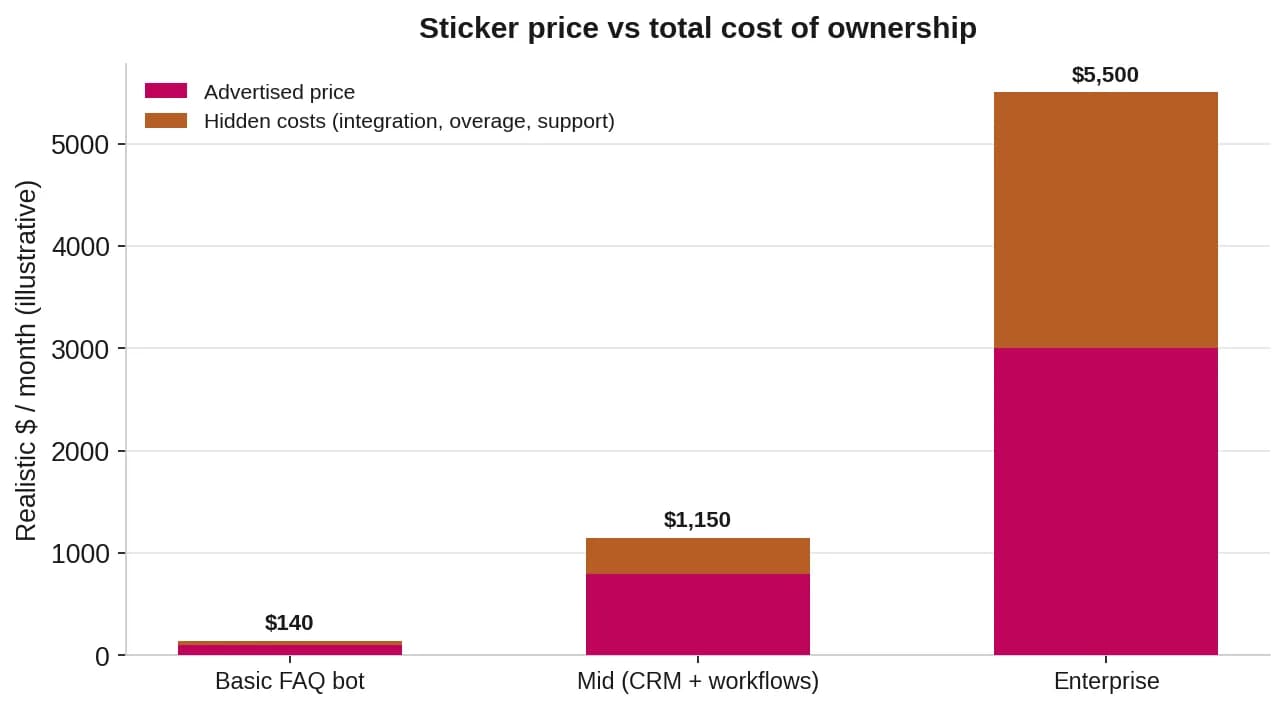
Ranges are industry-reported; get a quote at your real volume. To turn cost into a decision, model the return: read our full customer-service chatbot ROI breakdown for the cost-per-ticket and deflection math.
Copyable 7-criteria scorecard
Paste this into a spreadsheet, score each vendor 1–5, and multiply by the weight for a weighted total.
| Criterion | Weight | Score (1–5) | Weighted score |
|---|---|---|---|
| Resolution rate (not deflection) | 22% | ||
| Knowledge & training quality | 18% | ||
| Integration depth | 16% | ||
| Escalation & human handoff | 14% | ||
| Total cost of ownership | 12% | ||
| Channels & omnichannel | 10% | ||
| Compliance & data residency | 8% |
Which chatbot is right for your business size?
The right chatbot depends on your size and complexity, not on which vendor has the best ad. A quick way to decide:
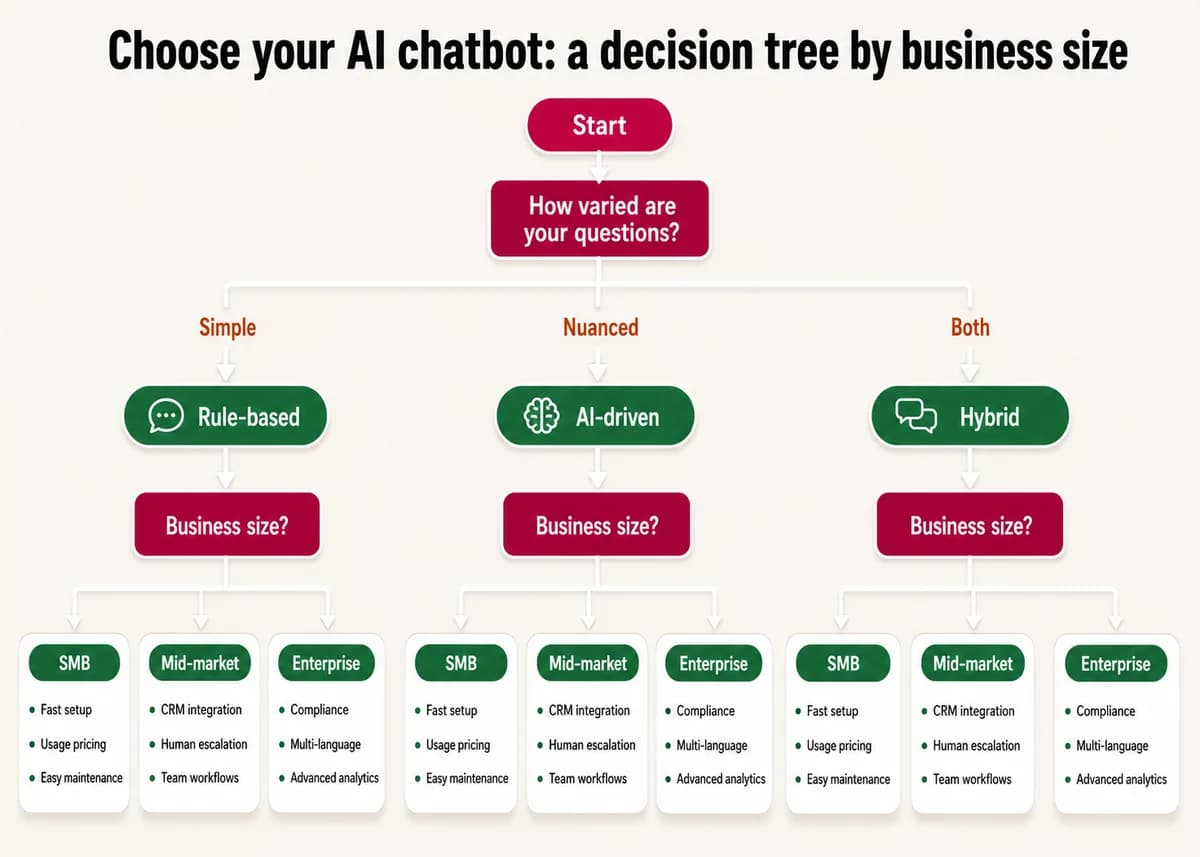
- Small business: prioritize fast setup (no IT), website + CRM integration, predictable usage-based pricing, and a strong knowledge base. Skip enterprise features you won't use.
- Mid-market: weight integration depth and escalation heavily - you have a CRM, a helpdesk, and a support team the bot must work with.
- Enterprise: compliance, data residency, multi-language, analytics, and total cost of ownership dominate. Run a formal pilot.
Where buyers go wrong (the 6-month regrets)
- Choosing on the demo. A demo on cherry-picked questions hides the gaps. Test with your own hardest, edge-case queries - a point Nielsen Norman research on chatbot UX makes repeatedly.
- Confusing deflection with resolution. High deflection can mean unhappy customers doing their own work.
- Ignoring lock-in and exit cost. Ask how you export your data and conversations if you leave.
- Underpricing the integration. The build connecting the bot to your systems often costs more than the subscription.
- Buying instead of building - or vice versa. For complex needs, weigh the build vs buy decision before committing.
How to run the evaluation
- Define the use case and success metric. One primary job (support, sales, scheduling) and the KPI that proves it.
- Shortlist 3–5 vendors against the scorecard. Score each 1–5 on the seven criteria, weighted.
- Run a live demo with your own questions. Include escalation and a few nasty edge cases.
- Pilot the top one or two. Run real traffic for two weeks. You can deploy an AI chat agent on a single flow to test before committing.
- Decide on evidence. Compare scorecards and pilot results - not who had the best sales deck.
Deploy a chat agent with SuperMIA
Once you've scored your options, you can put MIA to the test. With SuperMIA's chat agent, you connect your knowledge base and CRM, set escalation rules, and go live across web and WhatsApp - no code, most teams live in days. Bring your hardest questions to the demo and score us against the same seven criteria.
Book a 30-minute evaluation demo →
Frequently asked questions
How do I choose the best AI chatbot for my business?
Define your primary use case, then score vendors 1-5 on seven criteria: resolution rate, knowledge and training quality, integration depth, escalation to humans, total cost of ownership, channels, and compliance. Weight the criteria for your situation and run a live demo using your own hardest questions. Choose the platform that resolves issues, not the one with the best demo.
What is the difference between resolution rate and deflection rate?
Deflection rate measures how often a chatbot sends the user away from a human agent, often to a generic help page. Resolution rate measures how often it actually solves the user's specific problem. A high deflection rate can still mean the customer did more work and left unhappy, so resolution is the metric that predicts real value.
What are the main types of AI chatbots?
There are three: rule-based bots follow predefined scripts and suit simple FAQs; AI-driven bots use natural language understanding to handle varied phrasing and learn over time; hybrid bots combine scripted flows with AI for both consistency and flexibility. The right type depends on how complex and varied your customer questions are.
How much does an AI chatbot cost for a business?
A basic FAQ bot can run roughly $30-$150 per month. A mid-tier bot with CRM and helpdesk integration typically lands around $800-$1,200 per month. Enterprise-grade deployments with multi-language, analytics, and deep automation often run $3,000-$10,000+ per month. Always price the total cost of ownership, not just the advertised rate.
What is the best AI chatbot for a small business?
For a small business, the best AI chatbot is one that sets up without IT, integrates with your existing website and CRM, scales pricing with usage, and resolves common questions accurately. Prioritize fast setup, predictable pricing, and a strong knowledge base over enterprise features you will not use.

Harikrishna Patel
Harikrishna Patel is the founder of MIA – My Intelligent Assistant, the AI automation platform built under Botfinity Inc. in Dallas, Texas. With 15+ years in software engineering, AI/ML, and enterprise solution design, he focuses on creating practical, scalable AI tools that help businesses automate support, workflows, and operations through voice and chat.